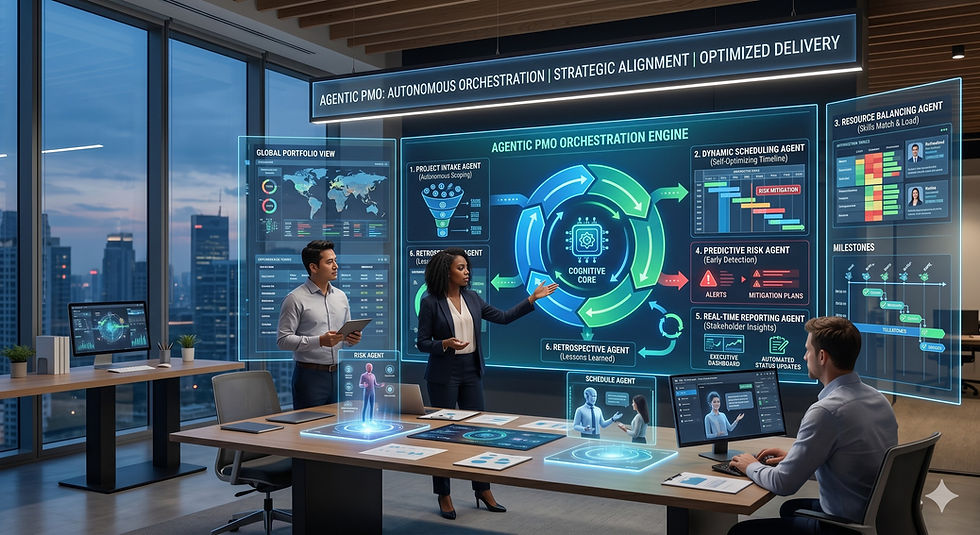
How Agentic AI Can Help Project Managers Handle Complex Multi-Step Processes

Most project delays don't come from bad planning. They come from the space between teams - where handoffs slow down, priorities drift, and no one has full visibility. Stakeholder approvals, resource allocation, risk tracking, vendor timelines - each of these runs on its own rhythm, and the project manager’s job is to hold them together.
For years, the tools available to do that have been largely passive: they store data, display dashboards, and send reminders. The thinking still happens with humans.
Agentic AI changes that dynamic. Standard AI tools wait to be asked. Give an agentic system an objective and it figures out the steps - pulling data, flagging issues, routing approvals - without waiting to be told what to do next. For project managers handling complex, multi-step processes, that distinction matters.
What Agentic AI Actually Does Differently

Most AI tools in use today are reactive. A project manager asks a question, the tool answers. They request a summary; the tool produces one. The human still drives every action.
Agentic AI operates with a goal rather than a prompt. Given an objective - say, preparing a risk report ahead of a steering committee - an agentic system can identify what data it needs, pull it from connected sources, identify gaps, flag anomalies, draft the report, and route it for review. It doesn’t wait to be asked at each step.
This makes agentic AI particularly relevant for the kind of work that consumes the most project management bandwidth: processes that involve many sequential decisions, cross-functional dependencies, and time-sensitive handoffs.
Finding the right implementation partner for a specific capability is increasingly where platforms like the B2B Marketplace DesignRush become useful, since the vendor landscape for agentic AI is expanding fast and varies considerably in maturity and specialization.
Where It Applies in a Project Management Context

The practical applications fall into a few categories, each addressing a different operational bottleneck.
Planning and scheduling updates. Traditional project schedules require manual intervention whenever a dependency shifts. An agentic system can monitor task completion data, detect downstream impacts automatically, and propose schedule revisions before a delay compounds. In large programs with hundreds of interdependent tasks, this moves the project manager from reactive firefighting to proactive oversight.
Risk and issue management. Identifying risks early is one of the most consistently under-resourced parts of a project. Agentic AI can run continuous monitoring across project data - budget burn, milestone velocity, stakeholder sentiment from communication logs - and surface risk signals before they reach the issue log. The PM reviews and acts on flagged items rather than having to find them.
Reporting and governance. Status reporting is one of the highest time-cost activities in program management relative to the value it produces. Agentic systems can compile data from multiple sources, apply standard reporting formats aligned to PMO templates, and produce draft reports on a regular cadence.
Managing Multi-Step Processes With Greater Precision
Complex projects involve processes that span weeks, involve multiple teams, and require consistent execution of dozens of individual steps.
Procurement workflows, change control procedures, onboarding sequences for new workstreams - these are exactly the types of processes where execution inconsistency creates the most downstream problems.
Agentic AI handles multi-step processes well because it can hold state across a long sequence.
The capabilities that make this practical include:
Memory across sessions: The system retains context from earlier stages of a process, so it doesn’t need to be re-briefed each time a new step begins
Conditional logic: Actions are triggered by outcomes rather than just schedules, so the process adapts when conditions change rather than proceeding blindly
Multi-system integration: Agentic tools can interact with project management platforms, communication tools, document repositories, and approval systems in sequence, removing the manual handoffs that typically slow cross-functional processes
Implementation Considerations for Project Teams
The systems depend on access to reliable, structured data - which means the underlying project data hygiene needs to be sound before the AI layer adds much value.
Key factors that determine how much value an agentic system delivers:
Data integration: How well the tool connects to existing systems - schedule platforms, RACI matrices, budget trackers, communication channels - determines the quality of its outputs
Process documentation: Agentic systems execute defined processes. Processes that are poorly documented or inconsistently followed will produce inconsistent automation
Human oversight design: The most effective implementations treat the AI as a capable team member that escalates to the PM rather than a black box making decisions autonomously. Defining where human review is required - and building those checkpoints in - is as important as the automation itself
The organizations seeing the most traction are typically those with mature PMO practices, since they already have the governance structures and documented processes that agentic systems need to function well.
Looking Ahead
The capability gap between what project managers can handle manually and what complex programs actually require has always existed. What’s changed is that the tools available to close that gap have become significantly more capable.
Agentic AI doesn’t replace project management judgment - it removes the friction that prevents project managers from applying it where it matters most.
For organizations navigating increasingly complex program environments, that’s a meaningful operational shift worth taking seriously.