
Agentic PMO: How to Automate Project Governance Using AI Agents

The Enterprise Shift Toward Agentic PMO Models
Project Management Offices are entering a period of structural transformation. Traditional governance models that depended heavily on manual reporting, static dashboards, and fragmented approval cycles are becoming increasingly difficult to sustain at enterprise scale. Organizations managing global portfolios now face accelerating delivery timelines, rising compliance obligations, and growing pressure to improve operational efficiency without increasing administrative overhead.
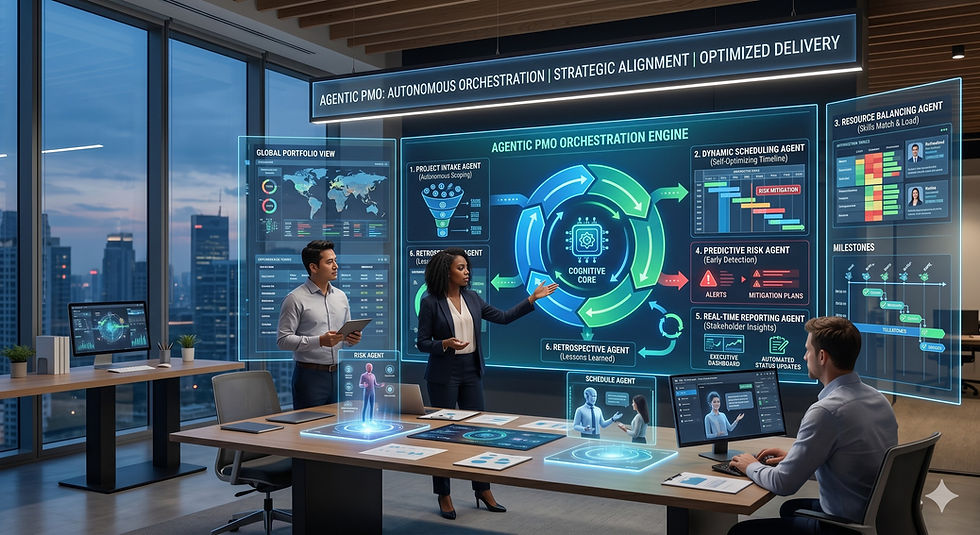
This environment has created the ideal conditions for the rise of the Agentic PMO. Instead of relying solely on human coordination, modern PMOs are beginning to deploy AI agents capable of automating governance activities, monitoring delivery health, escalating risks, validating compliance, and supporting strategic decision making across large project ecosystems.
The concept of agentic AI differs significantly from standard automation. Traditional workflow automation follows predefined rules and executes repetitive tasks in fixed patterns. Agentic AI systems operate with contextual awareness. These systems can interpret signals, evaluate changing project conditions, and take governance-oriented actions based on enterprise objectives.
For executive leadership teams, the implications are substantial. Governance automation no longer means simply generating reports faster. It now includes autonomous risk surveillance, intelligent portfolio balancing, predictive resource management, and continuous assurance monitoring.
Large organizations are particularly well positioned to benefit from this transition because enterprise PMOs often suffer from governance fatigue. Senior stakeholders spend enormous amounts of time validating status reports, reviewing escalation paths, and consolidating fragmented delivery information from multiple business units.
Agentic PMO frameworks address these inefficiencies by introducing AI-driven operational intelligence directly into governance processes.
Why Traditional PMO Governance Models Are Under Pressure
Enterprise PMOs have historically evolved around centralized oversight structures. Governance was designed to ensure project alignment, financial control, compliance validation, and executive visibility. While these goals remain essential, traditional execution methods are increasingly unsustainable.
Large organizations commonly manage hundreds of simultaneous initiatives across infrastructure modernization, cybersecurity, cloud migration, product development, compliance transformation, and operational optimization programs.
In many environments, governance overhead has become a delivery bottleneck.
Manual governance structures often create several recurring problems:
Governance Challenge | Traditional PMO Limitation | Agentic PMO Advantage |
Portfolio Reporting | Delayed manual consolidation | Real time automated intelligence |
Risk Escalation | Reactive identification | Predictive monitoring |
Compliance Tracking | Periodic reviews | Continuous validation |
Resource Forecasting | Spreadsheet dependency | Dynamic optimization |
Executive Visibility | Static dashboards | Context aware summaries |
Decision Support | Human interpretation only | AI assisted recommendations |
Organizations attempting to scale delivery using legacy PMO practices frequently encounter governance saturation. Program managers spend more time preparing reporting artifacts than improving delivery outcomes.
This creates a dangerous imbalance where governance exists primarily to sustain the governance process itself.
Agentic PMO models attempt to reverse this dynamic by embedding AI agents into governance workflows. Instead of waiting for monthly review meetings, AI systems continuously analyze delivery patterns, dependency conflicts, resource anomalies, and operational risks.
The result is a governance structure that becomes proactive rather than administrative.
Understanding What Makes AI Agents Different
Many executives incorrectly assume that AI agents are simply advanced chatbots. In reality, agentic systems represent a much broader operational capability.
An AI agent is a system capable of autonomously observing environments, processing contextual information, making decisions within defined boundaries, and executing actions aligned to organizational objectives.
Within PMO operations, AI agents can support several governance functions simultaneously.
Continuous Governance Monitoring
AI agents can monitor project health indicators across multiple systems including project management platforms, ticketing systems, financial systems, collaboration environments, and enterprise data repositories.
Instead of relying on manually submitted updates, the agent continuously evaluates delivery trends.
This allows organizations to identify deteriorating project conditions before escalation thresholds are breached.
Intelligent Escalation Management
Traditional escalation processes often depend on human interpretation. Risks may remain hidden because delivery teams hesitate to report emerging issues.
AI agents reduce this dependency by detecting behavioral and operational indicators associated with delivery failure.
Examples include:
Declining sprint completion rates
Increased change request frequency
Budget variance acceleration
Resource utilization instability
Vendor dependency delays
Declining stakeholder engagement metrics
When these conditions emerge, the AI agent can automatically trigger governance workflows or notify senior leadership.
Portfolio Decision Support
Enterprise PMOs frequently struggle with prioritization complexity.
AI agents can evaluate:
Strategic alignment
Financial impact
Delivery probability
Resource constraints
Risk exposure
Regulatory urgency
This creates a more data-driven governance environment where portfolio decisions are informed by continuously updated operational intelligence.
Key Differences Between Traditional PMOs and Agentic PMOs
The transition from traditional PMO structures to agentic governance models represents more than a technology upgrade. It fundamentally changes how organizations coordinate enterprise delivery.
Governance Philosophy
Traditional PMOs are process centric. Governance depends heavily on standardized reporting cycles, committee reviews, and hierarchical approvals.
Agentic PMOs become intelligence centric.
The emphasis shifts toward continuous insight generation, adaptive controls, and predictive intervention.
Operational Speed
Legacy governance often introduces delays because reporting cycles are periodic.
AI agents operate continuously.
This allows enterprises to reduce the time between issue emergence and corrective action.
Human Resource Allocation
Traditional governance structures require large administrative support functions.
Agentic PMOs allow organizations to redeploy governance personnel toward:
Strategic planning
Executive advisory services
Transformation leadership
Portfolio optimization
Risk governance
This changes the PMO from a reporting department into a strategic operational capability.
Governance Scalability
Manual governance becomes increasingly difficult as portfolios expand.
AI agents scale more efficiently because monitoring and analysis functions operate algorithmically.
This is especially valuable in multinational enterprises managing geographically distributed transformation programs.
Enterprise Use Cases for Agentic Governance
Several enterprise sectors are already moving toward AI-enabled governance frameworks.
Financial Services
Banks and financial institutions face extensive compliance obligations.
AI agents can automate governance checks related to:
Regulatory documentation
Audit evidence tracking
Change approval validation
Operational risk exposure
Third-party dependency monitoring
This reduces governance friction while improving audit readiness.
Healthcare and Life Sciences
Healthcare organizations operate in highly regulated environments where project governance failures can create legal and operational consequences.
Agentic PMO systems can support:
Compliance verification
Clinical transformation oversight
Infrastructure modernization governance
Data privacy monitoring
Vendor risk assessment
Manufacturing and Supply Chain Operations
Global manufacturing organizations manage interconnected transformation initiatives across logistics, procurement, automation, and digital operations.
AI agents help coordinate governance across distributed operational environments.
Examples include:
Predictive delivery risk monitoring
Supplier dependency analysis
ERP transformation governance
Infrastructure rollout coordination
Operational continuity assessment
Technology and SaaS Enterprises
Technology organizations often experience rapid portfolio expansion.
Agentic governance supports:
Agile portfolio coordination
Product release governance
Cloud infrastructure oversight
DevSecOps compliance tracking
AI governance management
This improves delivery velocity without sacrificing operational control.
Building an Enterprise Agentic PMO Strategy
Organizations implementing AI-enabled governance require a deliberate operational framework.
The most successful enterprises approach agentic PMO adoption as a strategic operating model transformation rather than a standalone software deployment.
Define Governance Objectives First
Enterprises should begin by identifying the governance outcomes they want to improve.
Examples include:
Faster risk detection
Reduced reporting overhead
Better executive visibility
Improved compliance assurance
Portfolio optimization
Delivery predictability
Without clear governance objectives, AI implementations often become disconnected from operational priorities.
Identify High Friction Governance Activities
The strongest automation opportunities typically exist in repetitive governance processes.
Examples include:
Status reporting
RAID log management
Financial reconciliation
Compliance evidence gathering
Resource utilization tracking
Steering committee preparation
These areas often produce immediate operational efficiency gains.
Establish AI Governance Controls
Organizations cannot deploy autonomous governance systems without operational safeguards.
Enterprises should define:
Escalation boundaries
Decision authority limits
Audit logging requirements
Human review checkpoints
Data access restrictions
Compliance validation mechanisms
This ensures AI agents operate within controlled governance frameworks.
Build Cross Functional Alignment
Agentic PMO adoption affects multiple operational domains including:
IT governance
Enterprise architecture
Cybersecurity
Data governance
HR operations
Finance
Legal and compliance
Cross functional alignment is essential to prevent fragmented implementation.
The Skills Modern PMO Leaders Need
As AI agents assume more governance responsibilities, PMO leadership roles will evolve significantly.
The future PMO leader will not simply manage schedules and reporting processes.
They will orchestrate intelligent governance ecosystems.
Strategic Data Interpretation
PMO leaders must become proficient at interpreting AI-generated operational insights.
This includes understanding:
Risk probability modeling
Delivery trend analysis
Resource optimization indicators
Portfolio forecasting outputs
Operational confidence scoring
The role increasingly resembles enterprise operational intelligence management.
AI Governance Oversight
Leaders must ensure AI systems remain aligned to organizational objectives.
This requires:
Governance validation
Ethical oversight
Bias management
Escalation supervision
Compliance monitoring
PMO executives will become accountable for the integrity of automated governance systems.
Enterprise Communication
AI systems may generate technical insights, but executives still require strategic interpretation.
PMO leaders must translate operational intelligence into business language that supports executive decision making.
This includes framing:
Financial impact
Delivery exposure
Strategic alignment
Operational tradeoffs
Resource implications
Human leadership remains essential even within highly automated governance environments.
Common Risks and Governance Concerns
Despite the advantages of agentic governance, organizations must also address several operational risks.
Over Automation
Some enterprises may attempt to automate governance too aggressively.
Governance requires contextual judgment, political awareness, and stakeholder management.
AI agents should support human governance leadership, not replace it entirely.
Data Quality Problems
AI governance systems are only as reliable as the enterprise data environment supporting them.
Inconsistent reporting structures, fragmented systems, and poor data hygiene can weaken governance accuracy.
Organizations should prioritize:
Data standardization
System integration
Taxonomy alignment
Metadata governance
Reporting consistency
Transparency and Trust
Executives may hesitate to rely on automated governance recommendations if decision logic is unclear.
Organizations should ensure AI governance systems provide explainable outputs.
Transparent operational reasoning improves stakeholder trust.
Security and Privacy Exposure
AI agents often require access to sensitive operational information.
This creates additional security responsibilities involving:
Access management
Encryption standards
Data segregation
Identity governance
Third-party risk management
Cybersecurity governance must evolve alongside AI adoption.
Practical Roadmap for Implementing an Agentic PMO
Organizations pursuing governance automation should adopt a phased implementation strategy.
Step 1: Assess Current Governance Maturity
Evaluate existing governance processes, reporting structures, escalation mechanisms, and operational bottlenecks.
Step 2: Identify Automation Priorities
Focus on repetitive, high friction governance activities that generate measurable operational inefficiencies.
Step 3: Establish Governance Policies
Define operational controls, escalation boundaries, audit requirements, and compliance safeguards.
Step 4: Integrate Enterprise Data Sources
Connect project systems, financial platforms, collaboration tools, and operational dashboards.
Step 5: Deploy Limited AI Governance Agents
Begin with narrow governance functions such as reporting automation or risk surveillance.
Step 6: Monitor Operational Performance
Track governance efficiency, reporting accuracy, escalation quality, and stakeholder adoption.
Step 7: Expand Governance Automation
Gradually extend AI governance capabilities across portfolio management and executive decision support.
Step 8: Institutionalize Continuous Improvement
Continuously refine governance models based on operational outcomes and executive feedback.
Frequently Asked Questions About Agentic PMOs
Can AI agents fully replace enterprise PMOs?
No. Enterprise PMOs perform strategic coordination, stakeholder management, executive alignment, and organizational governance functions that still require human leadership. AI agents are most effective when augmenting governance operations rather than replacing them entirely. The strongest enterprise models combine AI-driven operational intelligence with experienced leadership capable of interpreting organizational dynamics, managing political complexity, and aligning delivery priorities to broader business objectives.
What types of PMO processes are easiest to automate?
The easiest governance functions to automate are repetitive, rules-based activities involving structured operational data. Examples include reporting consolidation, compliance evidence tracking, risk pattern detection, resource utilization analysis, financial variance monitoring, and governance scheduling. Organizations usually achieve the fastest returns by targeting administrative overhead before expanding into predictive portfolio management and strategic decision support.
How can enterprises measure ROI from agentic PMO adoption?
Organizations should evaluate governance automation ROI using both operational and strategic indicators. Common metrics include reduced reporting effort, faster escalation response times, improved delivery predictability, lower compliance remediation costs, higher resource efficiency, and increased executive visibility. Some enterprises also track reductions in project recovery costs because earlier issue detection improves intervention effectiveness.
What governance safeguards should organizations establish before deploying AI agents?
Enterprises should define governance boundaries before implementation begins. This includes decision authority restrictions, audit logging requirements, approval escalation paths, data access controls, compliance checkpoints, and cybersecurity protections. Human oversight should remain embedded within critical governance workflows, particularly for high risk decisions involving finance, compliance, legal exposure, or strategic prioritization.
Why the Future PMO Will Be Intelligence Driven
The modern enterprise environment is becoming too dynamic for governance models built entirely around manual coordination.
Organizations now operate across distributed digital ecosystems involving cloud platforms, AI infrastructure, cybersecurity operations, global delivery teams, and increasingly complex regulatory obligations.
Within this environment, governance must evolve from retrospective reporting toward continuous operational intelligence.
Agentic PMO models provide a practical framework for this transition.
AI agents can automate governance monitoring, improve escalation quality, support executive decision making, and reduce administrative burden while preserving strategic oversight.
The organizations that succeed will not be those that automate blindly.
They will be the enterprises that combine:
Intelligent automation
Strong governance discipline
Human leadership
Enterprise data maturity
Strategic operational alignment
The future PMO will become less focused on document production and more focused on operational intelligence orchestration.
This transition represents one of the most important governance shifts currently reshaping enterprise delivery management.
Conclusion
Agentic PMO models are redefining how enterprises manage governance at scale. AI agents provide organizations with the ability to automate reporting, enhance risk visibility, improve compliance monitoring, and strengthen portfolio decision making without expanding administrative overhead.
The key difference between traditional PMOs and agentic governance environments lies in operational intelligence. Legacy governance structures depend heavily on manual coordination and periodic reporting cycles. Agentic PMOs operate continuously, generating contextual insights that support proactive intervention and executive oversight.
For enterprise leaders, the opportunity extends beyond efficiency improvements. AI-enabled governance creates the potential for more resilient delivery ecosystems where operational risks are identified earlier, strategic alignment improves, and decision making becomes increasingly data driven.
Successful organizations will approach agentic governance carefully. Strong implementation requires governance controls, data maturity, cybersecurity protections, executive sponsorship, and clear operational objectives.
Human leadership will remain essential. The future PMO is not fully autonomous. Instead, it is augmented by intelligent systems that enhance governance effectiveness while allowing leadership teams to focus on strategic execution.
Organizations that successfully integrate AI agents into enterprise governance structures will position themselves to manage transformation programs with greater agility, transparency, and operational confidence.
Discover More great insights on Project Maturity Models and Business Analysis


