The Evolution of the PMO: How Project Management Offices Are Changing


From Administrative Support to Strategic Enterprise Function
The evolution of the PMO is important because organizations increasingly expect project management offices to influence business outcomes rather than simply monitor project schedules, budgets, and reporting.
The Traditional Project Management Office
The traditional PMO developed primarily as a mechanism for improving consistency and control across projects. Its responsibilities commonly included establishing project methodologies, maintaining templates, consolidating status reports, monitoring schedules, tracking budgets, and supporting project managers with administrative processes.
This model provided important organizational value when companies were managing growing portfolios of projects without consistent governance. Standardized processes made it easier for executives to compare project performance and identify projects requiring intervention.
However, the traditional model often positioned the PMO as a service function rather than a strategic participant. Project managers delivered initiatives, executives made investment decisions, and the PMO primarily collected and reported information between these groups.
Why the Traditional Model Is Changing
The increasing complexity of enterprise portfolios has exposed limitations in a purely administrative PMO model. Organizations now manage combinations of technology programs, transformation initiatives, regulatory requirements, product development, operational improvements, and strategic investments simultaneously.
This creates a requirement for stronger portfolio-level analysis. Executives need to understand not only whether projects are on schedule, but whether the overall portfolio is producing sufficient business value relative to investment.
Research trends demonstrate that this shift is changing expectations around PMO responsibilities. Instead of simply asking whether projects are being delivered according to plan, organizations increasingly ask whether the right projects are being funded and whether those investments support strategic priorities.
The Shift From Project Control to Value Delivery
Modern PMOs are increasingly moving toward value management. This means evaluating project performance in terms of strategic contribution, expected benefits, financial outcomes, customer impact, operational improvements, and organizational capability.
A project can therefore be delivered successfully while still being unsuccessful from an enterprise perspective. Completing an initiative on time and within budget does not necessarily justify the investment if the expected business benefits are not achieved.
The PMO's role is consequently expanding from monitoring execution to helping organizations understand the relationship between investment, delivery, and strategic outcomes.
The Rise of the Strategic PMO
The strategic PMO is important because it connects project and program execution with enterprise priorities, helping leadership make better investment and resource decisions.
From Reporting to Decision Support
One of the most significant changes in PMO operations is the movement from reporting information to interpreting it. A traditional PMO may report that several projects are experiencing schedule variance, while a strategic PMO examines the underlying causes and potential portfolio consequences.
This requires stronger analytical capabilities. PMOs increasingly need to identify dependencies, resource conflicts, delivery risks, financial exposure, and strategic misalignment across multiple initiatives.
The difference is significant because executives generally do not need another collection of project status reports. They need actionable intelligence that helps them decide where to invest, where to intervene, and where to stop.
Connecting Projects to Corporate Strategy
Strategic PMOs increasingly act as a connection point between corporate strategy and project execution. Their responsibility is to determine whether project portfolios reflect the organization's strategic priorities.
For example, if an organization identifies digital transformation as a strategic priority but allocates most of its investment to maintaining legacy systems, the PMO can identify that disconnect.
Portfolio-level visibility allows leadership to examine whether capital, people, technology, and management attention are being allocated according to strategic objectives.
Portfolio Prioritization
Portfolio prioritization has become a central PMO responsibility because organizations rarely have sufficient resources to pursue every potentially valuable initiative simultaneously.
A strategic PMO can establish prioritization criteria covering strategic alignment, expected return, risk, regulatory necessity, customer value, operational impact, and resource requirements.
This creates a more transparent basis for investment decisions. Instead of allowing projects to compete primarily through individual business cases, organizations can evaluate initiatives within the context of the entire portfolio.
How PMO Models Are Diversifying
PMO diversification matters because organizations increasingly require different governance models depending on their operating environment, strategic objectives, and project complexity.
The Supportive PMO
A supportive PMO provides methodologies, training, templates, guidance, and project management expertise while allowing project teams considerable autonomy.
This model can work effectively in organizations where project management maturity is reasonably high and project teams require consistency without extensive centralized control.
The supportive PMO can also function as a center of expertise. It establishes common standards while allowing business units to adapt practices to their specific requirements.
The Controlling PMO
A controlling PMO has stronger authority over project methodologies, reporting, governance, and compliance.
It may establish mandatory project documentation, approval gates, reporting requirements, risk processes, and performance standards.
This model is particularly relevant in highly regulated or complex environments where inconsistent project practices can create significant financial, operational, or regulatory exposure.
The Directive and Enterprise PMO
A directive PMO assumes greater responsibility for project execution, while an enterprise PMO operates at a broader organizational level.
Enterprise PMOs may oversee portfolios spanning multiple business units and connect investment decisions with corporate strategy.
The increasing prominence of enterprise-level PMOs demonstrates how the function is expanding beyond individual project governance.
The Transformation Office
Transformation offices represent another development in PMO evolution. They typically focus on major organizational change programs rather than conventional project administration.
Their responsibilities can include transformation roadmaps, strategic initiatives, benefits realization, executive reporting, organizational dependencies, and change management.
This model is particularly relevant when an organization is undertaking multiple interconnected initiatives that collectively represent a significant change to its operating model.
Technology Is Reshaping the Modern PMO
Technology is important to PMO evolution because automation and advanced analytics are reducing manual reporting while increasing the amount of information available for portfolio-level decision-making.
Automation of PMO Administration
Modern project platforms can automate many activities historically performed manually by PMO teams. These include status collection, dashboard generation, notifications, workflow management, resource updates, and documentation.
Automation allows PMO professionals to redirect time toward analysis and governance.
The value is not simply that fewer hours are spent producing reports. The larger opportunity is that PMO teams can spend more time interpreting trends and helping executives make decisions.
AI-Enabled PMO Operations
Artificial intelligence is beginning to influence project forecasting, risk identification, document analysis, resource planning, reporting, and decision support.
AI systems can analyze large volumes of project information more quickly than manual processes, potentially identifying relationships that would otherwise remain difficult to detect.
However, AI-generated recommendations require governance and validation. Project data can contain inconsistencies, historical biases, missing information, and contextual factors that automated systems may not understand.
Predictive Portfolio Analytics
The modern PMO increasingly has access to predictive analytics rather than relying exclusively on historical reporting.
Instead of simply identifying that a project is behind schedule, predictive models can analyze patterns associated with schedule risk and identify projects that may require intervention before a major variance occurs.
This changes the PMO's operating model from reactive monitoring toward proactive risk management.
The PMO's Changing Role in Agile and Hybrid Delivery
The PMO's adaptation to agile and hybrid delivery is important because governance models that rely exclusively on traditional stage gates can conflict with iterative product development and adaptive delivery methods.
From Methodology Enforcement to Governance Enablement
Agile adoption has challenged PMOs to reconsider how governance should operate. Traditional governance often relies on predefined plans, formal milestones, and sequential approval stages.
Agile environments instead emphasize iterative delivery, continuous feedback, product ownership, and adaptation.
Modern PMOs increasingly need to establish governance principles without imposing unnecessary administrative overhead. The objective is to create sufficient visibility and control while allowing delivery teams to adapt their execution approach.
Hybrid Project Management
Many enterprises now operate hybrid environments where predictive and agile approaches coexist.
A major infrastructure program may use detailed traditional planning for construction while its software components use Scrum or another iterative method. A PMO must therefore govern outcomes consistently without assuming that every team should use identical delivery practices.
This requires governance based on principles, metrics, outcomes, and risk rather than methodology alone.
Measuring Outcomes Instead of Activity
Agile and hybrid environments have also encouraged PMOs to reconsider performance metrics.
Traditional measurements such as schedule variance and budget variance remain useful, but they may not fully explain whether a product team is creating customer value.
Modern PMOs can supplement traditional measures with indicators such as product adoption, customer satisfaction, business benefits, throughput, quality, time to value, and benefits realization.
The Modern PMO Capability Model
A modern PMO capability model is important because the effectiveness of the function increasingly depends on analytical, strategic, technological, and leadership capabilities rather than process administration alone.
Core Capabilities
The modern PMO requires a broader capability set than the traditional project support function.
These capabilities include portfolio management, strategic alignment, data analysis, financial management, risk governance, benefits realization, change management, technology enablement, stakeholder communication, and organizational leadership.
The relative importance of each capability will vary according to organizational maturity and business context.
The PMO Evolution Capability Framework
PMO Capability | Traditional Focus | Modern Focus | Strategic Outcome |
Reporting | Status collection | Decision intelligence | Faster executive decisions |
Governance | Process compliance | Risk and value governance | Better portfolio control |
Portfolio Management | Project tracking | Investment prioritization | Improved resource allocation |
Analytics | Historical metrics | Predictive insights | Earlier intervention |
Technology | Project administration | Automation and AI | Greater operational efficiency |
Strategy | Limited involvement | Strategic alignment | Stronger execution of priorities |
Benefits | Project completion | Benefits realization | Greater business value |
Leadership | PMO coordination | Executive advisory | Stronger enterprise influence |
Developing PMO Talent
The evolution of the PMO also changes the skills required from PMO professionals.
Project management knowledge remains important, but modern PMO professionals increasingly need financial literacy, data analysis, strategic thinking, business acumen, technology awareness, communication skills, and organizational change capabilities.
The data indicates that analytical and technology-related skills are becoming increasingly important across professional roles. PMOs that fail to develop these capabilities may struggle to transition from administrative service providers into strategic enterprise functions.
Measuring the Performance of a Modern PMO
PMO measurement matters because organizations need evidence that the function is improving project and portfolio outcomes rather than simply increasing governance activity.
Moving Beyond Activity Metrics
Traditional PMO metrics often focus on the volume of reports produced, methodology compliance, project documentation, and governance meeting attendance.
These metrics measure activity, but they do not necessarily demonstrate organizational value.
Modern PMOs should evaluate outcomes such as portfolio performance, benefits realization, strategic alignment, risk exposure, resource utilization, decision speed, and investment performance.
Benefits Realization
Benefits realization provides an important connection between project delivery and organizational value.
A PMO can track whether expected financial, operational, customer, or strategic benefits actually materialize after project implementation.
This creates accountability beyond project closure. A project should not necessarily be considered fully successful simply because it was delivered according to its original constraints.
Executive Decision Quality
Another important measure is the PMO's contribution to executive decision-making.
A high-performing PMO should provide leadership with accurate, timely, and actionable information about portfolio priorities, risks, dependencies, resource constraints, and investment performance.
The objective is not to produce more information. It is to improve the quality and speed of decisions affecting the organization's project portfolio.
The Future of the Project Management Office
The future of the PMO is important because the function is likely to become increasingly integrated with strategy, transformation, data, artificial intelligence, and enterprise investment management.
From PMO to Enterprise Value Office
Some organizations are likely to move beyond conventional PMO structures toward broader enterprise value functions.
These models can combine portfolio governance, transformation management, benefits realization, strategic execution, and investment oversight.
The underlying principle is that organizations increasingly need a centralized capability for managing the relationship between strategic intent and organizational execution.
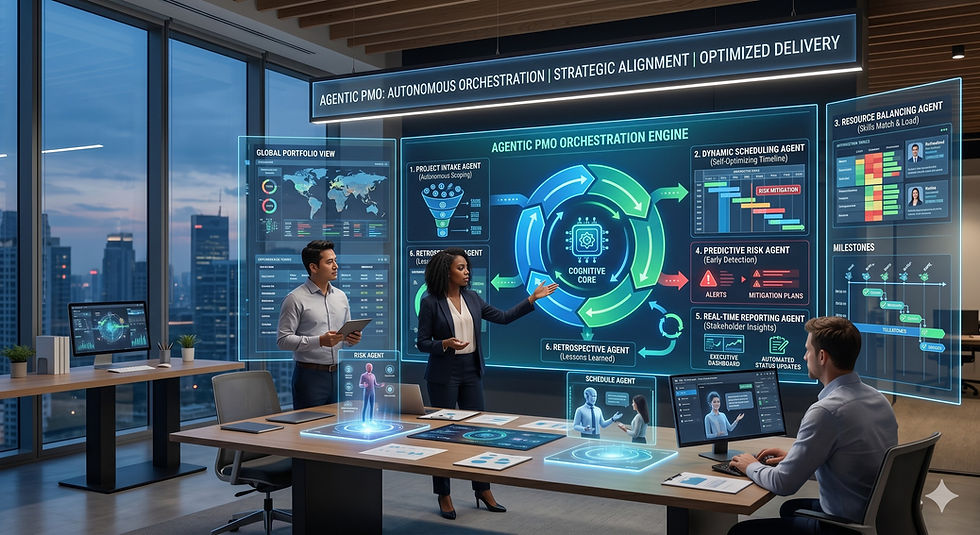
AI and Autonomous PMO Processes
Over the next several years, AI is likely to automate increasing portions of PMO administration.
Routine status collection, report generation, document analysis, risk scanning, meeting summarization, and portfolio monitoring are all areas where AI can reduce manual effort.
The PMO professional's role is therefore likely to shift further toward interpretation, governance, decision support, and strategic leadership.
The PMO as a Strategic Orchestrator
The strongest future PMOs are likely to operate as orchestration functions rather than administrative departments.
They will connect strategy, investment, people, technology, delivery teams, risk management, and benefits realization.
This does not mean every organization requires an enterprise PMO. The appropriate model will continue to depend on organizational size, complexity, regulatory requirements, project maturity, and strategic objectives.
Frequently Asked Questions About the Evolution of the PMO
Why is the traditional PMO model no longer sufficient for many organizations?
Traditional PMOs often emphasize reporting, methodology, and project-level control, while modern organizations increasingly require portfolio-level insight and strategic alignment. As project environments become more complex, executives need information about investment priorities, dependencies, risks, and benefits. Consequently, PMOs are increasingly expected to support enterprise decision-making rather than simply monitor project execution.
What is the difference between a traditional PMO and a strategic PMO?
A traditional PMO primarily focuses on governance, methodology, reporting, and project support. A strategic PMO expands its responsibilities into portfolio prioritization, strategic alignment, investment analysis, benefits realization, and executive decision support. The fundamental distinction is that the strategic PMO evaluates whether the organization is delivering the right initiatives, not simply whether approved projects are being delivered correctly.
Will artificial intelligence replace the Project Management Office?
Artificial intelligence is more likely to change PMO responsibilities than eliminate the function entirely. AI can automate reporting, identify potential risks, analyze project data, and generate management information. However, strategic prioritization, governance, stakeholder management, organizational context, and accountability still require human judgment. PMOs are therefore likely to become more analytical and strategic as routine administration becomes increasingly automated.
What should organizations measure to determine whether a PMO is successful?
Organizations should measure PMO performance through outcomes rather than administrative activity. Useful measures include portfolio alignment, benefits realization, investment performance, resource utilization, risk exposure, decision cycle time, delivery performance, and stakeholder satisfaction. A PMO that produces extensive reporting but does not improve investment decisions or project outcomes may have high operational activity without demonstrating equivalent organizational value.
Conclusion: The Evolution of the PMO: How Project Management Offices Are Changing
The evolution of the PMO reflects a fundamental change in how organizations manage strategic execution. The function is moving from administrative coordination and project control toward portfolio intelligence, strategic alignment, benefits realization, transformation management, and enterprise decision support.
Over the next two years, this transition is likely to accelerate as AI, predictive analytics, integrated portfolio platforms, and increasingly complex delivery models reshape PMO operations. Routine reporting and administrative processes are likely to become increasingly automated, while demand for analytical judgment, strategic governance, and benefits management increases.
By 2028, leading PMOs are likely to operate less as centralized reporting departments and more as strategic orchestration functions. Their value will increasingly be judged by whether they help organizations select the right investments, allocate scarce resources effectively, anticipate portfolio risks, accelerate strategic execution, and realize measurable business benefits.
The PMO will not disappear. Its mandate will continue to evolve from managing project control toward managing enterprise value.
Tags: PMO Evolution, Project Management Office, Strategic PMO, PMO Transformation, Project Portfolio Management, PMO Governance, Future of Project Management