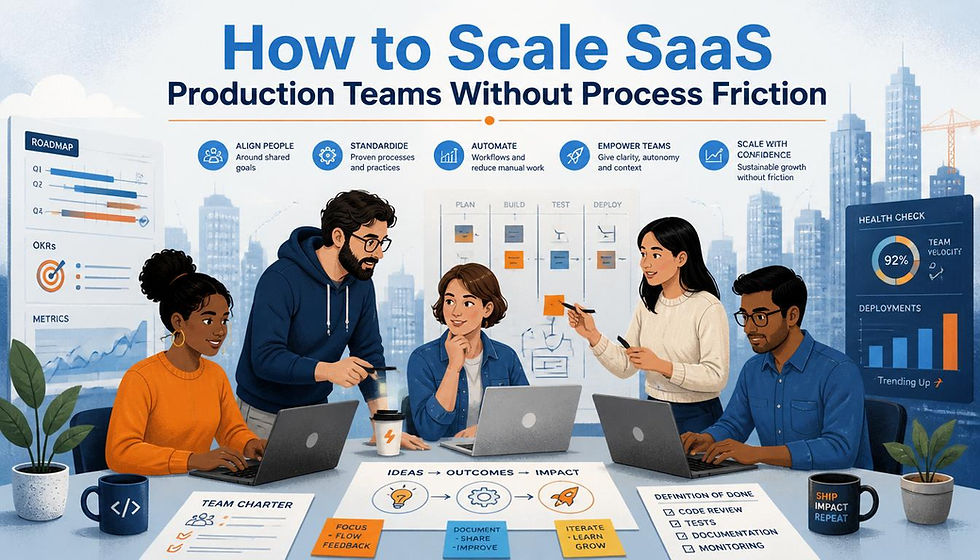
SaaS Project Management: A Complete Guide to Managing SaaS Projects


What Is SaaS Project Management?
SaaS project management is practically important because software delivered through the cloud requires teams to coordinate continuous development, infrastructure, security, customer requirements, and frequent releases rather than treating delivery as a single finished product.
Understanding SaaS Projects
Software as a Service, or SaaS, refers to software applications delivered over the internet, typically through a subscription or usage-based commercial model.
Unlike traditional software projects where a defined version may be delivered to customers and then maintained, SaaS products typically remain under continuous development.
The project management environment therefore includes product development, engineering, design, quality assurance, cloud infrastructure, cybersecurity, customer experience, analytics, sales, marketing, and support.
Project managers must coordinate these functions while maintaining alignment with product strategy and customer requirements.
How SaaS Projects Differ From Traditional Projects
Traditional projects often have relatively clear start and finish points.
SaaS initiatives can have defined project phases, but the underlying product frequently continues evolving after the original project has been completed.
This creates a distinction between project delivery and product development. A project may deliver a major platform capability, migration, integration, or release, while the SaaS product itself continues operating as a long-term service.
The Role of the SaaS Project Manager
The SaaS project manager coordinates dependencies, schedules, resources, risks, stakeholders, and delivery objectives.
However, the role often requires stronger collaboration with product managers and technical leaders than traditional project environments.
A SaaS project manager needs to understand enough about software architecture, cloud infrastructure, APIs, cybersecurity, DevOps, testing, and product analytics to identify dependencies and challenge unrealistic assumptions.
The project manager does not need to be the technical expert. The responsibility is to ensure that technical decisions are understood in terms of delivery consequences.
Planning SaaS Projects
Effective planning is important in SaaS because dependencies between product requirements, software development, infrastructure, security, and customer delivery can create significant downstream effects when they are not identified early.
Defining the Project Objective
A SaaS project should begin with a measurable business or customer objective.
Objectives might include launching a new product capability, migrating customers to a new platform, introducing an integration, improving onboarding, replacing legacy infrastructure, or meeting a regulatory requirement.
A statement such as "improve the platform" is too broad to provide effective project control.
A stronger objective identifies the expected outcome, target users, constraints, and measurable success criteria.
Requirements Management
Requirements management is particularly important because SaaS products can receive input from customers, sales teams, support, product management, engineering, compliance, and senior leadership.
These sources can produce competing priorities.
Requirements should therefore be documented, prioritized, validated, and connected to business outcomes.
Traceability can help project managers determine which requirements are included, which are deferred, and how changes affect the delivery plan.
Roadmaps and Project Plans
Product roadmaps and project plans serve different purposes.
A roadmap communicates strategic product direction and expected areas of development.
A project plan focuses on the specific activities, dependencies, resources, milestones, risks, and deliverables required to achieve a defined objective.
Confusing these two artifacts can create unrealistic expectations because a product roadmap is not necessarily a committed delivery schedule.
Managing Dependencies
SaaS projects commonly involve complex dependencies.
A feature may depend on an API, database change, security review, third-party service, infrastructure modification, user-interface work, documentation, customer support preparation, or data migration.
Dependency mapping should therefore occur early.
The project manager should identify both internal and external dependencies and establish ownership for each critical relationship.
Agile and SaaS Project Management
Agile methods are important in SaaS environments because iterative delivery allows teams to validate assumptions, respond to customer feedback, and release functionality without waiting for an entire product initiative to reach completion.
Scrum and SaaS Development
Scrum provides a structured framework for iterative software development through short development cycles, regular planning, reviews, and retrospectives.
SaaS teams can use Scrum to break larger product objectives into smaller increments.
However, Scrum should not become a substitute for strategic planning.
A team can execute technically efficient sprints while still working on the wrong priorities if product objectives, customer needs, or commercial requirements are poorly defined.
Kanban for SaaS Operations
Kanban can be particularly useful for SaaS teams managing continuous flows of work.
Support issues, infrastructure tasks, defects, security findings, technical debt, and small enhancements may not fit naturally into fixed sprint structures.
Visualizing work in progress can help teams identify bottlenecks and limit excessive concurrent work.
Hybrid SaaS Delivery
Many SaaS organizations use hybrid approaches rather than following one methodology exclusively.
A major platform migration may require detailed predictive planning, while software feature development can use Agile delivery.
Security, compliance, procurement, and infrastructure activities may also require formal approval processes.
The project management approach should therefore reflect the characteristics of the work rather than forcing every activity into one framework.
Managing SaaS Development Teams
Managing cross-functional SaaS teams is important because product delivery depends on multiple specialist disciplines that can create bottlenecks when responsibilities, priorities, or decision rights are unclear.
Engineering and Product Collaboration
Product managers generally focus on what should be built and why, while engineering teams determine how technical solutions can be implemented.
Project managers help coordinate these perspectives.
Effective collaboration requires agreement on objectives, priorities, dependencies, acceptance criteria, technical constraints, and delivery expectations.
A project manager should also ensure that engineering risks are communicated in business terms that nontechnical stakeholders can understand.
Design and User Experience
User experience can materially affect the success of a SaaS capability.
A technically functional feature can still fail to deliver value if users cannot understand or efficiently use it.
Design work should therefore be integrated into planning rather than treated as an activity that occurs immediately before development.
User research, prototypes, usability testing, and design validation can reduce the risk of building functionality that does not meet actual customer needs.
Quality Assurance
Quality assurance must operate throughout SaaS delivery rather than being concentrated immediately before release.
Automated testing, integration testing, regression testing, performance testing, security testing, and user acceptance testing can address different classes of risk.
The appropriate testing strategy depends on the product, architecture, customer requirements, regulatory environment, and consequences of failure.
DevOps and Operations
SaaS delivery creates a close relationship between development and operations.
Infrastructure, deployment pipelines, monitoring, observability, backups, incident response, and system availability can directly affect project outcomes.
Project managers should therefore include operational readiness in delivery planning.
A feature should not be considered fully delivered if the organization cannot operate, monitor, support, and recover it effectively.
Managing Risk in SaaS Projects
SaaS risk management is important because software projects face interconnected technical, operational, commercial, security, and customer risks that can develop rapidly during delivery.
Technical Risk
Technical risks can involve architecture, scalability, integration complexity, legacy systems, technical debt, performance, and third-party dependencies.
A technical risk register should identify both the potential event and its business consequence.
For example, "database performance risk" provides limited information. A stronger formulation might identify the possibility that database limitations could prevent the platform from supporting the projected customer load.
Cybersecurity Risk
Security must be integrated throughout SaaS project management.
Risks can include unauthorized access, insecure APIs, data exposure, vulnerable dependencies, inadequate authentication, configuration errors, and insufficient monitoring.
Security reviews should occur at appropriate stages rather than being treated exclusively as a final pre-release activity.
Availability and Reliability Risk
Customers typically expect SaaS applications to remain available and responsive.
Reliability risks can therefore have direct commercial consequences.
Project teams should consider capacity, redundancy, disaster recovery, backup procedures, monitoring, incident response, and recovery objectives where relevant to the service.
Vendor and Third-Party Risk
SaaS products often depend on external providers for hosting, payments, identity management, analytics, communications, APIs, or other infrastructure.
A failure at a third-party provider can therefore become a SaaS project risk.
Critical suppliers should be assessed for reliability, security, contractual commitments, service levels, business continuity, and exit options.
SaaS Project Performance and Metrics
Measuring SaaS project performance is important because traditional measures such as schedule and budget alone do not fully capture whether a software initiative creates customer and business value.
Delivery Metrics
Traditional project metrics remain relevant.
Teams can monitor milestone achievement, schedule variance, cost performance, resource utilization, unresolved risks, dependency status, and change volume.
However, these measures should be interpreted alongside product and operational metrics.
Delivering every milestone on schedule does not necessarily indicate success if the resulting functionality is rarely used.
Software Delivery Metrics
Engineering organizations can use software delivery metrics to understand development performance.
Common measures include deployment frequency, lead time for changes, change failure rate, and mean time to restore service.
These measures can provide insight into delivery flow and operational stability.
Project managers should avoid turning individual metrics into isolated performance targets because teams can optimize a metric while damaging another dimension of delivery.
Product and Customer Metrics
SaaS projects should also connect delivery to customer outcomes.
Depending on the initiative, relevant measures may include feature adoption, active users, customer retention, conversion, onboarding completion, support volume, customer satisfaction, or revenue impact.
The appropriate metrics should be established before delivery begins where possible.
The SaaS Project Performance Framework
The following SaaS Project Delivery Performance Framework connects project execution with product and operational outcomes.
Performance Dimension | Example Measures | Primary Question |
Schedule | Milestone variance, cycle time | Is delivery predictable? |
Cost | Budget variance, development cost | Is investment controlled? |
Quality | Defects, failed releases | Does the solution meet requirements? |
Engineering | Lead time, deployment frequency | Is development flowing effectively? |
Reliability | Availability, incidents, recovery time | Can customers depend on the service? |
Adoption | Feature usage, active users | Are customers using the capability? |
Customer | Satisfaction, support volume | Is the solution meeting customer needs? |
Business | Revenue, retention, cost reduction | Is the project creating expected value? |
SaaS Release and Change Management
Release management is important because frequent SaaS deployments increase the number of opportunities to introduce changes while reducing the time available for traditional release controls.
Release Planning
Release planning should consider technical readiness, testing, infrastructure, security, customer communications, documentation, support preparation, and rollback requirements.
A release is therefore more than deploying application code.
The organization should understand what customers will experience and whether operational teams are prepared to support the change.
Feature Flags and Controlled Releases
Feature flags can allow organizations to deploy code without immediately making functionality available to every customer.
This can support controlled testing, phased adoption, and rapid rollback.
Canary releases and gradual rollouts can similarly reduce exposure when a change has uncertain operational consequences.
These techniques can complement Agile delivery by reducing the risk associated with large-scale releases.
Change Control
Continuous development does not eliminate the need for change control.
Major changes to scope, architecture, security requirements, customer commitments, budget, or delivery dates should still be assessed.
The difference is that SaaS organizations often need change processes that operate quickly enough to support frequent releases.
Excessive approval layers can create bottlenecks, while inadequate control can produce uncontrolled complexity.
Managing SaaS Project Stakeholders
Stakeholder management is critical in SaaS because decisions can involve technical teams, customers, executives, sales, marketing, support, security, finance, and external partners.
Executive Stakeholders
Executives generally need information about strategic alignment, investment, risk, delivery confidence, and expected business outcomes.
Project reporting should therefore emphasize decisions and exceptions rather than providing excessive technical detail.
A useful executive report might identify current status, major risks, decisions required, forecast changes, and expected business impact.
Customer Stakeholders
Customer involvement can provide valuable evidence about whether a SaaS capability solves a genuine problem.
However, individual customer requests should not automatically become project requirements.
Product teams should evaluate customer feedback against broader market needs, strategic objectives, technical feasibility, and commercial priorities.
Internal Stakeholders
Sales may prioritize customer commitments, engineering may prioritize technical stability, support may prioritize recurring customer problems, and security may prioritize risk reduction.
These priorities can conflict.
The project manager helps create a shared decision framework so that competing requirements are evaluated transparently.
SaaS Project Governance and Continuous Improvement
Strong governance is important because SaaS organizations need sufficient control to manage risk and investment without slowing down the iterative delivery model that allows products to evolve rapidly.
SaaS Governance
Governance should define who makes decisions about scope, priorities, funding, risk, architecture, security, release readiness, and major changes.
Decision rights should be clear.
Ambiguous authority can create delays because teams repeatedly escalate issues that could have been resolved at a lower level.
Lessons Learned
SaaS teams can generate significant learning through each release, incident, customer feedback cycle, and project review.
Lessons learned should focus on actionable improvements.
For example, discovering that security reviews repeatedly delay releases may indicate that security involvement should occur earlier in product planning rather than simply adding another final-stage review.
Technical Debt
Technical debt is an important consideration for SaaS project management.
Short-term delivery decisions can create longer-term maintenance costs, reliability problems, security exposure, or development constraints.
Project managers should ensure that significant technical debt is visible and considered alongside feature development.
Ignoring technical debt can gradually reduce delivery capacity.
The Future of SaaS Project Management
The future of SaaS project management will increasingly involve AI-assisted planning, continuous delivery, predictive analytics, automated quality controls, and tighter integration between project, product, engineering, and operational data.
Artificial Intelligence in SaaS Projects
AI can support project managers by analyzing project information, identifying patterns, summarizing risks, forecasting potential delays, and assisting with documentation.
AI can also analyze large volumes of requirements, support test generation, identify anomalies, and assist engineering teams.
Human oversight remains important because AI-generated recommendations can reflect incomplete data or incorrect assumptions.
Predictive Project Management
Predictive analytics can help identify conditions associated with delivery problems before they become major issues.
For example, increasing unresolved dependencies, declining throughput, rising defect rates, or growing requirements volatility could indicate elevated delivery risk.
This creates an opportunity to shift project management from retrospective reporting toward earlier intervention.
Continuous Product Delivery
The boundary between project management and product management is likely to become increasingly interconnected.
Major initiatives will still require defined objectives, funding, governance, and delivery accountability.
However, SaaS organizations will increasingly evaluate success based on measurable customer and business outcomes rather than simply whether a project delivered its planned scope.
Frequently Asked Questions About SaaS Project Management
How is SaaS project management different from traditional project management?
SaaS project management must account for continuous software development, cloud infrastructure, frequent releases, customer feedback, cybersecurity, integrations, and ongoing operational requirements. Traditional projects can often define a clearer endpoint, while SaaS initiatives may deliver capabilities into a product that continues evolving. This requires stronger integration between project management, product management, engineering, operations, security, and customer teams.
Which project management methodology is best for SaaS development?
There is no universal methodology that is appropriate for every SaaS project. Agile approaches such as Scrum and Kanban are commonly useful for iterative software development, while hybrid approaches can be more appropriate when projects include infrastructure, compliance, procurement, or migration activities. The most effective model is determined by project complexity, uncertainty, dependencies, regulatory requirements, and organizational capability.
What are the most important metrics for managing SaaS projects?
Important metrics should cover project delivery, software development, reliability, customer adoption, and business outcomes. Schedule and cost measures remain relevant, but SaaS teams should also consider deployment performance, defect rates, service reliability, feature adoption, customer satisfaction, and expected business value. A balanced measurement framework prevents teams from optimizing delivery speed while overlooking quality, reliability, or customer outcomes.
How can project managers manage risk in SaaS development?
Project managers should establish risk management across technical, security, operational, commercial, customer, and third-party dependencies. High-priority risks should have clear owners, response strategies, triggers, and escalation thresholds. Continuous monitoring is particularly important because SaaS environments can change rapidly. Integrating risk information with project, engineering, operational, and customer data can provide earlier visibility of emerging problems.
Conclusion: SaaS Project Management: A Complete Guide to Managing SaaS Projects
SaaS project management requires a broader approach than traditional project delivery because software products operate continuously and depend on interconnected technical, operational, commercial, and customer capabilities.
Effective SaaS project management combines structured planning with Agile delivery, strong requirements management, dependency control, risk management, release governance, stakeholder coordination, and measurable performance management.
The most successful approach does not treat delivery as simply building software. A SaaS project must ultimately produce a reliable capability that customers can use, support teams can maintain, security teams can protect, and the business can measure.
Over the next two years, AI is likely to have an increasing influence on SaaS project management. Project managers will gain access to more sophisticated forecasting, automated reporting, risk analysis, requirements analysis, testing support, and delivery intelligence.
The role itself is likely to become more analytical and strategic. Instead of spending substantial time assembling project information, project managers will increasingly interpret data, challenge forecasts, manage dependencies, coordinate decisions, and focus teams on measurable outcomes.
The defining characteristic of effective SaaS project management will therefore be the ability to combine delivery discipline with continuous adaptation. Organizations that establish strong governance without creating unnecessary bureaucracy will be better positioned to deliver software rapidly while maintaining quality, security, reliability, and customer value.
Tags: SaaS Project Management, SaaS Projects, SaaS Product Development, Agile Project Management, SaaS Delivery, Software Project Management, SaaS Management