
Optimizing Operational Workflows: How to Scale SaaS Production Teams Without Process Friction

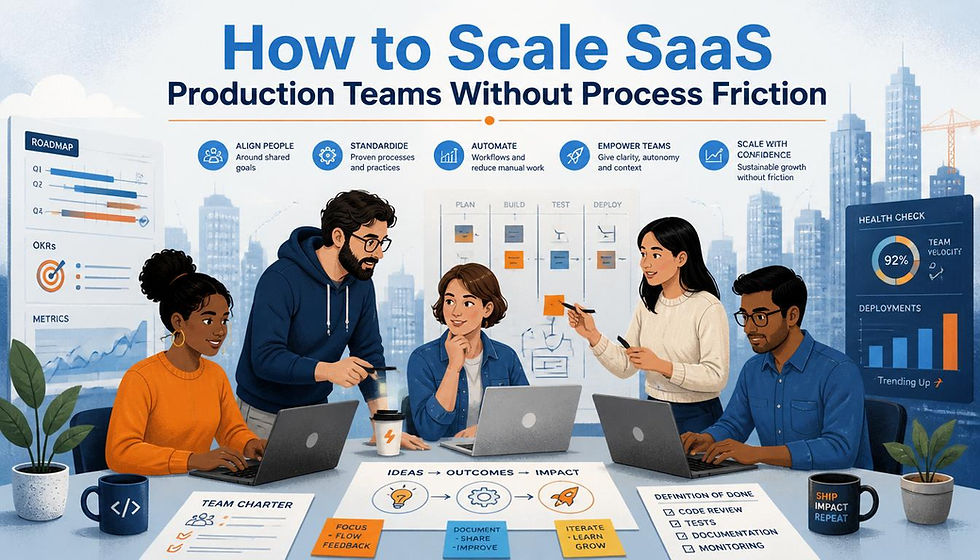
Scaling a SaaS product isn't simply about adding more developers. As engineering teams grow, so does operational complexity. Communication becomes fragmented, release cycles slow down, priorities shift more frequently, and even experienced teams begin spending more time coordinating work than building new features.
Many organizations assume these growing pains are inevitable. In reality, they usually indicate that operational workflows haven't evolved alongside the product. Sustainable growth depends on creating processes that scale just as effectively as the engineering team itself. For companies using a staff augmentation service, strong operational foundations also ensure that internal and external engineers can collaborate as one cohesive team instead of working in parallel.
Why Process Friction Appears During Growth
In the early stages of a SaaS product, development often moves quickly. Small teams communicate informally, everyone understands the product roadmap, and decisions can be made within minutes.
As products mature, however, the situation changes. More developers, additional stakeholders, expanding feature sets, and increasing customer expectations introduce dependencies that informal communication can no longer support.
Typical symptoms include:
Unclear ownership of tasks
Repeated or duplicated work
Delayed code reviews
Inconsistent development standards
Longer release cycles
Knowledge concentrated within individual team members
These problems rarely result from weak technical skills. More often, they stem from workflows that were designed for a startup but are now supporting a much larger organization.
Standardize the Delivery Process
One of the most effective ways to reduce operational friction is to establish a repeatable workflow that every feature follows.
Rather than relying on different approaches across teams, successful SaaS companies define a consistent path from idea to production. Every stage has clear responsibilities, expected outputs, and review criteria.

When development follows a standardized process, onboarding becomes faster, project visibility improves, and fewer issues appear late in the release cycle. Engineers spend less time clarifying requirements and more time building valuable functionality.
Improve Cross-Functional Collaboration
Modern SaaS development extends far beyond engineering.
Every release depends on collaboration between product managers, designers, developers, QA specialists, DevOps engineers, security experts, and business stakeholders.
When these teams operate independently, delays become inevitable.
The most efficient organizations reduce friction by creating a shared source of truth. Product requirements, technical specifications, design assets, sprint priorities, and documentation should remain accessible to everyone involved in delivery.
This transparency minimizes misunderstandings, reduces duplicate work, and enables faster decision-making throughout the project lifecycle.
Integrate External Engineers Into Existing Workflows
Many growing SaaS companies expand delivery capacity through external engineering support. However, adding developers alone doesn't solve operational problems.
External engineers should become part of the existing product team rather than forming a separate development unit.
They should participate in planning sessions, follow identical coding standards, contribute to code reviews, and work within the same project management environment as internal employees.
For businesses adopting a staff augmentation service, integration is significantly more important than geography. When everyone follows the same operational framework, additional engineers increase productivity instead of introducing coordination overhead.
Use Automation to Eliminate Repetitive Work
Manual processes become increasingly expensive as engineering organizations grow.
Continuous integration pipelines, automated testing, deployment automation, monitoring platforms, static code analysis, and AI-assisted development tools all help reduce repetitive work while improving consistency across releases.
Automation should not replace engineering expertise. Instead, it should remove routine tasks that slow developers down. This allows teams to spend more time improving architecture, solving complex technical problems, and delivering customer value.
Organizations that automate their operational workflows also gain greater confidence in every release because quality checks become repeatable rather than dependent on manual effort.
Measure Process Performance
Operational workflows should evolve continuously.
Growing SaaS companies regularly evaluate how efficiently work moves through the delivery pipeline. Metrics such as deployment frequency, lead time, defect rates, review turnaround, and production incidents provide valuable insight into where bottlenecks exist.
Rather than optimizing individual teams, successful organizations optimize the entire delivery system. Small improvements at every stage often produce greater long-term results than simply increasing engineering capacity.
Regular retrospectives, workflow reviews, and feedback sessions help teams identify opportunities to simplify processes before inefficiencies become permanent.
Conclusion - How to Scale SaaS Production Teams Without Process Friction
Scaling a SaaS product successfully requires more than hiring additional developers. Without well-designed operational workflows, larger teams often create greater complexity instead of higher productivity.
Organizations that invest in standardized delivery processes, transparent collaboration, automation, continuous improvement, and seamless integration of external specialists create engineering environments that continue to perform as the business grows.
For companies leveraging a staff augmentation service, strong operational workflows ensure every new contributor becomes productive quickly, collaborates effectively with the existing team, and helps deliver high-quality software without introducing unnecessary process friction.


