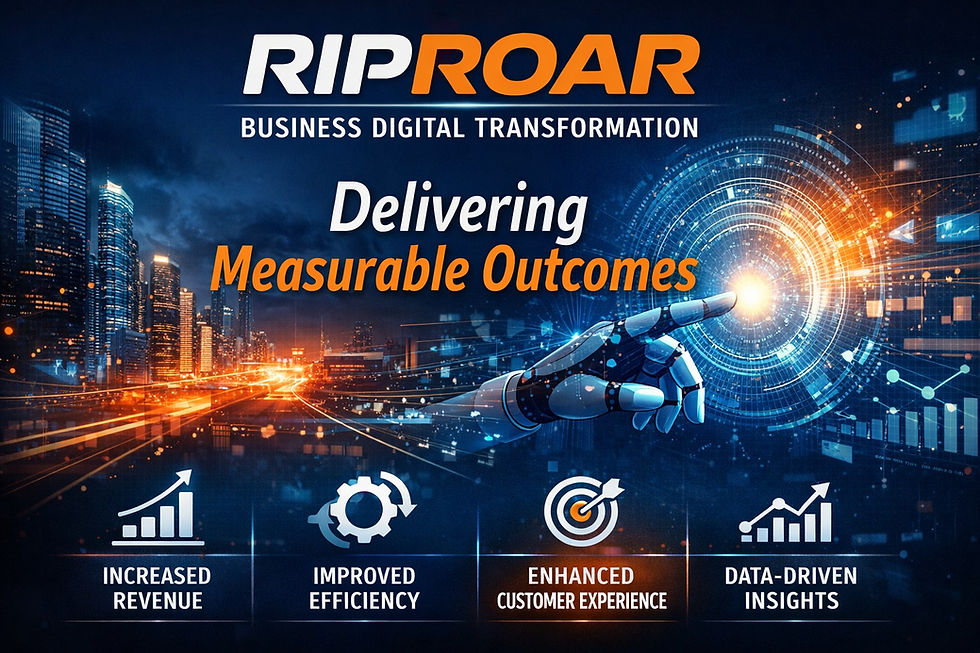
Riproar Business Digital Transformation: Delivering Measurable Outcomes

Digital transformation in large enterprises goes beyond adopting new technology. It requires a fundamental change in how organizations operate, compete, and deliver value at scale. As markets shift rapidly and stakeholder expectations grow, executive teams face pressure to modernize legacy systems, redesign operating models, and improve decision-making without disrupting core operations.
Riproar business digital transformation offers an enterprise-focused approach that connects digital ambition with disciplined execution.
This approach treats transformation not as a series of isolated projects but as an integrated business strategy. It aligns leadership intent, organizational capability, data-driven insight, and technology enablement to produce measurable results.
For large organizations, this method addresses the complexity, governance needs, and risks that come with scale, demanding clear structure and ongoing oversight.
This post explores how enterprises can apply Riproar principles to drive strategic alignment, modernize operations, strengthen governance, and improve performance across business units and regions.
The focus remains on execution, leadership accountability, and long-term value creation.
Digital Transformation at Enterprise Scale
Many enterprise transformation efforts fail because they start with technology choices instead of business goals. Riproar business digital transformation flips this approach. It begins with clear enterprise objectives such as growth, efficiency, resilience, or compliance. Then it identifies how digital capabilities support those goals.
This shift in focus ensures that technology investments directly contribute to business outcomes. For example, a global manufacturing company aiming to improve supply chain resilience might prioritize digital tools that enhance real-time visibility and predictive analytics rather than simply upgrading IT infrastructure.
By starting with outcomes, organizations can avoid common pitfalls like fragmented initiatives, wasted resources, and lack of measurable impact. This approach also encourages leadership teams to stay aligned on priorities and maintain accountability throughout the transformation journey.
Aligning Leadership and Organizational Capability
Successful #BusinessTransformation depends on strong leadership execution and organizational readiness. Riproar emphasizes aligning leadership intent with the capabilities needed to deliver change. This means:
Defining clear roles and responsibilities for transformation sponsors and teams
Building skills and knowledge across the organization to support new ways of working
Establishing governance structures that balance agility with risk management
For instance, a financial services firm undergoing digital transformation created a cross-functional leadership council to oversee progress and resolve conflicts. This council ensured that decisions reflected enterprise priorities and that teams had the resources to execute effectively.
Leadership alignment also involves communicating a compelling vision that connects digital initiatives to business value. When employees understand how their work contributes to enterprise goals, engagement and adoption improve.
Modernizing the Operating Model
The operating model defines how an organization delivers value through its people, processes, and technology. Riproar business digital transformation requires redesigning this model to support digital ways of working at scale.
Key elements include:
Simplifying and standardizing processes to reduce complexity and improve efficiency
Enabling data-driven decision-making by integrating analytics into daily operations
Creating flexible technology platforms that support innovation and rapid change
A global retailer, for example, revamped its operating model by centralizing data management and automating inventory replenishment. This change reduced stockouts and improved customer satisfaction while lowering operational costs.
Modernizing the operating model also means breaking down silos between business units and geographies. Riproar encourages creating shared services and common standards that enable collaboration and consistency across the enterprise.
Strengthening Governance and Risk Management
Large enterprises face significant governance challenges during digital transformation. Scale increases risk exposure, regulatory scrutiny, and the need for compliance. Riproar addresses this by embedding governance into the transformation process rather than treating it as an afterthought.
Effective governance includes:
Clear decision rights and escalation paths
Regular performance monitoring against defined metrics
Risk identification and mitigation plans integrated into project management
For example, a healthcare organization implemented a governance framework that required all digital initiatives to undergo security and compliance reviews before deployment. This approach reduced incidents and ensured alignment with regulatory requirements.
Strong governance supports transparency and trust among stakeholders. It also helps maintain momentum by identifying issues early and enabling timely course corrections.
Driving Measurable Outcomes Across Business Units
Riproar business digital transformation focuses on delivering measurable outcomes that matter to the enterprise. This means setting clear targets, tracking progress, and adjusting actions based on data.
Examples of measurable outcomes include:
Revenue growth from new digital channels
Cost savings through process automation
Improved customer satisfaction scores
Faster time-to-market for new products
A multinational energy company used Riproar principles to align its digital initiatives with enterprise goals. By tracking key performance indicators across business units, the company identified high-impact projects and scaled successful pilots quickly.
This outcome-driven approach ensures that transformation efforts deliver real value rather than just technology upgrades. It also reinforces leadership accountability by linking results to strategic objectives.
Discover "Riproar Business Digital Transformation: The Ultimate Roadmap to Future Growth" by Digital Viorix
Frequently Asked Questions
What is Riproar business digital transformation?
Riproar business digital transformation is an enterprise-focused approach that aligns digital initiatives with strategic business objectives. It emphasizes leadership ownership, operating model redesign, governance discipline, and measurable outcomes rather than isolated technology deployment. The model is designed for large organizations managing complexity across multiple business units, regions, and regulatory environments.
How does Riproar differ from traditional digital transformation programs?
Traditional programs often focus on technology modernization or isolated process automation. Riproar business digital transformation integrates strategy, governance, data, workforce capability, and execution into a single enterprise framework. This reduces fragmentation and ensures digital investment delivers sustained business value rather than short-term improvement.
What types of organizations benefit most from Riproar?
Riproar is most effective in large enterprises, multinational corporations, and regulated industries such as financial services, healthcare, manufacturing, and energy. These organizations require strong governance, risk management, and scalable operating models alongside digital innovation.
How important is executive sponsorship in the Riproar approach?
Executive sponsorship is critical. Riproar treats digital transformation as a leadership responsibility rather than an IT initiative. Senior leaders are accountable for outcomes, resource prioritization, and adoption, ensuring transformation remains aligned with enterprise strategy and performance objectives.
How does Riproar support operating model change?
Riproar business digital transformation embeds digital capabilities into how work is structured and delivered. This includes redefining roles, decision rights, workflows, and performance measures so digital change becomes part of normal operations rather than a parallel program.
How does Riproar address governance and risk?
Riproar establishes governance structures focused on decision quality, risk visibility, and strategic alignment. Risk management is integrated into transformation planning, covering cybersecurity, data privacy, regulatory compliance, and operational continuity. Controls are applied proportionately to maintain assurance without slowing execution.
What role does data play in Riproar business digital transformation?
Data is treated as a strategic enterprise asset. Riproar emphasizes consistent data architecture, quality standards, and analytics that support executive decision-making. Insights are embedded into workflows and governance forums to drive action and accountability.
How does Riproar manage change fatigue in large organizations?
Riproar reduces change fatigue by limiting initiative overload, sequencing transformation efforts, and reinforcing priorities through leadership communication and performance management. Change is positioned as an evolution of the operating model rather than a continuous series of disruptions.
How is success measured under the Riproar model?
Success is measured through financial, operational, and organizational outcomes. These include cost efficiency, revenue impact, decision speed, adoption rates, risk reduction, and leadership alignment. Metrics are tracked consistently to ensure benefits realization and long-term value creation.
Can Riproar support post-merger integration and growth?
Yes. Riproar business digital transformation supports integration by providing standardized platforms, governance, and performance frameworks that enable newly acquired businesses to align quickly with enterprise operating models while maintaining flexibility where required.
Conclusion
Riproar business digital transformation offers a structured and pragmatic framework for large enterprises navigating complex, multi-dimensional change. By placing enterprise objectives at the center of transformation efforts, organizations avoid the common trap of technology-led initiatives that lack strategic cohesion.
The Riproar approach reinforces alignment between leadership intent, organizational capability, and execution discipline, ensuring that digital investments translate into tangible operational and financial performance. Through operating model modernization, strengthened governance, and a consistent focus on measurable outcomes, enterprises can progress confidently without destabilizing core operations or introducing unmanaged risk.
For executive teams, the value of this approach lies in its ability to balance ambition with control. Digital transformation becomes a managed evolution rather than a disruptive shock to the organization. Leadership accountability is clearly defined, decision-making structures are reinforced, and performance management is directly linked to transformation objectives. This creates transparency, builds organizational confidence, and enables leaders to make informed trade-offs as priorities evolve. Importantly, governance is positioned as an enabler of execution, supporting speed and resilience rather than constraining progress.
Business leaders should therefore view digital transformation as a continuous, integrated enterprise strategy rather than a sequence of isolated programs or technology deployments. When embedded into the operating model, governance framework, and leadership routines, transformation becomes self-sustaining.
This mindset supports long-term value creation, improves adaptability, and strengthens competitive positioning. In markets defined by rapid change and increasing complexity, enterprises that adopt a disciplined, outcome-driven approach such as Riproar business digital transformation are better equipped to sustain performance, manage uncertainty, and lead with confidence at scale.
Key Resources and Further Reading
Hashtags
#DigitalTransformation #EnterpriseStrategy #BusinessTransformation #LeadershipExecution #OperatingModel