Project Manager Leadership Development: Essential Competencies for Career Growth


The Role of Leadership Development in Project Management
Project manager leadership development is critical because project success depends on a leader's ability to align people, decisions, resources, and business objectives rather than simply administer schedules and budgets.
From Project Administration to Project Leadership
Project management has traditionally been associated with planning, scheduling, budgeting, risk control, and reporting. Those capabilities remain essential, but the modern project manager must also influence people who may have different priorities, professional backgrounds, incentives, and levels of organizational authority.
A project manager can maintain a technically accurate schedule while still struggling to secure stakeholder commitment or resolve persistent team conflict. Leadership development addresses this gap by strengthening the behavioral and strategic capabilities that turn project plans into coordinated execution.
The evidence suggests that project environments place substantial demands on communication, decision-making, relationship management, and adaptability. These capabilities become increasingly important as project complexity, cross-functional dependency, and executive visibility increase.
Why Leadership Capability Affects Project Outcomes
Projects operate through a chain of decisions. Requirements are clarified, priorities are negotiated, risks are escalated, resources are assigned, and trade-offs are approved. The quality and speed of these decisions can directly affect delivery performance.
Leadership development helps project managers make those decisions more effectively by improving judgment, influence, communication, and accountability. These capabilities also shape how teams respond when the original project plan no longer matches operational reality.
A strong project leader does not simply report that a milestone is at risk. The leader identifies the cause, establishes the consequences, evaluates alternatives, engages the relevant decision-makers, and drives the corrective action.
Leadership as a Career Accelerator
Leadership development also affects career progression. Project managers who consistently demonstrate strategic thinking, stakeholder influence, team leadership, and commercial awareness are better positioned for senior project, program, portfolio, transformation, and operations roles.
Career progression increasingly depends on the ability to operate beyond task-level delivery. Senior leaders need project managers who can interpret business objectives, manage ambiguity, influence executives, and create accountability across organizational boundaries.
Strategic Thinking and Business Leadership Competencies
Strategic thinking is a core project manager leadership competency because effective project leaders must connect individual delivery decisions with broader organizational goals, financial priorities, customer outcomes, and long-term business value.
Connecting Projects to Business Strategy
A project should not be managed as an isolated collection of tasks. Project managers need to understand why the initiative exists, what business problem it addresses, and which outcomes justify the investment.
This requires familiarity with organizational strategy, operating models, revenue drivers, cost structures, customer priorities, and competitive pressures. A project manager who understands these factors can evaluate decisions against business value rather than treating the project plan as the only source of authority.
Industry analysis shows that strategic alignment becomes particularly important when organizations have multiple initiatives competing for funding and specialist resources. Project leaders who can articulate business value help sponsors make better prioritization decisions.
Thinking Beyond the Triple Constraint
Scope, schedule, and cost remain fundamental project dimensions, but senior project leadership increasingly requires attention to benefits, adoption, resilience, compliance, customer experience, and organizational capability.
A project manager may deliver within the approved budget while producing limited business value if adoption is poor or operational teams are unable to sustain the resulting change.
Leadership development therefore encourages broader outcome-based thinking. The project manager considers what happens after implementation, who must adopt the result, how value will be measured, and what organizational changes are required to sustain performance.
Developing Commercial Awareness
Commercial awareness allows project managers to understand how contractual conditions, procurement decisions, resource costs, supplier relationships, and financial assumptions influence delivery.
This competency is particularly valuable in large technology, construction, consulting, infrastructure, and transformation programs where commercial decisions can materially affect project viability.
Project managers with stronger commercial judgment can identify financial exposure earlier, challenge unrealistic assumptions, and communicate the consequences of scope or timing decisions more effectively to sponsors.
Communication, Influence and Stakeholder Leadership
Communication and influence are fundamental leadership competencies because project managers frequently need to secure action from people they do not directly manage.
Executive Communication
Executive stakeholders generally require concise information about outcomes, risks, decisions, dependencies, financial implications, and actions. Providing excessive operational detail can obscure the decisions that require leadership attention.
Effective project managers therefore translate complex information into decision-ready communication. A strong executive update answers what changed, why it matters, what options exist, and what decision is required.
This does not mean removing complexity from the underlying analysis. It means presenting complexity in a form that allows senior stakeholders to act on it.
Influencing Without Formal Authority
Many project managers lead matrix teams where engineers, analysts, finance professionals, vendors, subject-matter experts, and functional managers report elsewhere.
Influence becomes essential under these conditions. Project managers must establish credibility, understand competing priorities, negotiate commitments, and explain why participation matters.
The data indicates that authority based solely on job title is often insufficient in cross-functional environments. Influence is strengthened through credibility, consistency, expertise, fairness, and clear communication.
Managing Stakeholder Expectations
Stakeholder management is not simply a communications exercise. It involves understanding expectations, political dynamics, decision rights, concerns, incentives, and the consequences of project outcomes for each stakeholder group.
Leadership development helps project managers move from reactive stakeholder management toward deliberate relationship management. Potential objections can be identified earlier, difficult decisions can be framed more effectively, and escalation can become a controlled governance mechanism rather than a sign of project failure.
Decision-Making, Accountability and Problem Solving
Decision-making capability is central to project manager leadership development because project environments generate uncertainty, competing priorities, incomplete information, and time-sensitive choices.
Making Decisions Under Uncertainty
Project managers rarely possess perfect information. Waiting for complete certainty can allow risks to develop into more expensive problems.
Effective leaders establish what is known, what remains uncertain, which assumptions are being used, and what information would materially change the decision. This creates a disciplined basis for action without pretending that uncertainty has disappeared.
Strong decision-making also requires understanding reversibility. Some decisions can easily be changed later, while others create substantial financial, technical, or operational commitments.
Establishing Accountability
Accountability works best when ownership is explicit. Project managers should define who is responsible for actions, who has authority to decide, when commitments are due, and how progress will be monitored.
Weak accountability often appears as repeated status discussions without clear ownership. Leadership development helps project managers move conversations toward specific commitments and measurable outcomes.
Accountability should also operate upward. Project managers need the confidence to explain when sponsor decisions, resource constraints, or unresolved dependencies are preventing delivery rather than absorbing every problem personally.
Developing Structured Problem Solving
Complex project problems often have several interacting causes. Treating symptoms without identifying root causes can result in recurring disruption.
A structured problem-solving approach may examine process failures, capability constraints, technology limitations, unclear ownership, dependencies, supplier performance, and decision delays.
The leadership competency is not simply analytical reasoning. It is the ability to convert analysis into action by securing agreement, assigning responsibility, and monitoring whether the intervention actually changes project performance.
Team Leadership, Coaching and Performance Management
Team leadership is a defining project-management competency because project outcomes depend on how effectively individuals collaborate, communicate, solve problems, and respond to pressure.
Building High-Performance Teams
High-performing teams require clarity around purpose, responsibilities, decision rights, working practices, and performance expectations. Project managers establish these conditions while adapting them to the project's complexity and organizational context.
Teams also require trust. When individuals believe that raising concerns will result in blame, important information may remain hidden until it becomes more difficult and expensive to address.
Research trends demonstrate that effective team environments support stronger collaboration when expectations are clear and people understand how their contributions connect to project outcomes.
Coaching Project Team Members
Leadership development increasingly involves coaching rather than simply directing. Coaching encourages individuals to analyze problems, consider alternatives, and develop greater ownership of decisions.
A project manager might ask a team member to explain the assumptions behind an estimate instead of immediately correcting it. This approach can improve capability while also providing the leader with better insight into how the team is thinking.
Coaching is particularly valuable for emerging project professionals who need opportunities to develop judgment and independent decision-making.
Managing Performance Issues
Strong project leaders do not avoid difficult performance conversations. They address issues early, focus on observable behavior and project impact, and establish clear expectations for improvement.
Performance management should also distinguish between an individual capability problem and a systemic project problem. A missed commitment may result from poor performance, but it may also result from unreasonable workload, unclear priorities, insufficient resources, or conflicting instructions.
Leadership maturity requires diagnosing the situation accurately before determining the appropriate response.
Emotional Intelligence, Conflict Management and Change Leadership
Emotional intelligence and change leadership are increasingly important because project managers must guide teams through uncertainty, competing interests, organizational disruption, and difficult interpersonal situations.
Building Emotional Intelligence
Emotional intelligence helps project managers recognize their own reactions and better understand the perspectives of others. This is particularly valuable during escalations, negotiations, performance discussions, and periods of organizational change.
Self-awareness helps leaders identify when frustration or pressure is influencing communication. Self-regulation creates space to respond deliberately rather than reacting impulsively.
Empathy also improves stakeholder interpretation. Understanding why someone is resistant to a change does not mean agreeing with the resistance. It allows the project manager to identify whether the concern relates to workload, capability, risk, incentives, uncertainty, or trust.
Resolving Conflict Constructively
Conflict can be productive when it challenges weak assumptions or exposes important risks. It becomes damaging when disagreement turns personal, repetitive, or obstructive.
Effective project leaders separate the issue from the individuals involved. They establish facts, clarify areas of disagreement, identify underlying interests, and move the discussion toward an acceptable decision or action.
The evidence suggests that unresolved conflict can consume management attention and reduce collaboration. Early intervention is therefore a leadership competency rather than merely a human resources responsibility.
Leading Through Organizational Change
Change projects frequently create uncertainty about responsibilities, processes, technology, and future operating models. Employees may support the desired outcome while still resisting the transition required to achieve it.
Project managers need to communicate why change is necessary, what will happen, what will remain stable, and how concerns will be addressed. Leadership development improves the ability to maintain momentum without dismissing legitimate employee concerns.
Developing a Project Manager Leadership Development Framework
A structured development framework is more effective than informal leadership training because it connects competencies to observable behaviors, project outcomes, feedback, and career objectives.
The Project Manager Leadership Capability Matrix
The Project Manager Leadership Capability Matrix provides a practical framework for evaluating development priorities across core project leadership competencies.
Leadership Competency | Core Behavior | Development Indicator | Project-Level Impact |
Strategic thinking | Connects delivery with business objectives | Can explain project value and trade-offs | Better prioritization |
Communication | Delivers clear, audience-specific messages | Stakeholders understand decisions and risks | Faster alignment |
Influence | Secures commitment without relying on hierarchy | Cross-functional commitments are maintained | Stronger execution |
Decision-making | Acts effectively with incomplete information | Decisions are timely and evidence-based | Reduced delivery delay |
Accountability | Establishes clear ownership | Actions have named owners and dates | Improved execution discipline |
Team leadership | Creates clarity and trust | Team members raise issues early | Better collaboration |
Emotional intelligence | Regulates reactions and reads team dynamics | Difficult situations remain constructive | Stronger relationships |
Conflict management | Resolves disagreements based on causes | Recurring disputes decline | Greater team stability |
Coaching | Develops individual capability | Team members assume greater ownership | Increased team capacity |
Commercial awareness | Understands cost and contractual implications | Financial exposure is identified earlier | Better project control |
Measuring Leadership Development Progress
Development becomes more meaningful when progress is observable. Project managers can track indicators such as stakeholder feedback, escalation patterns, decision-cycle time, team engagement feedback, recurring conflict, risk escalation quality, and delivery predictability.
No single metric provides a complete measure of leadership effectiveness. A balanced assessment should combine quantitative indicators with structured qualitative feedback.
Leadership reviews can also compare current behavior with the competencies required for the next career level. This prevents development from becoming a generic training exercise and ties investment directly to professional progression.
Creating a Two-Year Development Path
A two-year development path can begin with core leadership behaviors such as communication, self-awareness, accountability, and stakeholder management. Once these capabilities become consistent, development can progress toward strategic thinking, executive influence, commercial leadership, and complex change management.
The sequence matters because advanced leadership depends on foundational behaviors. A project manager who struggles to communicate clearly with a delivery team will find executive influence considerably harder to sustain.
Development should combine formal education, stretch assignments, mentoring, coaching, feedback, and deliberate application on live projects. Repetition converts theoretical knowledge into practical leadership behavior.
Career Progression and the Future of Project Manager Leadership
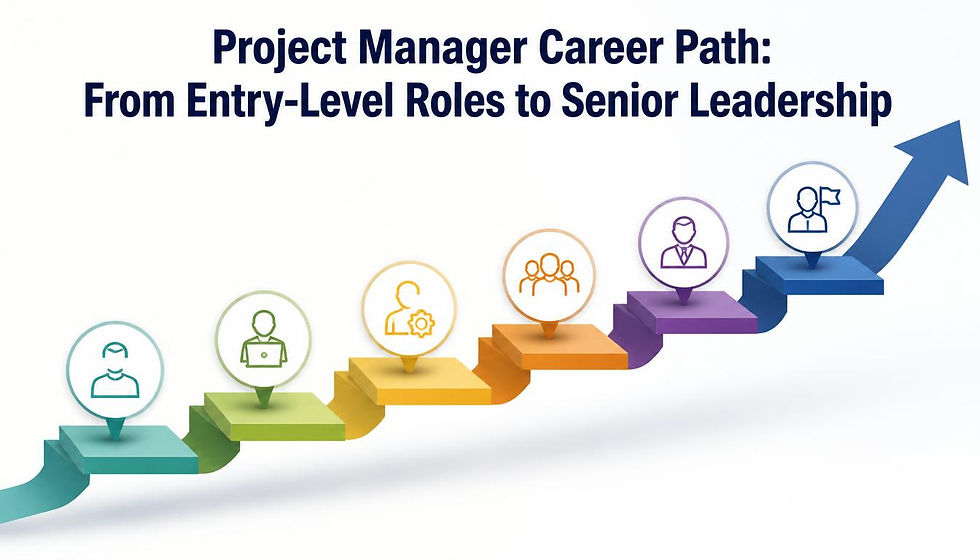
Leadership development increasingly determines whether project managers remain focused on delivery coordination or progress toward senior roles involving strategy, transformation, programs, and enterprise change.
From Project Manager to Senior Leadership
Career progression often requires a shift from managing individual workstreams toward managing systems of interdependency. Senior project leaders must understand organizational priorities, governance structures, investment decisions, stakeholder politics, and long-term capability development.
This transition requires broader judgment. The question changes from “Are we delivering the plan?” to “Are we delivering the right outcome, and are we managing the consequences effectively?”
Project managers preparing for senior roles should therefore seek assignments that expose them to executive governance, major transformations, commercial decisions, and organizational change.
Leadership Development and AI
AI is increasingly supporting planning, reporting, forecasting, documentation, risk analysis, and other project-management activities. As these capabilities expand, leadership competencies are likely to become more significant sources of professional differentiation.
AI can produce analysis and recommendations, but project managers still need to determine how decisions affect people, organizations, customers, suppliers, and strategic objectives. They also need to manage the trust, accountability, and adoption issues that accompany technology-driven change.
The data indicates that technology does not eliminate leadership requirements. It changes where leaders spend their time and increases the need for judgment, communication, and oversight.
Two-Year Outlook for Project Manager Leadership Development
Over the next two years, project manager leadership development is likely to place greater emphasis on strategic decision-making, AI-enabled management, executive communication, organizational change, and workforce adaptability.
Organizations are likely to place more value on project leaders who can combine delivery discipline with business judgment. Project managers who demonstrate leadership across people, technology, commercial considerations, and strategic outcomes should be better positioned for progression into senior project and program leadership.
The strongest development programs will move beyond generic leadership courses and focus on measurable competencies applied directly to complex delivery environments.
FAQ
How does project manager leadership development differ from conventional project management training?
Project management training generally emphasizes methods, processes, tools, planning, risk, scheduling, and governance. Leadership development focuses more heavily on judgment, influence, communication, stakeholder relationships, team performance, conflict management, and strategic thinking. Effective development combines both because project managers require technical delivery competence and the leadership capability needed to turn that competence into organizational results.
Which leadership competencies should a project manager develop first?
Project managers should typically begin with communication, accountability, self-awareness, stakeholder management, and decision-making because these capabilities affect daily interactions across almost every project environment. Once these foundations are established, leaders can develop more advanced competencies such as executive influence, strategic thinking, commercial leadership, organizational change, and enterprise-level transformation leadership.
How can organizations measure whether project manager leadership development is improving project performance?
Organizations can evaluate leadership development through a combination of behavioral and delivery indicators. Useful measures include stakeholder feedback, team engagement results, escalation patterns, decision-cycle time, recurring conflict, risk visibility, delivery predictability, and leadership assessment results. Comparing these measures before and after development initiatives can provide stronger evidence than training completion rates alone.
What leadership capabilities will become most valuable for project managers as AI adoption increases?
Strategic judgment, communication, emotional intelligence, change leadership, ethical decision-making, stakeholder influence, and AI governance are likely to become increasingly valuable. As automated systems perform more administrative analysis and reporting, project managers will spend proportionally more time interpreting information, challenging recommendations, managing human responses, and deciding how technology should be applied within complex organizational environments.
Conclusion: Project Manager Leadership Development: Essential Competencies for Career Growth and Project Success
Project manager leadership development provides the bridge between technical delivery capability and broader organizational leadership. The strongest project managers understand that successful delivery depends on strategic thinking, communication, influence, accountability, decision-making, team leadership, emotional intelligence, conflict management, and commercial awareness.
Leadership capability also creates a direct connection between project performance and career progression. Project managers who can manage complexity, influence stakeholders, coach teams, and connect delivery decisions to business outcomes are better prepared for senior project, program, transformation, and portfolio responsibilities.
Over the next two years, leadership development is likely to become increasingly focused on the intersection of human leadership and AI-enabled project management. Project managers will need to interpret increasingly sophisticated automated analysis while maintaining accountability for decisions, stakeholder relationships, team performance, and organizational change.
The project managers best positioned for progression will be those who develop beyond process expertise and demonstrate consistent leadership behavior under pressure, ambiguity, and competing priorities. Leadership development will therefore remain a central competency for professionals seeking stronger project outcomes and sustained career growth.
Tags: project manager leadership development, project management leadership, project manager skills, leadership competencies, project leadership skills, project management career development, project manager career growth