
Project Manager Career Path: From Entry-Level Roles to Senior Leadership

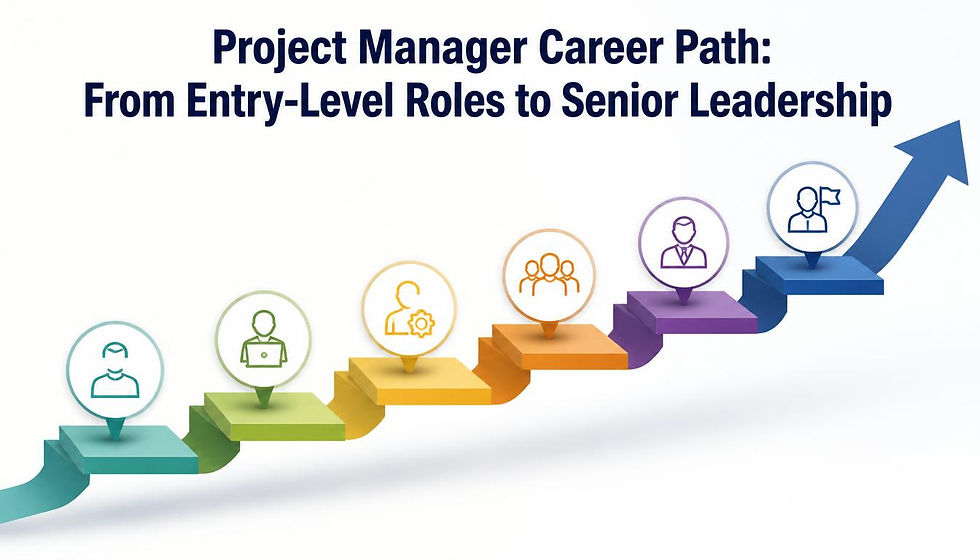
A project management career rarely develops through a single, predictable sequence of job titles. Some professionals begin as project coordinators and progress into increasingly complex delivery roles. Others enter through business analysis, engineering, operations, consulting, finance, technology, or functional leadership before moving into project management.
The more useful way to understand a project manager career path is therefore not as a ladder of titles, but as an expansion of accountability.
Early-career professionals are primarily responsible for maintaining project information, coordinating activities, and supporting delivery. Project managers become accountable for integrating scope, schedule, resources, risks, decisions, and stakeholders. Senior project managers operate in environments where ambiguity, organizational politics, commercial constraints, and competing priorities become as consequential as the project plan itself.
Beyond that point, career paths diverge. A project manager may move toward program leadership, portfolio management, PMO leadership, transformation, consulting, or a specialist discipline.
The important question is not simply, "What title comes next?" It is, "What larger class of decisions am I becoming capable of owning?"
What the Project Manager Career Path Actually Looks Like
Project management progression is best understood as a movement from coordination toward increasingly consequential decision-making.
Job titles vary substantially between organizations. A project coordinator in one company may perform work comparable to a junior project manager elsewhere. A senior project manager may have authority over a single strategically important initiative while a program manager oversees several less complex projects.
For that reason, titles provide an imperfect measure of seniority. Four dimensions provide a better framework:
Scope: How much work, budget, geography, technology, or organizational change is involved?
Complexity: How many dependencies, stakeholders, uncertainties, and competing constraints must be managed?
Decision authority: What decisions can the individual make without escalation?
Organizational impact: How significant are the consequences if the project succeeds or fails?
Early progression tends to increase all four.
A project coordinator may maintain schedules and action logs. A project manager becomes accountable for whether the integrated plan is achievable. A senior project manager may be expected to resolve conflicts between business units, negotiate tradeoffs with executives, manage suppliers, and recover troubled delivery.
At program and portfolio levels, the nature of work changes again. The professional is no longer optimizing only one delivery system. They are managing relationships between initiatives, investment choices, organizational capacity, strategic priorities, and competing demands for resources.
That distinction matters when planning a career. Pursuing a larger title without deliberately increasing decision scope can produce limited professional growth. Conversely, taking on difficult assignments can accelerate development even when the formal title remains unchanged.
The Entry-Level Foundation: Learning How Projects Actually Move
Entry-level project roles develop the mechanics on which more senior project management depends.
Project coordinators, project analysts, PMO analysts, project administrators, and similar roles commonly support schedules, meeting coordination, action tracking, reporting, documentation, RAID logs, financial administration, governance packs, and project information.
These activities can appear administrative, but they expose professionals to the operating system of project delivery.
A strong early-career practitioner learns how commitments become activities, how activities become milestones, and how apparently minor deviations can become material delivery problems.
The objective should not be to remain an efficient administrator. It should be to understand why the information exists and what decisions depend on it.
For example, maintaining a RAID log is fundamentally different from understanding which risks could alter the critical path. Updating a budget is different from understanding the assumptions behind the forecast. Recording an action is different from understanding whether the action resolves the underlying dependency.
This is where project management judgment begins to develop.
Early-career professionals should therefore seek exposure to:
planning and scheduling
scope and requirements
risk and issue management
change control
financial tracking
governance and reporting
stakeholder communications
resource planning
supplier management
project assurance
benefits and outcomes
The strongest foundation is broad enough to show how these mechanisms interact.
A professional who understands schedule, cost, scope, risk, resources, governance, and stakeholder dynamics as connected systems will generally be better prepared for project management responsibility than someone who has mastered only one reporting process.
Becoming a Project Manager: Integration Becomes the Core Skill
The transition into project management occurs when responsibility shifts from supporting project processes to integrating them.
A project manager is accountable for turning objectives into an executable delivery system.
That requires more than maintaining a plan. The project manager must understand whether the plan is internally coherent, whether assumptions remain valid, whether dependencies are controlled, whether resources are sufficient, and whether stakeholders remain aligned with the decisions being made.
This is also where tradeoffs become unavoidable.
A compressed schedule may require additional resources. Additional resources may increase cost. A scope reduction may protect a milestone while weakening expected benefits. A supplier decision may reduce immediate cost while increasing operational risk.
The project manager's value increasingly comes from making these relationships visible and helping the organization make informed decisions.
This creates an important career transition.
A junior practitioner can demonstrate competence by producing accurate information. A project manager demonstrates competence by using information to control delivery.
The difference is substantial.
Project managers also begin to develop a more sophisticated understanding of stakeholders. Not every stakeholder needs the same information, the same level of involvement, or the same decision rights. Effective engagement therefore becomes an exercise in governance rather than simply communication.
As responsibility grows, project managers should deliberately seek assignments that expose them to ambiguity rather than only well-defined delivery environments.
Complex stakeholders, uncertain requirements, cross-functional dependencies, supplier relationships, regulatory constraints, and organizational change provide developmental value because they force the practitioner to exercise judgment rather than simply apply process.
Senior Project Management: Managing Complexity Rather Than Just Size
Senior project management is not simply project management with a larger budget.
The defining change is usually the level of ambiguity and organizational consequence surrounding delivery.
A senior project manager may inherit projects where the original business case no longer reflects current conditions, stakeholders disagree about priorities, delivery assumptions have weakened, or multiple functions have conflicting incentives.
The challenge becomes less about asking whether tasks are complete and more about determining whether the delivery system remains viable.
Senior practitioners therefore need stronger capabilities in areas such as:
executive stakeholder management
commercial judgment
organizational change
strategic alignment
negotiation
escalation management
supplier and contract management
risk appetite
benefits realization
recovery planning
governance design
They also need to understand when conventional project controls are insufficient.
A project can have a current schedule, regular status reporting, and a formally maintained risk register while still being strategically unhealthy. For example, a project may be progressing according to its revised plan while the business case supporting that plan has materially deteriorated.
Senior project management requires the ability to challenge that situation.
This is one reason experienced project managers become valuable beyond their technical project skills. They provide an independent view of whether delivery activity still supports the intended business outcome.
At this stage, professional reputation increasingly depends on judgment. Senior stakeholders need confidence that difficult information will be surfaced early, tradeoffs will be articulated clearly, and escalation will occur when management intervention is genuinely required.
Choosing What Comes Next: Program, Portfolio, PMO, or Specialist Leadership
There is no single destination beyond senior project management.
Several career paths become viable, each requiring a different expansion of capability.
Career stage | Primary accountability | Capability emphasis | Typical complexity |
Project coordinator or analyst | Project support and information integrity | Planning, reporting, documentation, coordination | Defined workstream or project |
Project manager | Integrated delivery | Scope, schedule, cost, risk, resources, stakeholders | Cross-functional project |
Senior project manager | Complex delivery and organizational outcomes | Judgment, commercial management, governance, recovery, executive engagement | High-risk or strategically important project |
Program manager | Coordinated outcomes across related projects | Interdependencies, benefits, strategic alignment, cross-project decisions | Multiple projects and business areas |
Portfolio or PMO leader | Investment, governance, prioritization, and delivery capability | Portfolio economics, governance, capacity, standards, executive decision support | Enterprise-wide change portfolio |
Transformation or executive leader | Enterprise outcomes and strategic change | Strategy execution, operating model, investment, organizational leadership | High-impact enterprise transformation |
Program management is a natural progression for professionals who enjoy coordinating interconnected initiatives. The emphasis shifts from controlling one project to managing relationships between projects and ensuring that combined activity produces the intended benefits.
Portfolio leadership is more investment-oriented. The central questions become which initiatives should receive resources, whether the portfolio remains aligned with strategy, and how organizational capacity should be allocated across competing priorities.
PMO leadership can range from operational governance to enterprise portfolio management. Senior PMO professionals may own standards, assurance, delivery methodologies, resource visibility, performance reporting, governance, and investment decision support.
Transformation leadership moves further toward enterprise strategy. The professional may be accountable for changes to operating models, technology platforms, customer propositions, organizational structures, or major business capabilities.
There are also specialist routes.
Experienced project managers can move into project controls, risk, commercial management, transformation, change management, agile delivery, technology delivery, sustainability, or industry-specific project leadership.
Consulting provides another route, particularly for professionals who can transfer delivery experience across organizations and diagnose complex operating problems.
The correct path depends less on prestige than on the type of work the individual wants to own.
Certifications, Experience, and the Economics of Career Development
Professional certifications can provide structure, vocabulary, and evidence of formal learning, but they do not substitute for delivery experience.
A certification can demonstrate that an individual has studied a body of knowledge. It cannot by itself demonstrate that the person can recover a failing project, negotiate a difficult commercial position, challenge an executive assumption, or manage competing stakeholders under pressure.
The value of certification therefore changes according to career stage.
Early in a career, formal training can help establish foundational concepts and create a common professional language. Later, targeted qualifications may support specialization or demonstrate knowledge relevant to a particular operating environment.
Experience should nevertheless remain the central development currency.
The most valuable assignments are not necessarily the largest. A smaller project involving difficult stakeholders, uncertain requirements, commercial exposure, or organizational change may provide more development than a larger project operating within a highly controlled environment.
Career development can therefore be viewed as an accumulation of increasingly difficult decision contexts.
A useful question before accepting an assignment is:
What capability will this role force me to develop that I cannot demonstrate today?
The answer might involve executive communication, commercial negotiation, financial ownership, multi-vendor management, international delivery, regulatory complexity, organizational change, or recovery of distressed projects.
This creates a more deliberate approach to career progression.
Instead of collecting titles and certifications, professionals can build a portfolio of experiences that demonstrates progressively greater accountability.
Building a Deliberate Long-Term Career Strategy
Project management careers benefit from deliberate positioning because experience can otherwise become broad without becoming distinctive.
A professional who has managed ten projects may not necessarily have a stronger market position than someone who has managed five highly relevant projects in a valuable domain.
Career strategy should therefore consider both management capability and market relevance.
Industry knowledge can become increasingly important at senior levels. Technology transformation, financial services, healthcare, infrastructure, energy, government, manufacturing, and professional services all create different project environments and require different forms of domain understanding.
Specialization does not necessarily narrow a career. In some circumstances, it increases professional differentiation.
The same principle applies to capability specialization. A project manager with strong commercial skills may become valuable on major outsourcing programs. Someone with deep technology experience may specialize in enterprise transformation. Another professional may develop expertise in complex capital projects, regulatory change, data programs, or organizational transformation.
Senior careers are often built at the intersection of several capabilities rather than through mastery of project methodology alone.
A practical development strategy can therefore include four questions:
What scale of responsibility do I currently demonstrate?
What type of complexity have I successfully managed?
Which decisions am I trusted to make independently?
What capability would materially increase my value over the next two years?
The fourth question is particularly important.
Career progression should not be based entirely on what the market rewarded in the previous five years. It should also consider where organizational demand is developing.
That does not mean chasing every emerging technology or management trend. It means identifying durable capabilities that remain valuable as tools and delivery methods change.
Where the Project Management Career Path Is Heading
The project management profession is likely to become more differentiated rather than disappear as automation increases.
AI-enabled tools can increasingly assist with scheduling, reporting, document analysis, risk identification, meeting summarization, forecasting, and other information-intensive activities. As these capabilities improve, some traditional project administration will require less manual effort.
That could change the economics of career progression.
If junior professionals receive less exposure to routine coordination work because software performs more of it, organizations may need to redesign how early-career practitioners develop delivery judgment.
At the same time, automation may increase the relative importance of capabilities that are difficult to mechanize reliably: problem framing, negotiation, stakeholder alignment, organizational judgment, decision-making under uncertainty, and understanding why a project is drifting rather than merely detecting that it is drifting.
This creates an important distinction between project information management and project leadership.
The former is increasingly supported by technology. The latter still depends heavily on context, judgment, authority, relationships, and accountability.
Over the next two years, it is reasonable to expect project management roles to incorporate more AI-assisted delivery management. The extent of that change will depend on technology maturity, organizational governance, data quality, regulatory requirements, and the willingness of organizations to redesign established workflows.
The likely result is not one standardized career path but greater differentiation between professionals who primarily administer delivery processes and those who can interpret complex information and convert it into sound management decisions.
Conclusion: Project Manager Career Path: From Entry-Level Roles to Senior Leadership
A project manager career path is best understood as a progression in accountability rather than a sequence of job titles.
Early roles establish the mechanics of project delivery. Project managers integrate those mechanics into a controlled delivery system. Senior project managers operate within greater ambiguity, commercial pressure, stakeholder complexity, and organizational consequence. Beyond that point, professionals can move into program management, portfolio leadership, PMO leadership, consulting, specialist disciplines, or enterprise transformation.
The most effective career strategy is therefore to pursue increasing decision responsibility rather than simply larger titles.
Professionals should seek assignments that expand the scale, complexity, and consequence of the decisions they can credibly own. They should use certifications to strengthen formal knowledge, while treating real delivery experience as the primary evidence of capability.
Over the next two years, greater use of AI is likely to reduce some administrative work while increasing the relative value of judgment, integration, stakeholder leadership, and strategic decision support. That outlook could change as automation capabilities, governance requirements, and organizational operating models develop.
The enduring career advantage will belong to project professionals who can connect delivery detail with organizational outcomes and make sound decisions when the answer is not already contained in the project plan.
Frequently Asked Questions
What is the typical project manager career path?
A common progression moves from project coordinator or analyst roles into project management, then senior project management. From there, professionals may move into program management, portfolio management, PMO leadership, consulting, specialist disciplines, or transformation leadership. The exact sequence varies considerably by organization, industry, and the individual's capabilities.
How long does it take to become a senior project manager?
There is no universal timeframe. Progression depends on the complexity of assignments, organizational structure, demonstrated performance, industry experience, and decision-making responsibility. Someone who repeatedly manages complex, high-consequence work may progress differently from someone whose roles remain narrowly defined. The quality and breadth of experience generally matter more than elapsed time alone.
Is a project management certification necessary for career progression?
A certification is not universally required. It can provide structured knowledge, professional credibility, and evidence of formal training, particularly early in a career or when moving between organizations. However, senior progression typically depends much more heavily on demonstrated delivery experience, leadership, commercial judgment, stakeholder management, and the ability to handle complex project environments.
What can a project manager become after reaching senior level?
Senior project managers can move into several directions, including program management, portfolio management, PMO leadership, transformation, consulting, project controls, commercial management, risk, change management, and specialist delivery leadership. Some remain senior project specialists while others move toward broader organizational leadership. The appropriate path depends on the type of decisions, complexity, and organizational impact the professional wants to own.
Tags:project manager career path, project management career, project manager career progression, project manager skills, project management leadership, program management, PMO leadership


