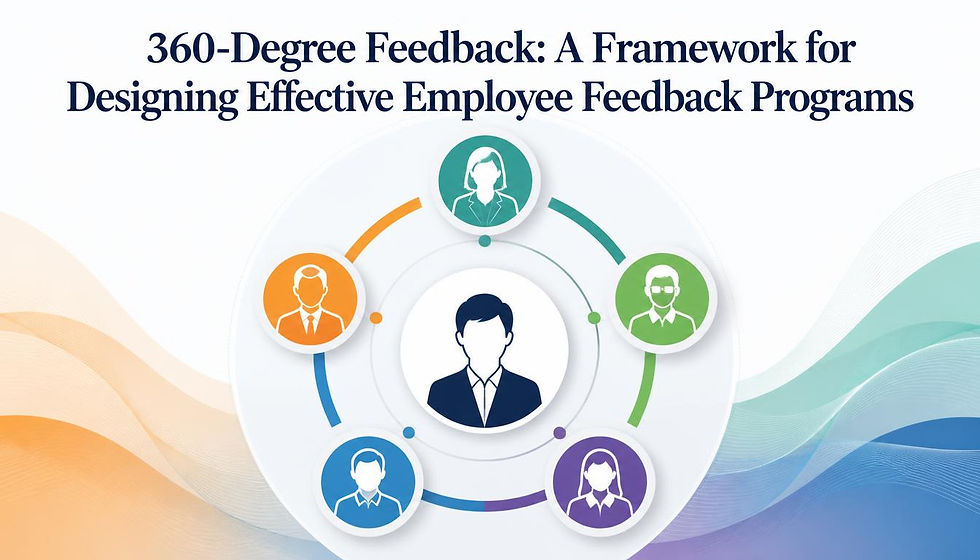
Project Leadership 360-Degree Feedback: A Framework for Assessing Leadership Effectiveness


A project leader’s effectiveness is visible in more than delivery dates, budget variance, and status reports. It also appears in the quality of decisions, the confidence people have in raising risks, the way conflict is handled, and whether teams can coordinate without constant escalation. These behaviors are difficult to assess from a single reporting line. Project leadership 360-degree feedback provides a structured way to compare how a leader’s behavior is experienced by managers, peers, team members, and relevant stakeholders.
The value is not the number of ratings collected. It is whether the feedback reveals actionable differences in how leadership is experienced, and whether the organization can translate those differences into observable changes. A 360-degree process should therefore be designed as a leadership-development system, not as a popularity survey or a substitute for delivery performance evidence.
1. Define the decision the assessment must support
Start by defining why the organization is collecting feedback. A development assessment for an experienced project manager should not automatically use the same rules as a formal performance or promotion decision. Developmental feedback can encourage candor and reflection; employment decisions require stronger controls for consistency, evidence, and procedural fairness. Combining the purposes without explaining the consequences can undermine trust and distort responses.
For project leadership, useful objectives include identifying behaviors that slow decisions, improving stakeholder alignment, strengthening team psychological safety, developing program-level leadership capability, and preparing project managers for larger assignments. Choose a small number of outcomes that matter to the organization, then connect each to observable behavior. “Improve communication” is too broad. “Explain the decision, owner, rationale, and next checkpoint after a material scope change” is assessable.
Before launching, agree who owns the process, who can see identifiable responses, how results will be used, and what happens if feedback raises a concern about misconduct or safety. Explain confidentiality accurately. In small teams, comments may be identifiable even when names are removed, so do not promise absolute anonymity. Set minimum reporting thresholds for small rater groups and establish a route for handling sensitive allegations outside the development report.
2. Assess behaviors that predict effective project leadership
A useful instrument measures behaviors within the leader’s influence, not general impressions or project outcomes that depend on many other factors. Project delivery is shaped by scope stability, sponsor decisions, funding, dependencies, supplier performance, and organizational capacity. A leader may influence these conditions without controlling them. The assessment should capture leadership contribution while separate delivery measures provide context.
Use a concise competency model. Too many dimensions create fatigue and produce a report that is difficult to prioritize. Each competency should have a clear definition, a few behaviorally specific items, and a reason it matters in the project environment.
Competency | Observable behaviors | Useful evidence or follow-up |
Direction and decisions | Clarifies outcomes, trade-offs, decision rights, and escalation thresholds. | Decision cycle time; unresolved decisions; feedback on clarity. |
Stakeholder alignment | Surfaces competing priorities, confirms commitments, and manages expectations early. | Stakeholder commitment reliability; repeated expectation gaps. |
Team leadership | Invites challenge, responds constructively to bad news, and addresses conflict promptly. | Risk escalation patterns; team pulse feedback; issue resolution. |
Delivery governance | Uses proportionate controls, makes risks visible, and follows through on actions. | Aged actions; risk response completion; quality of governance decisions. |
Adaptability and learning | Adjusts plans when evidence changes and captures lessons that alter future work. | Decision reversals with rationale; lessons adopted; response to change. |
The table is a starting model, not a universal scorecard. Tailor the behaviors to the role and context. A delivery lead running a stable infrastructure project may need different emphasis from a transformation director coordinating multiple business units. Validate the instrument with project sponsors, PMO leaders, experienced project managers, and representative team members before using it at scale.
Use a consistent rating scale with behaviorally anchored descriptions. For example, distinguish “rarely demonstrates this behavior,” “demonstrates it inconsistently,” and “demonstrates it reliably in relevant situations.” Include “not enough opportunity to observe” rather than forcing a guess. Add a small number of open-text prompts asking what the leader should continue, change, or do more consistently. Avoid vague questions such as “Is this person a good leader?”
3. Build a credible and balanced rater group
Different rater groups observe different parts of a project leader’s work. A sponsor may see governance, commercial judgment, and escalation quality. Peers may see cross-functional coordination and reliability of commitments. Direct reports may observe delegation, inclusion, coaching, and responses to bad news. The leader’s self-assessment adds a comparison point, but it is not a gold standard against which everyone else is automatically judged.
Select raters based on direct, recent exposure to the behaviors being assessed, not seniority alone. A large number of raters who barely work with the leader can create a misleading appearance of precision. As a practical design choice, seek enough responses in each group to protect confidentiality and interpret patterns, while recognizing that the appropriate minimum depends on team size, risk, and organizational policy. Where a group is too small, combine categories only if the merged group remains meaningful, or report qualitative themes without a separate score.
Set clear nomination rules. The leader can suggest raters, but a neutral process owner should check for coverage and obvious omissions. Consider whether the sample includes people who experienced difficult trade-offs, not only those with a positive relationship. At the same time, do not recruit raters to settle personal disputes. Explain the reference period, expected completion time, confidentiality boundaries, and how to comment on observed behavior rather than personality.
The process should also account for context. A stakeholder who interacted with a leader during one crisis may offer valuable evidence about pressure behavior, but not enough to assess every competency. Ask raters to consider only what they have observed. Treat missing responses as missing data, not as neutral ratings, and avoid comparing scores across leaders when their rater populations and project conditions are materially different.
4. Interpret patterns, not just averages
A 360 report becomes useful when it helps the leader ask better questions. A single overall score can hide differences between rater groups, while a small numerical gap can be overinterpreted. Review the distribution, response count, written comments, role relationships, and the opportunity each group had to observe the behavior. Ratings are evidence to investigate, not a definitive measurement of leadership effectiveness.
Compare self-ratings with other perspectives to identify hypotheses. If a project manager rates stakeholder alignment highly but peers describe late changes and unclear commitments, the gap may indicate a blind spot. It may also reflect different expectations, uneven exposure, or a specific project context. The right next step is to explore examples and patterns, not to label the leader as self-unaware on the basis of one difference.
Look for three types of signal: repeated strengths worth protecting, recurring friction that appears across more than one group, and meaningful differences between groups. The third category is often especially useful. If sponsors see decisive leadership while team members experience abrupt decisions, the leader may be optimizing for speed without explaining the rationale or creating space for challenge. The development opportunity is more precise than “communicate better.”
Treat written comments with discipline. Separate behavior descriptions from assumptions about intent. Group recurring themes without presenting a paraphrase as a verbatim quote. Do not dismiss an uncomfortable theme because only a few comments mention it, but do not generalize from one comment either. If a serious allegation emerges, use the organization’s established investigation or safeguarding process rather than trying to resolve it through a development conversation.
Research on multisource feedback cautions against assuming that the report itself creates improvement. Smither, London, and Reilly’s review of 24 longitudinal studies found that improvement in ratings over time was generally small. Their analysis points to the importance of recipient readiness, belief that change is feasible, appropriate goals, and concrete action. This supports a key design principle: the feedback report is an input to development, not the intervention by itself.
5. Convert feedback into measurable behavior change
A development conversation should end with a short list of priorities, not a long catalogue of every low score. Ask the leader to identify one or two behaviors with the greatest potential effect on team effectiveness or delivery. For each, agree what will change, when the behavior should occur, who can observe it, and how progress will be reviewed. A goal such as “be more collaborative” is hard to test; “invite delivery leads to identify dependencies before approving a baseline change” is more observable.
Use a practical action plan with four elements: the target behavior, the situations in which it should be demonstrated, a source of practice or support, and a review measure. Coaching, peer observation, sponsor feedback, or structured reflection can help, but support should match the development need. If the issue is decision clarity, the leader might trial a standard decision log and ask peers whether ownership and rationale are now clear.
Measure progress at more than one level. At the behavior level, repeat selected questions or gather targeted observations after a suitable interval. At the team level, look for changes in risk escalation, unresolved conflict, decision latency, or repeated rework where those indicators are relevant. At the project level, interpret schedule, cost, quality, and benefits data alongside contextual factors. Do not attribute a change in project performance to the feedback program without considering other causes.
A follow-up pulse can be more useful than repeating a full assessment too soon. Reassessment timing should allow the leader to practice the behavior and for raters to observe it. The organization should evaluate the program itself: completion rates, rater coverage, participant confidence in confidentiality, action-plan completion, observed behavior change, and whether the process informs development decisions. High completion rates alone do not demonstrate impact.
The PMO or leadership development function should own the operating model. Standardize core competencies, instructions, privacy rules, and reporting principles, while allowing role-specific behaviors. Review aggregate themes across cohorts to identify organizational barriers. If multiple project leaders receive feedback about slow decisions, the cause may be unclear governance or overloaded approval forums rather than individual capability alone.
Common failure modes and safeguards
The most common failure is treating 360-degree feedback as an annual administrative exercise. When reports arrive without coaching, time to practice, or sponsor support, participants can become defensive or ignore the findings. Another failure is using scores as a ranking system without controlling for role, project complexity, rater exposure, and organizational context. Ranking can reward popularity or visibility rather than effective leadership.
Technology can simplify distribution, reminders, aggregation, and trend reporting, but it cannot make a weak competency model valid. Automated text analysis should be treated cautiously, especially where comments are sensitive, samples are small, or language is ambiguous. Restrict access to raw comments, set retention rules, and explain how data will be used. A well-governed spreadsheet and a credible facilitated conversation can be more valuable than a sophisticated platform used without a clear purpose.
Finally, do not confuse developmental feedback with formal performance management. Where the organization intends to use results for promotion, compensation, or corrective action, communicate that purpose before collection and use explicit standards with appropriate review and appeal mechanisms. If the primary objective is development, protect that purpose so participants can engage honestly and leaders can act on the findings.
FAQs
How many raters should a project leader have?
There is no universal number. Prioritize relevant observation and sufficient group sizes for confidentiality over a high total. Set minimum reporting thresholds, disclose limitations, and avoid separate group scores when a small sample would make individuals identifiable.
Should 360-degree feedback affect a project manager’s performance rating?
It can inform a broader assessment, but it should not be the sole basis for performance or promotion decisions. Define the purpose in advance, apply consistent standards, and consider delivery evidence, role context, and procedural fairness.
How often should leadership 360-degree feedback be repeated?
Repeat it only after the leader has had time to practice targeted behaviors and raters have had opportunities to observe them. Use interim check-ins for progress, then reassess selected competencies or the full model according to the development cycle.
Conclusion: Project Leadership 360-Degree Feedback: A Framework for Assessing Leadership Effectiveness
A credible project leadership 360-degree feedback framework connects observable behaviors to a clear development purpose, gathers perspectives from people who have actually seen those behaviors, and interprets differences with care. Its strongest contribution is not a composite score. It is a disciplined conversation about how leadership is experienced and what should change.
Over the next two years, organizations are likely to place greater emphasis on linking leadership development data with project delivery and workforce indicators, while applying more scrutiny to privacy and automated analysis. The opportunity is to improve the quality of insight, not to create a single algorithmic leadership score. Programs that preserve context, provide support, and check whether behavior changes are more defensible than those that simply collect more ratings.