
360-Degree Feedback: A Framework for Designing Effective Employee Feedback Programs

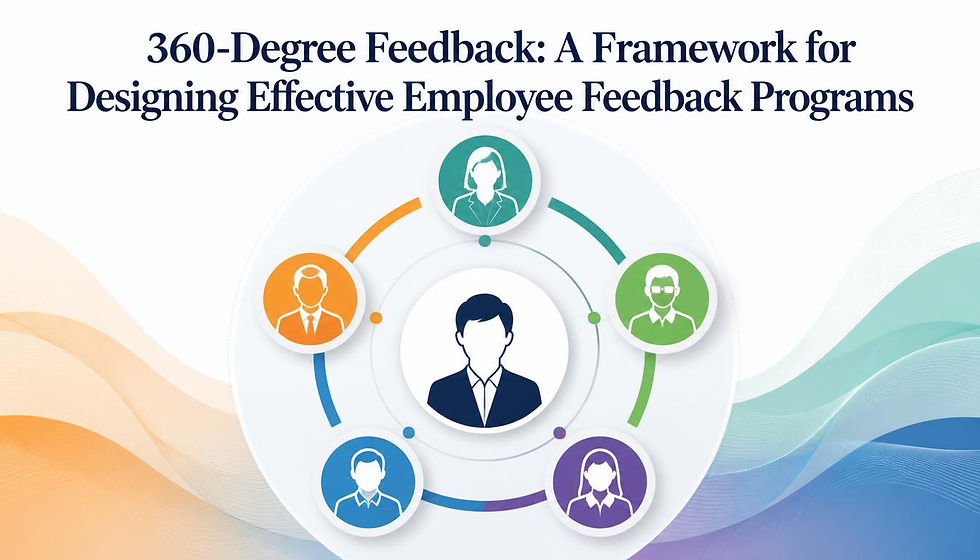
360-degree feedback is most effective when it is treated as a structured development system rather than a questionnaire sent to a group of colleagues. The method gathers observations from multiple people who regularly interact with an employee, then combines those perspectives with the employee's self-assessment to identify patterns in behavior, capability, and development needs.
The value of the approach depends heavily on program design. Poorly defined competencies, inappropriate raters, weak confidentiality controls, vague questions, and inadequate follow-up can turn a sophisticated assessment process into an unreliable collection of opinions. A well-designed program establishes clear purpose, appropriate participation, consistent measurement, and a credible path from feedback to action.
What 360-Degree Feedback Measures
A 360-degree feedback assessment collects observations about an employee from several perspectives rather than relying exclusively on a manager's evaluation. Typical raters may include the employee's manager, peers, direct reports, internal stakeholders, and, where relevant, customers or other external partners.
The central premise is that different working relationships expose different aspects of behavior. A manager may observe prioritization and accountability, while direct reports may have greater visibility into communication, delegation, coaching, or day-to-day leadership behavior.
Self-Assessment and Multi-Rater Perspectives
Most 360-degree processes include a self-assessment completed using the same or closely related competency framework. Comparing self-ratings with ratings from others can identify areas where an employee's perception differs materially from the experience of colleagues.
The discrepancy itself should not automatically be interpreted as evidence that one group is correct. A difference may reflect role visibility, different expectations, limited observation, or genuine variation in behavior across situations.
For example, a project leader might rate communication highly because they provide detailed updates to senior stakeholders. Their team might identify communication as a development area because requirements are less consistently communicated during execution. Both observations could be valid within different parts of the operating environment.
Competencies Must Be Observable
A strong assessment measures behaviors that raters can reasonably observe rather than vague personality characteristics.
"Demonstrates effective stakeholder communication" provides a more useful basis for assessment than "is a strong communicator." The first can be translated into observable behaviors such as clarifying decisions, communicating risks, adapting messages to different audiences, and confirming understanding.
This distinction matters because 360-degree feedback is fundamentally dependent on the quality of the observations available to raters. If employees are being assessed against abstract traits they rarely have an opportunity to observe, the resulting scores can become impressions rather than meaningful assessments.
Designing the Assessment Framework
The competency framework determines what the organization is actually asking employees and raters to evaluate. It should therefore be established before the questionnaire is written, with enough specificity to reflect the organization's operating environment without creating an assessment so large that participants cannot provide thoughtful responses.
A useful framework generally combines a manageable number of competencies with behavioral descriptions. Depending on the role, these might include strategic thinking, collaboration, decision-making, accountability, communication, customer orientation, people leadership, execution, adaptability, and technical or functional expertise.
Align Competencies With the Role
A common design error is applying the same competency model to every employee regardless of responsibility. A senior executive, project manager, software engineering lead, and frontline supervisor may share certain capabilities, but their responsibilities and observable behaviors are not identical.
A core organizational framework can provide consistency, while role-specific competencies capture differences in accountability. This creates a more defensible assessment than attempting to measure every employee against an identical list.
The framework should also reflect what the organization actually values. If strategic decision-making is formally identified as a leadership competency but employees are rewarded primarily for short-term operational output, the assessment may generate feedback that has little connection with actual organizational incentives.
Build Questions Around Behavior
Questionnaire items should describe recognizable behavior and provide enough context for raters to make a reasonable judgment.
Instead of asking whether someone "shows leadership," a questionnaire could assess whether the individual establishes clear priorities, addresses performance issues promptly, creates accountability, or helps others resolve obstacles.
Rating scales also require careful consideration. A numerical scale can provide structure and facilitate comparison, but precision should not be confused with accuracy. A rating of 4 rather than 3 does not necessarily represent a precisely measurable difference in behavior.
Open-ended questions can complement ratings by capturing examples that numerical scores cannot explain. Questions such as "What should this person continue doing?" and "What behavior would make this person more effective?" can produce useful qualitative context when respondents have sufficient knowledge of the employee.
Selecting Raters and Protecting Feedback Quality
Rater selection is one of the most consequential decisions in a 360-degree process because the assessment is only as relevant as the perspectives included in it. Raters should generally have sufficient exposure to the employee's work to make informed observations.
The objective is not to assemble the largest possible group. A carefully selected set of people with meaningful working relationships can provide more useful information than a large group chosen primarily to increase the number of responses.
Rater Groups and Context
Different rater groups reveal different dimensions of performance. Managers may have greater visibility into strategic delivery and organizational accountability. Peers can observe collaboration and cross-functional behavior, while direct reports may see delegation, coaching, and management practices that are less visible to senior leaders.
Organizations should also consider whether certain raters have enough exposure to the relevant behavior. A colleague who interacts with an employee only occasionally may not be in a strong position to assess day-to-day management practices.
Confidentiality is another major design consideration. Organizations frequently aggregate responses from peer or subordinate groups so that individual respondents cannot readily be identified. The precise threshold and reporting rules should be established before data collection begins rather than introduced after potentially sensitive feedback has been received.
Avoid Using 360 Feedback as a Standalone Performance Verdict
A developmental 360 assessment and a formal performance evaluation serve different purposes. Combining them without careful governance can create incentives for raters to provide defensive or politically influenced responses.
If employees believe every comment could affect compensation, promotion, or job security, some participants may become reluctant to provide candid developmental feedback. Conversely, if the process is entirely disconnected from organizational accountability, leaders may struggle to translate the findings into meaningful action.
The appropriate relationship between the two systems depends on organizational purpose. Many programs are designed primarily for development, while formal performance management uses additional evidence such as objectives, business results, role expectations, and manager assessment.
Turning Feedback Into Development Action
A 360-degree report has limited value if it becomes an endpoint. The organizational benefit comes from interpreting the findings, identifying a small number of meaningful priorities, and establishing mechanisms for behavioral change.
Feedback should therefore be reviewed in context rather than treated as a collection of scores. Consistently strong ratings across multiple rater groups can identify established strengths. A repeated development concern across several groups may warrant closer investigation, particularly when it relates directly to role expectations.
Interpreting Patterns Rather Than Isolated Scores
The most useful analysis looks for convergence, divergence, and recurring themes.
Suppose a manager receives strong ratings for technical expertise but weaker ratings for delegation from direct reports. The issue is not necessarily a lack of leadership capability. It could indicate that the manager's technical proficiency has encouraged them to retain work that should increasingly be distributed across the team.
Similarly, a substantial difference between self-ratings and other ratings deserves investigation rather than an automatic judgment. The difference may reveal a blind spot, but it can also reflect differences in role context or limited visibility.
A development plan should normally concentrate on a limited number of priorities. Attempting to correct every moderate rating at once can dilute attention and make behavioral change difficult to sustain.
Connect Feedback to Observable Actions
Development objectives should translate feedback into behaviors that can be observed later.
For example, "improve delegation" is an incomplete objective. A stronger development plan might require the manager to clarify ownership at the beginning of projects, establish decision rights, conduct structured delegation conversations, and review whether work is being returned unnecessarily.
Progress can then be discussed using evidence from subsequent work rather than relying solely on another numerical rating. Coaching, mentoring, targeted training, project assignments, and manager observation can all support the development process.
A repeat 360 assessment can provide another perspective later, but it should not be the only measure of improvement.
Common Failure Points in 360-Degree Programs
Many 360-degree programs fail through design or implementation problems rather than because multi-rater feedback is inherently unsuitable. The most frequent weaknesses involve unclear objectives, poor questionnaire design, inappropriate raters, insufficient preparation, and weak follow-through.
One common problem is excessive questionnaire length. Organizations sometimes attempt to measure every conceivable competency, resulting in participant fatigue and less thoughtful responses. A smaller number of well-defined items can produce a more manageable assessment and make the resulting report easier to interpret.
Another problem is ambiguous purpose. If leaders describe a program as developmental while employees suspect it will be used directly for compensation or promotion decisions, the stated purpose and perceived purpose diverge. That gap can affect participation and trust.
Bias and Interpretation
Multi-rater feedback does not eliminate bias simply because multiple people participate. Raters can be affected by recency, personal relationships, differing standards, limited observation, or broader perceptions of an employee.
Aggregation can reduce the prominence of an individual response, but it does not automatically correct systematic bias shared by a group. For example, a team may have a different interpretation of a competency from senior management.
Training raters to distinguish observable behavior from personal preference can improve the quality of responses. Clear behavioral descriptions also give participants a stronger basis for making judgments.
Feedback Delivery Matters
The presentation of results can influence how employees respond to them. A report containing dozens of scores and comments without interpretation may create defensiveness or confusion rather than development.
For sensitive or leadership-level assessments, facilitated feedback can help employees distinguish between a pattern worth acting on and an isolated comment that requires further context. The facilitator's role should be to help interpret the information without rewriting the feedback to make it more comfortable.
The objective is not to make every result positive. It is to make the information usable.
Measuring Program Effectiveness
Organizations should evaluate the 360-degree process itself rather than assuming that collecting completed questionnaires demonstrates success. Program metrics should examine participation, data quality, development activity, and whether the process remains relevant to organizational needs.
Program Dimension | Useful Measures | What the Measure Can Reveal | Limitation to Consider |
Participation | Completion rate, rater participation by group | Whether the process is operationally accessible and sufficiently populated | High participation does not guarantee high-quality observations |
Assessment quality | Completion patterns, item response consistency, qualitative comment quality | Whether the questionnaire generates usable information | Numerical consistency does not establish validity |
Feedback relevance | Recurring themes, cross-rater patterns, self-other differences | Whether the assessment identifies meaningful areas for discussion | Differences can have legitimate contextual explanations |
Development activity | Development objectives created, coaching or training activity, follow-up reviews | Whether feedback is being converted into action | Activity alone does not prove behavioral improvement |
Behavioral change | Subsequent observations, manager review, repeat assessment themes | Whether targeted behaviors appear to change over time | Changes may be influenced by factors unrelated to the 360 process |
Program governance | Confidentiality issues, complaints, process exceptions | Whether participants trust and understand the system | Low reported problems may also reflect underreporting |
Three observations are particularly significant. First, participation metrics describe the operation of the process, not the quality of the feedback itself. Second, development activity provides evidence that the organization acted on feedback, but completing a training course does not demonstrate changed behavior. Third, repeat assessments can help identify movement over time, but changes should be interpreted alongside role changes, management changes, organizational restructuring, and other contextual factors.
A mature program therefore combines process metrics with qualitative review. Program owners should periodically examine whether the competencies remain relevant, whether participants understand the purpose, and whether managers are equipped to support development after reports are issued.
Choosing the Right Role for 360-Degree Feedback
360-degree feedback is not the appropriate assessment method for every employee, every role, or every organizational decision. Its usefulness increases when the individual has enough meaningful interactions across a network of colleagues for multiple perspectives to add information that a single manager cannot easily provide.
It can be particularly relevant for leadership development, cross-functional roles, people management, professional services, project environments, and positions where influence extends beyond formal reporting relationships.
For highly individual roles with limited observable interaction, a conventional manager assessment, objective-based review, skills assessment, or work-product evaluation may provide more relevant evidence. Similarly, technical proficiency may require domain-specific assessment rather than relying primarily on perceptions from colleagues.
The distinction between methods is therefore important. A 360-degree assessment provides information about how an individual's behavior is experienced by people around them. It does not independently establish whether the person achieved business objectives, possesses technical competence, or should receive a particular employment outcome.
Over the next two years, 360-degree feedback is likely to become increasingly integrated with digital performance-management and talent platforms. Automated reporting, natural-language analysis, workflow integrations, and more continuous feedback mechanisms can reduce administrative effort and help organizations identify recurring themes across large programs.
Those developments also create constraints. AI-assisted interpretation can introduce privacy, data-governance, transparency, and bias considerations, particularly where employee comments are processed automatically. Organizations will need clear rules about what data can be analyzed, how outputs are reviewed, and whether automated interpretations are being used for consequential employment decisions.
The direction of travel is therefore toward more connected feedback systems rather than simply more frequent questionnaires. Whether that produces better development outcomes will depend on assessment quality, organizational trust, managerial follow-through, and the discipline with which feedback data is governed.
FAQ: How often should an organization conduct 360-degree feedback?
There is no universal interval that suits every organization. The appropriate frequency depends on the purpose of the program, the amount of behavioral change expected, and the time required for employees to act on previous feedback. A developmental assessment conducted too frequently may capture limited change and create participant fatigue. Periodic reassessment is generally more useful when enough time has passed for meaningful development activity.
FAQ: Who should provide 360-degree feedback?
Raters should generally be people who have sufficient, relevant exposure to the employee's work. Depending on the role, this may include managers, peers, direct reports, internal stakeholders, customers, or other partners. Selection should be based on the behaviors being assessed rather than simply choosing the largest available group. Raters who cannot reasonably observe a competency should not be expected to provide a meaningful assessment of it.
FAQ: Should 360-degree feedback be used for performance ratings?
It can inform performance discussions, but organizations should distinguish multi-rater developmental feedback from formal performance evaluation. A 360 assessment captures perceptions of behavior from multiple working relationships, while performance management may also require objectives, results, role expectations, and managerial judgment. Combining the systems requires clear governance so participants understand how their responses will be used.
FAQ: What makes a 360-degree feedback program effective?
Effective programs generally have a clearly defined purpose, relevant competencies, observable assessment criteria, appropriate raters, credible confidentiality arrangements, manageable questionnaires, and structured follow-up. The assessment should lead to specific development actions rather than ending with delivery of a report. Program owners should also evaluate the process itself and revise the framework when competencies, organizational structures, or strategic priorities change.
Conclusion: 360-Degree Feedback: A Framework for Designing Effective Employee Feedback Programs
A 360-degree feedback program is fundamentally an information system for understanding how an employee's behavior is experienced across different working relationships. Its usefulness depends less on the number of raters or sophistication of the software than on whether the organization asks the right questions of the right people and creates a credible process for acting on the results.
The strongest programs connect observable competencies with appropriate rater groups, protect the integrity of responses, interpret patterns rather than isolated scores, and translate findings into specific development actions. They also recognize the boundaries of the method. Multi-rater feedback is not a substitute for objective performance measures, technical assessment, or informed managerial judgment.
Over the next two years, greater integration with HR platforms, analytics, continuous feedback tools, and AI-assisted analysis is likely to change how organizations administer and interpret 360-degree assessments. The direction of that development will depend on data governance, employee trust, regulatory expectations, and the ability of organizations to distinguish useful automated analysis from consequential decisions that require human oversight.
Tags: 360-degree feedback, employee feedback, performance management, leadership development, talent management, employee assessment, HR technology


