How Thinking Like a Project Manager Helps Students Succeed in College

There's a specific kind of stress that hits around week eight of the semester. You're not panicking yet, but you can feel it building three things due within five days, a reading you keep pushing back, a vague sense that somewhere along the way you fell behind without noticing when.
Most students know that feeling. What's less obvious is why some people mostly avoid it. They're not necessarily more organized by nature. They've just picked up a way of thinking that project managers use at work. And it maps onto college life better than you'd expect.
Why Project Management Thinking Works for Students
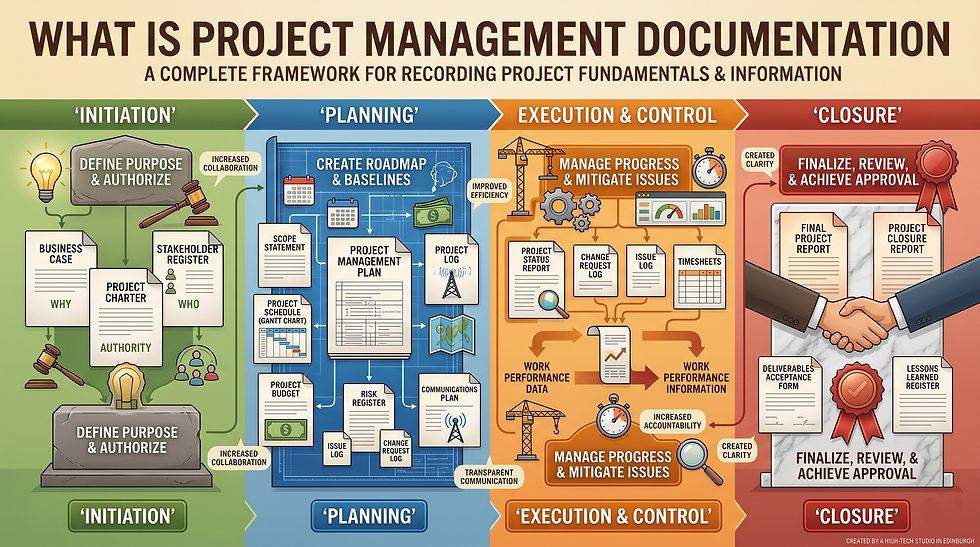
Here's what project management actually is, underneath all the terminology: look at what needs to happen, figure out the order, build in time for things to go sideways, and check in regularly enough to catch problems early.
A college semester fits that almost perfectly. Fixed start, fixed end, multiple things running in parallel, deadlines that don't care how your week went. The students who handle it well are almost always the ones who treated the semester as one connected thing from the beginning not a pile of separate tasks that each demand attention when they get close enough to feel urgent.
Research from the American Psychological Association found that students who set structured, specific goals consistently outperform those who work reactively. Not because they're more motivated because they're less surprised. Having a plan means you already know where you are.
Getting Your Research Foundation Right
One thing that trips people up, and doesn't get much attention, is the gap between time spent studying and how much actually sticks.
A lot of that comes down to research skills knowing how to find sources worth using, how to read critically rather than just accumulating notes, and how to build an actual argument from the material you've gathered. Most students develop this through trial and error over years. But there are ways to shortcut the learning curve. Seeing what rigorous academic work actually looks like in practice is one of them and students who seek out professional literature review writing help often use it less as a crutch and more as a benchmark, a concrete example of how evidence gets organized and how claims get supported. Timely delivery of finished work almost always starts here, at this stage, not at the writing phase the students who know how to research before they write rarely get stuck the same way the others do. It changes the whole shape of the process.
With that foundation in place, the rest of the semester becomes significantly more manageable if you actually plan it.
Building a Semester Plan That Holds Up
The most common version of "planning" in college is checking when things are due. That's not really planning it's just awareness. Planning is figuring out what needs to happen before the deadline to make the deadline real.
At the start of the semester, take fifteen minutes. Pull all the syllabi, write down every major deadline, put everything in one place you'll actually look at. Then work backward for anything significant, break it into pieces small enough to schedule. Not "write the essay." Outline by the 8th. Draft by the 14th. Revisions before the 18th.
Week 1 get the full picture, everything in one place.
Weeks 1–2 turn deadlines into milestones with actual dates attached.
Weeks 3–12 follow the plan, but stay flexible. If you've built two days of buffer into each major deliverable, schedule shifts stay manageable instead of catastrophic.
End of semester ten minutes: what worked, what didn't, what you'd change. The people who do this get noticeably better, fast.
The Skills That Actually Matter
Choosing What to Work on First
Every week will have more on it than you can finish. The students who manage this best aren't doing less they're making better decisions about sequence. What has the most weight for the final grade? What's actually due soonest? Those go first. Most people, left to their own instincts, start with whatever feels least intimidating. That's a reliable way to stay perpetually behind.
Talking to People Before It's a Crisis
In project management, silence is usually the most expensive mistake. Small problems surfaced early stay small. For students this is direct: if you're confused, email the professor now, not the night before. If your group project is off track, say so. Show up to office hours when you're struggling, not after the exam. Students who communicate early tend to have genuinely different relationships with their professors it shows up in ways that aren't immediately obvious.
Assuming Something Will Go Wrong
Not in a pessimistic way. Just building a little margin into everything. Laptops fail. Reading takes longer than you thought. You misread the brief. You get sick for a few days. None of these need to be disasters. They become disasters when there's no slack left in the system. Starting a couple days earlier than feels necessary is usually enough.
Tracking Time Honestly
Most people have a working theory about where their time goes. Most are at least partly wrong. Try logging it for a week not what you planned to do, what you actually did. Almost everyone finds more available time than they assumed, and a few specific places it quietly disappears.
A Few Tools Worth Keeping Simple
Productivity tools have a high abandonment rate. The ones that last tend to be the ones that don't require much maintenance:
● Kanban board Trello or Notion, three columns: to do, in progress, done. Moving things to done gives a small hit of satisfaction that turns out to matter.
● A Sunday review fifteen minutes, once a week. Look at what's coming, flag anything that needs attention, pick one clear priority for Monday. That's it.
● One deadline calendar every major due date in a single view. Not across emails and syllabi and notes one place.
● The two-minute rule anything that takes under two minutes, do it immediately. Small undone tasks accumulate into background noise that's heavier than the tasks themselves.
● A check-in every two weeks are you ahead, on pace, or drifting? Catching drift at two weeks is easy. Catching it at twelve is not.
Consistency Compounds
Any habit practiced once changes nothing. Practiced across a full semester, even loosely, it compounds. Students who do basic weekly planning stop being ambushed by things they could have seen coming which is, genuinely, most of what "staying on top of things" actually means.
What It Feels Like When It's Working
There's a real difference between a semester that feels like constant damage control and one where you mostly know where you stand. The second version leaves room for things that don't fit on a to-do list the conversations, the detours, the parts that tend to matter most in retrospect.
Students who build these habits also show up differently when they enter the workforce. Not because they learned vocabulary, but because they spent four years getting comfortable with complexity managing multiple things at once, communicating when it's uncomfortable, following through without someone checking on them. Those skills are hard to develop later.
Before You Close This Tab
You don't need a system. You need a habit or two that you actually use. Map the semester in week one. Break the big things into milestones. Check in on yourself regularly. That's most of it.
What changes when you do this consistently isn't dramatic. It's just that the bad surprises get rarer. And that, more than anything, is what gives you room to actually be present for the rest of it.
The way you learn to work here is the way you'll work. Worth being a little intentional about it.