Business Readiness vs. Technical Readiness: Key Differences, Assessment Criteria, and Implementation Risks

A technology implementation can pass every system test and still fail to deliver its intended business outcome. The platform may be stable, integrations may work, and security controls may be verified, yet employees may lack the capacity to adopt new processes, managers may not agree on ownership, or operational teams may be unprepared to support the change. The reverse is also possible: leaders and users may be ready, but the technology may be unreliable, insecure, or unable to meet a critical requirement.
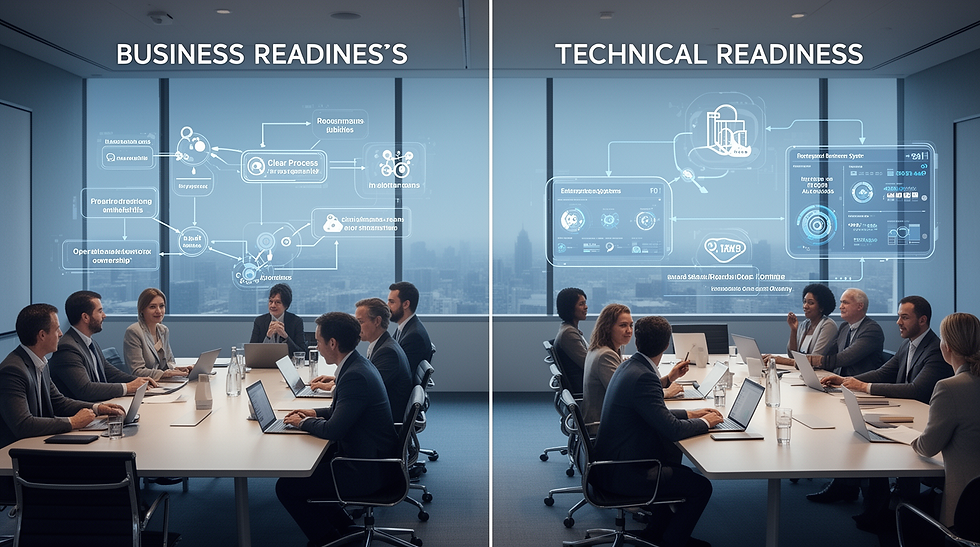
Business readiness vs. technical readiness are related but distinct judgments. Business readiness asks whether the organization can absorb, operate, and sustain the change while achieving its intended outcomes. Technical readiness asks whether the solution and its supporting technology are sufficiently complete, secure, integrated, tested, and supportable for the intended use. Treating them as separate evidence-based workstreams makes go-live decisions more credible and exposes risks that a single readiness score can hide.
Why Business Readiness and Technical Readiness Must Be Separated
The distinction is not that business readiness belongs to people and technical readiness belongs to IT. Both cross organizational boundaries. Business readiness includes process design, decision rights, staffing, training, operational controls, and benefit ownership. Technical readiness includes architecture, data, integration, security, performance, recoverability, and support tooling. The two intersect wherever a technical capability must enable a business activity.
For example, a new customer relationship management system might pass functional and performance testing. That is evidence of technical readiness, not proof that sales teams have agreed on lead definitions, data ownership, approval rules, training coverage, or how pipeline quality will be measured. Equally, a business unit can approve new workflows and train users while an unresolved interface defect prevents orders from reaching the fulfillment platform. Neither workstream can compensate for a critical failure in the other.
A useful readiness decision therefore asks three questions: can the solution work in its target environment, can the organization use and operate it as designed, and are the remaining risks acceptable to an explicitly accountable decision-maker? These questions should be assessed independently before their implications are combined into a release recommendation.
Business Readiness: Assessment Criteria
Business readiness measures the organization’s ability to transition to the future state and sustain the expected outcomes. It should be assessed against the actual changes in roles, processes, customer or employee experience, controls, and service delivery, rather than through a generic survey alone.
Leadership and accountability. The executive sponsor, process owners, and operational leaders should understand the intended outcomes, make timely decisions, resolve cross-functional conflicts, and accept responsibility for the new operating model. A named benefit owner should be accountable for measuring whether expected value is realized after implementation.
People, skills, and capacity. Identify affected groups, the skills they need, training completion, time available for practice, coverage for absences, and any capacity conflict with business-as-usual work. Attendance at training is not sufficient evidence by itself. Where possible, test whether users can perform representative tasks and know where to get help.
Processes and operating model. Confirm that future-state procedures, roles, escalation paths, policies, handoffs, and controls are documented and approved. Check whether teams can complete end-to-end work, including exceptions and high-volume periods. A locally optimized process may still fail if upstream or downstream teams have not changed their practices.
Stakeholder acceptance and communications. Determine whether affected teams understand what is changing, why it is changing, when it will happen, and what is expected of them. Use interviews, workshops, observed behavior, and targeted surveys to identify practical concerns. Do not treat a positive average survey score as proof that every critical role is prepared.
Operational continuity and benefits. Confirm support coverage, service ownership, supplier arrangements, updated performance measures, business continuity procedures, and a realistic plan for tracking benefits. Readiness is incomplete if the project can switch on the solution but cannot maintain service or establish whether the investment has produced the intended result.
Technical Readiness: Assessment Criteria
Technical readiness evaluates whether the solution is fit for its specified purpose in the target operating environment. The criteria depend on the implementation, but should be testable and traceable to requirements, architecture decisions, operational needs, and risk controls.
Functional and nonfunctional performance. Evidence should show that critical requirements have passed agreed tests, material defects have been resolved or formally accepted, and performance, availability, scalability, and resilience meet defined thresholds. A high pass rate can be misleading if the failed tests concern a critical customer journey or regulatory control.
Integration and data. Verify end-to-end interfaces, data mappings, migration completeness, reconciliation, data quality, ownership, and error handling. Test realistic volumes and failure conditions, not only successful transactions. Establish how data will be corrected and reconciled if the migration or integration produces inconsistent results.
Security, privacy, and compliance. Confirm access controls, privileged access, logging, vulnerability remediation, data protection requirements, retention, and applicable compliance obligations. The relevant security or risk owner should explicitly accept any residual exposure. A security checklist marked complete is not a substitute for evidence that controls operate as intended.
Deployment, recovery, and supportability. Validate the release procedure, configuration, monitoring, alerting, backups, recovery objectives, rollback or contingency options, and incident ownership. Confirm that the service desk and technical support teams have runbooks, access, diagnostics, escalation contacts, and knowledge of known limitations.
Environment and dependencies. Check infrastructure capacity, licenses, network paths, certificates, vendor readiness, third-party dependencies, and configuration differences between test and production. Technical readiness can deteriorate after testing if the release environment changes or a dependency is upgraded without regression checks.
How to Assess Both Types of Readiness
Start by defining the scope of the change and the decision the assessment must support. Readiness is not an abstract rating of the organization or technology. It is a judgment about whether specific capabilities are sufficient for a defined deployment, user group, operating context, and level of risk.
Translate the scope into evidence-based criteria. For each criterion, name an accountable owner, the evidence required, the date it must be current, the threshold for acceptance, and the action if it fails. Evidence might include test results, reconciliations, approved procedures, observed task performance, support rota confirmation, or signed risk acceptance. Record missing evidence as unknown, not as a pass.
The table below separates the two assessment lenses and shows the kind of evidence that supports a defensible decision.
Business Readiness vs. Technical Readiness Assessment Matrix
Assessment area | Business readiness evidence | Technical readiness evidence | Typical warning sign |
Ownership and governance | Named process and benefit owners; decisions and escalations agreed | Technical service owner; architecture and operational approvals recorded | Teams assume another group owns unresolved issues |
People and operations | Role-based training, task demonstrations, support coverage, approved procedures | Service desk access, runbooks, monitoring, incident and recovery rehearsals | Users or support staff cannot perform critical tasks |
Process and data | Future-state workflows, controls, exception handling, data accountability | Migration reconciliation, interface tests, validation and error handling | Transactions work technically but produce incorrect business outcomes |
Risk and compliance | Business impact understood; control owners and contingency actions confirmed | Security testing, access reviews, resilience tests, vulnerabilities dispositioned | Critical risks are accepted informally or have no owner |
Go-live and sustainability | Cutover communications, adoption measures, benefit tracking, continuity plan | Deployment rehearsal, rollback or recovery path, capacity and stability evidence | Launch is possible, but recovery or post-launch ownership is unclear |
Three observations follow from this matrix. First, a readiness label is only as strong as the evidence behind it. Second, shared areas such as data and support need both a business owner and a technical owner because their failure modes differ. Third, an unresolved issue should be judged by consequence, not simply counted alongside minor defects.
Use a simple rating scale if it helps comparison, but define the meaning of each rating. For example, green can mean the agreed evidence is complete and the acceptance threshold is met; amber can mean a bounded gap has an owner, mitigation, deadline, and explicit approval; red can mean a critical requirement is unmet or the risk is outside agreed tolerance. Do not average a red critical control into an apparently acceptable overall score.
Reassess at meaningful milestones and after material changes. A readiness review performed weeks before cutover may become stale if a key supplier changes an interface, a migration rehearsal fails, a senior process owner leaves, or training coverage drops. The assessment should be a living decision record, not a one-time compliance exercise.
Implementation Risks and Go/No-Go Decisions
The most damaging readiness failures occur when organizations mistake progress for preparedness. A project can be on schedule while important operating decisions remain unresolved; a test report can look strong while the test scope excludes a critical dependency. Readiness reviews should make these gaps visible before the cost of correction rises.
Common risks include late discovery of process ownership gaps, inadequate user capacity, poor data quality, incomplete security remediation, supplier dependencies, unsupported workarounds, and recovery plans that have never been rehearsed. Another risk is decision ambiguity: teams may report a gap, but no one has authority to accept the exposure or stop the release.
Set non-negotiable go-live criteria for critical controls, customer-impacting journeys, data integrity, legal obligations, and recoverability. Define which lower-severity issues may be accepted, by whom, and under what conditions. An amber rating should never be a vague compromise. It should specify the affected capability, business consequence, mitigation, owner, deadline, monitoring method, and contingency if the mitigation fails.
The final decision should combine business and technical evidence without collapsing them into one score. A go decision means the required capabilities are ready and residual risks are within approved tolerance. A conditional go should be used only when the conditions are explicit, enforceable, and monitored. A no-go is appropriate when a critical requirement is unmet, evidence is unreliable, or the organization cannot safely operate or recover from the change.
If readiness is insufficient, the response should be targeted rather than ceremonial. Assign remediation to an accountable owner, fund the work, define completion evidence, and set a reassessment date. If the gap cannot be closed in time, consider reducing deployment scope, staging the rollout, extending a parallel run, or delaying cutover. The schedule is a constraint to manage, not evidence that the organization is ready.
FAQs
Can a project be technically ready but not business ready?
Yes. The system may pass technical tests while users lack training, operational procedures remain incomplete, or process owners have not agreed how work will be handled. Those gaps can prevent adoption and benefits realization.
Who should own the readiness assessment?
The project manager coordinates the assessment, but business process owners, technical leads, operations, security, change leaders, and the sponsor own evidence within their domains. The designated governance authority makes the go/no-go decision.
Should business and technical readiness use one score?
They can be summarized on one dashboard, but should retain separate ratings and evidence. A combined average can conceal a critical technical defect or an organizational gap that makes safe adoption impossible.
Conclusion: Business Readiness vs. Technical Readiness: Key Differences, Assessment Criteria, and Implementation Risks
Business readiness and technical readiness answer different questions about the same change. One tests whether the organization can adopt, operate, and sustain the new capability; the other tests whether the solution works securely and reliably in its intended environment. Both must be assessed against defined criteria, supported by current evidence, and linked to named owners and explicit risk decisions.
The strongest implementation governance keeps the assessments distinct, coordinates shared dependencies, and prevents schedule pressure from replacing evidence. When a gap remains, leaders should understand its consequence, decide whether it is acceptable, and fund a credible response. This approach will not remove all implementation uncertainty, but it makes readiness decisions more transparent and reduces the likelihood that a successful deployment is mistaken for a successful business change.