Solutions Architect Job Description: A Detailed Guide

Updated: 19 hours ago
In the golden age of monolithic software, building an enterprise system was like constructing a castle. You bought a massive server, installed a single Oracle database, and built a fortress around it. It was rigid, expensive, and relatively simple to diagram.
Today, building an enterprise system is like designing a living city. It involves orchestrating thousands of microservices, connecting multi-cloud environments (AWS, Azure, and On-Premise), integrating third-party APIs (Stripe, Twilio), and ensuring that data flows securely through a mesh of ephemeral containers managed by Kubernetes.
In this chaotic, high-velocity landscape, a critical role has emerged to bring order to the madness. This is the role of the Solutions Architect (SA).
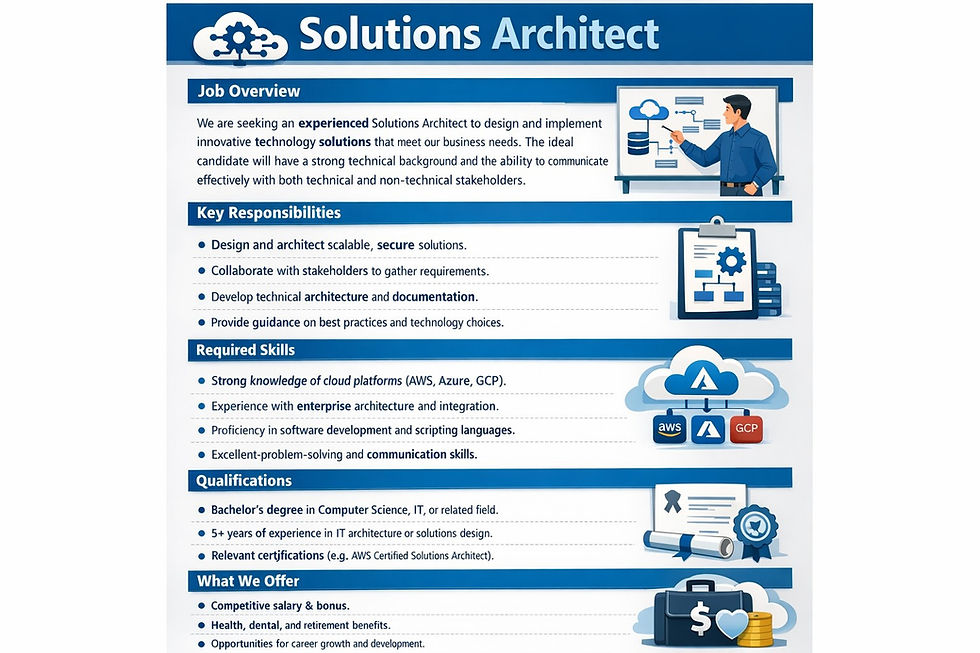
For the modern enterprise, the Solutions Architect is not just a "senior developer." They are the strategic diplomat who translates the abstract vision of the C-Suite ("We need to launch in Asia by Q3") into the concrete technical blueprint that Engineering can execute ("We need a multi-region sharded database with a CDN edge layer"). They are the guardians of technical feasibility and the architects of long-term scalability.
This guide provides a definitive analysis of the Solutions Architect career path. We will dissect the nuances between Pre-Sales and Post-Sales roles, explore the difference between an SA and an Enterprise Architect, and detail the technical and soft skills required to command the high six-figure salaries associated with this profession.
The Strategic Necessity: Why SAs Exist
To understand the job, one must understand the "Translation Gap."
The Business Stakeholder speaks the language of Outcome: Revenue, Time-to-Market, Customer Retention, ROI.
The Engineering Team speaks the language of Implementation: Latency, Throughput, API Schema, ACID Compliance.
Without a Solutions Architect, these two groups talk past each other. The Business asks for "Real-time personalization," and Engineering builds a massive, expensive data pipeline that takes two years to deploy. The SA steps in to mediate. They analyze the business requirement ("We just need to show the user's name and last purchase") and design a "Right-Sized" technical solution that balances cost, speed, and quality.
The "Buy vs. Build" Decision
One of the most strategic responsibilities of the SA is guiding the "Buy vs. Build" decision.
Scenario: Marketing wants a new email engine.
Engineer Instinct: "I can build that in Python in a weekend."
SA Strategic View: "Yes, but you will have to maintain it forever. It will distract us from our core product. We should buy SendGrid (SaaS) and integrate it."
The SA prevents the organization from accruing "Technical Debt" by stopping engineers from reinventing the wheel.
The Two Worlds: Pre-Sales vs. Post-Sales
The title "Solutions Architect" is used in two very different contexts. Candidates must understand which world they are entering, as the daily life and compensation structures differ wildly.
1. The Pre-Sales Solutions Architect (Sales Engineer)
The Environment: Vendor-side (e.g., working for AWS, Salesforce, Databricks).
The Goal: To win the deal.
The Role: You accompany the Sales Rep to meetings with prospective clients. The Sales Rep talks about pricing; you talk to the client's CTO. You prove that your software can solve their problem. You build "Proof of Concepts" (POCs) and give technical demos.
The Vibe: High energy, competitive, commission-based compensation. You are the "Technical Closer."
2. The Post-Sales / Internal Solutions Architect
The Environment: Client-side (e.g., working for a Bank, a Retailer, or a Consulting firm).
The Goal: To deliver the project.
The Role: Once the contract is signed (or the internal initiative is approved), you own the design. You draw the diagrams. You select the specific database technologies. You stay with the project for 6-12 months to ensure the developers don't deviate from the vision.
The Vibe: Deep focus, operational responsibility, salary-based compensation. You are the "Technical owner."
SA vs. Enterprise Architect vs. Tech Lead
Confusion often exists regarding how the SA fits into the technical hierarchy.
Enterprise Architect (EA):
Scope: The entire organization. 5-year horizon.
Focus: Standardization. "All teams must use Java." "We are moving to the Cloud."
Analogy: The City Planner who decides where the roads and power lines go.
Solutions Architect (SA):
Scope: A specific business problem or product line. 6-18 month horizon.
Focus: Solution Design. "For the new Mobile App, we will use React Native and Firebase."
Analogy: The Architect who designs a specific skyscraper within the city.
Technical Lead / Engineering Manager:
Scope: The code and the team. 2-week Sprint horizon.
Focus: Implementation quality. "Is this function efficient?" "Is the code readable?"
Analogy: The Foreman who manages the construction crew building the skyscraper.
Core Responsibilities: The Anatomy of the Job
The daily deliverables of an SA are rarely lines of code. They are Artifacts of Alignment.
1. Architectural Diagramming
The SA's primary weapon is the whiteboard (or Lucidchart/Visio). They must be able to visualize complex systems.
C4 Model: A standard approach to diagramming.
Level 1 (Context): How the system fits into the world.
Level 2 (Containers): The applications and databases.
Level 3 (Components): The internal structure of the apps.
The Strategic Value: A good diagram reveals bottlenecks. "Look, all traffic is hitting this single load balancer. That is a single point of failure."
2. Non-Functional Requirements (NFR) Definition
Business users define "Functional Requirements" (The button must work). The SA defines the "Non-Functional Requirements" (The button must work for 1 million users at once).
Scalability: Can it handle Black Friday traffic?
Reliability: If AWS US-East goes down, does the system fail over to US-West?
Security: Is the PII encrypted at rest and in transit?
Observability: How will we know if it breaks?
3. Stakeholder Negotiation
The SA is often the "bad guy" who has to tell the Business "No."
Scenario: Product Management wants "Zero Latency."
SA Response: "Zero latency violates the laws of physics. We can give you 50ms latency for $10k/month, or 10ms latency for $100k/month. Which do you want?"
This is the art of Trade-off Analysis.
4. The Cloud "Well-Architected" Review
For SAs working in the cloud, the bible is the Well-Architected Framework (AWS/Azure). The SA constantly reviews the infrastructure against five pillars:
Operational Excellence
Security
Reliability
Performance Efficiency
Cost Optimization
The Skill Set: The "T-Shaped" Professional
A great Solutions Architect typically has 10+ years of experience. They usually start as software engineers or sysadmins and evolve.
The "Horizontal" Bar (Breadth)
You need to know a little bit about everything.
Networking: DNS, CIDR blocks, Subnets, Firewalls. You need to know why the database can't talk to the web server.
Database Theory: SQL vs. NoSQL. ACID vs. BASE consistency models. When to use Redis vs. Postgres.
DevOps: CI/CD pipelines, Docker, Kubernetes. You don't need to write the Helm charts, but you need to know how the deployment flow works.
Security: OAuth2, SAML, Encryption standards.
The "Vertical" Bar (Depth)
You usually have one area of deep specialization.
Example: "I am an SA who specializes in Data & Analytics." (Deep knowledge of Snowflake, Spark, Kafka).
Example: "I am an SA who specializes in Mobile Architecture." (Deep knowledge of iOS/Android constraints, offline syncing).
The "Soft" Skills (The Differentiator)
Technical Storytelling: Can you explain "Eventual Consistency" to a CEO using an analogy about a coffee shop? If you can't, you will fail to get budget approval.
Empathy: Understanding the pain of the developers who have to build your design, and the pain of the users who have to use it.
Methodologies: TOGAF vs. Agile Architecture
How does an SA actually structure their work? There is a generational divide in methodologies.
The "Old School": TOGAF (The Open Group Architecture Framework)
Process: Heavy documentation. Detailed definitions of Business, Data, Application, and Technology architectures.
Use Case: Massive government projects or banking transformations where compliance is king.
Criticism: Too slow. "Waterfall Architecture."
The "New School": Agile Architecture
Process: "Just Enough Architecture." The SA draws the high-level boundaries but leaves the internal implementation details to the dev teams.
Philosophy: "The architecture evolves." The SA is embedded in the Scrum team, making micro-decisions every sprint rather than handing down a massive document at the start.
The Tech Stack: Tools of the Trade
If you walk by an SA's desk (or look at their second monitor), you will see:
Diagramming: Lucidchart, Miro, Microsoft Visio, Draw.io.
Cloud Consoles: AWS Management Console, Azure Portal (SA's spend 30% of their life here).
Documentation: Confluence, Notion. The SA is the "Scribe" of the system.
Modeling: ArchiMate (for formal enterprise modeling).
Career Path: Climbing the Technical Ladder
The Solutions Architect role is one of the few paths in tech where you can earn executive-level compensation without managing people.
Level 1: Associate Solutions Architect
Experience: 2-5 years.
Role: Supports a Senior SA. Builds simple POCs. Focuses on learning the cloud platform.
Level 2: Solutions Architect
Experience: 5-10 years.
Role: Owns small to medium projects independently. Handles standard client interactions.
Level 3: Senior Solutions Architect
Experience: 10-15 years.
Role: Owns the largest, most complex accounts or products. Mentors juniors. Often speaks at conferences.
Level 4: Principal Solutions Architect
Experience: 15+ years.
Role: Strategic thought leader. Defines the "Best Practices" for the entire company. Interfaces with the C-Suite.
Compensation: Can exceed $300k - $400k in major tech hubs.
Exit Opportunities:
CTO (Chief Technology Officer): For smaller companies.
Chief Architect: For large enterprises.
Product Management Leadership: Moving from "How" to "What."
Hiring an SA: The Interview Gauntlet
If you are interviewing for an SA role, expect the "Whiteboard Challenge."
The Prompt: "Design a URL shortening service like TinyURL."
What They Are Testing: They don't care about the code. They care about the questions you ask.
Bad Candidate: Immediately starts drawing a database.
Good Candidate: Asks "How many users?" "Is it read-heavy or write-heavy?" "Do we need analytics?" "What is the budget?"
The Trap: They will throw a curveball. "Okay, now traffic spikes by 100x. What breaks first?" You must be able to identify the bottleneck (e.g., the database write lock) and propose a solution (e.g., sharding or caching).
Conclusion: The Designer of the Digital World
The Solutions Architect is the urban planner of the digital economy. As enterprises continue their migration to the cloud and begin to integrate AI into their core operations, the complexity of the landscape will only increase.
The demand for professionals who can stand in the chaos, see the patterns, and draw a clear path forward is insatiable. It is a role that demands a relentless hunger for learning because the technology you architected yesterday might be obsolete tomorrow. But for those who love the puzzle of systems thinking, there is no more rewarding career. You are not just writing code; you are designing the future.
Tags:
Solutions Architect, Sales Engineer, Enterprise Architecture, Cloud Computing, AWS Careers, System Design, Tech Careers, Software Architecture, TOGAF, Agile Architecture