
Work Breakdown vs Project Plan: A Complete Guide for Project Managers

Work Breakdown Structures and Project Plans are two of the most important tools in modern project management. They help organizations plan effectively, coordinate large teams, manage complex deliverables, establish clarity, allocate resources, control risk, and deliver successful outcomes. Although both are used together, they serve very different purposes. Many project teams confuse them, mix them up, or use them incorrectly, which leads to misalignment, unclear expectations, unrealistic timelines, rework, and inefficient delivery across the organization.
In enterprise environments where projects span multiple teams, functions, vendors, and geographies, the ability to understand the difference between a Work Breakdown Structure and a Project Plan is essential. The Work Breakdown Structure provides the structural blueprint of the work, while the Project Plan provides the roadmap for how that work will be executed. When used correctly, both tools complement each other and create a strong project foundation.
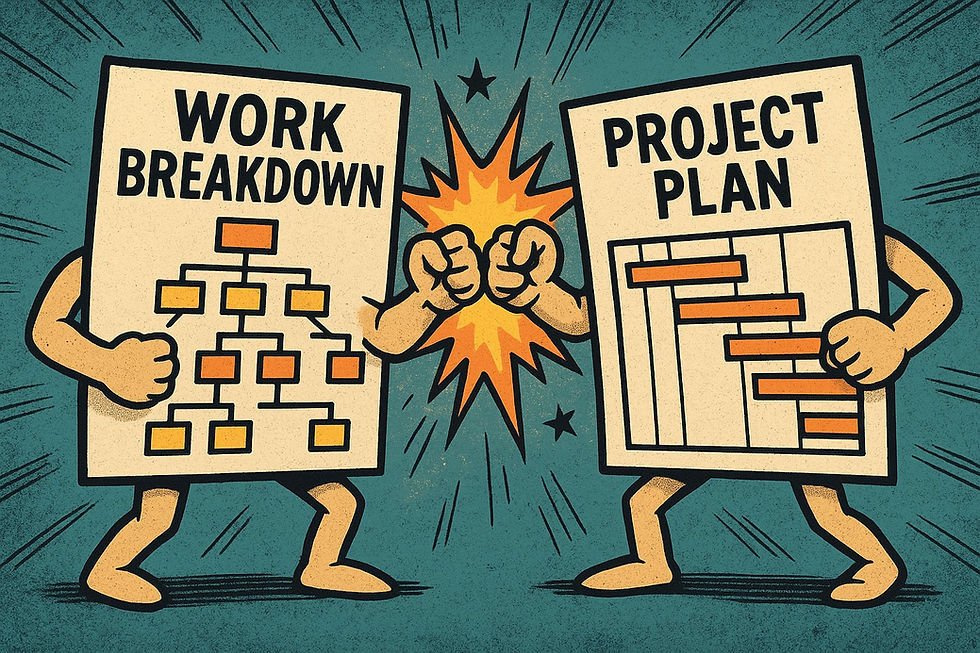
This comprehensive enterprise guide explores Work Breakdown vs Project Plan in depth. It explains what each tool is, how they differ, how they work together, why organizations need both, what mistakes to avoid, how to build them, and how they support governance, scheduling, resourcing, and delivery. This guide is written for project managers, PMO leaders, transformation teams, portfolio managers, business analysts, and executives responsible for delivering strategic projects at scale.
What a Work Breakdown Structure Is
A Work Breakdown Structure is a hierarchical decomposition of project work. It breaks the total scope of the project into manageable parts called work packages. The Work Breakdown Structure does not describe schedule, sequencing, dates, or resource allocation. It describes the structure of the work itself.
Key Characteristics of a Work Breakdown Structure
Focuses on deliverables, outputs, and work products
Uses a hierarchical structure
Decomposes work into smaller components
Ends at the work package level
Provides scope clarity
Forms the foundation for cost, schedule, and resource planning
Does not contain dates or timelines
Uses a standardized numbering structure
The Work Breakdown Structure is a scope management tool, not a scheduling tool.
What Is a Project Plan
A Project Plan describes how the project will be executed. It contains schedule, milestones, sequencing, task dependencies, resources, risks, and a governance model. The Project Plan is the tactical roadmap for delivery.
Key Characteristics of a Project Plan
Contains scheduling information
Defines sequencing, dependencies, and timelines
Assigns resources to tasks
Includes risks, issues, and constraints
Tracks progress over time
Updates dynamically during delivery
Aligns stakeholders on how the project will operate
Serves as the central management document for execution
The Project Plan answers how and when the work will be done.
Work Breakdown vs Project Plan: The Core Difference
Although both tools are essential, they serve different purposes.
The Work Breakdown Structure Defines Scope
It answers what must be delivered.
The Project Plan Defines Execution
It answers how and when the work will be completed.
Simple Summary
Work Breakdown Structure equals scope definition
Project Plan equals execution roadmap
Understanding this distinction helps teams avoid rework and misalignment.
Why Organizations Need Both
Large organizations delivering complex projects require both documents for several reasons.
Clarity of Scope
The Work Breakdown Structure ensures that everyone understands what must be delivered.
Structure for Planning
The Project Plan relies on the Work Breakdown Structure to estimate effort and schedule.
Accountability
Clear work packages and scheduled tasks assign ownership.
Risk Reduction
Misunderstood scope creates risk. The Work Breakdown Structure prevents scope gaps.
Stakeholder Alignment
The Project Plan ensures agreement on timelines and expectations.
Stronger Governance
Both tools support governance reviews and status reporting.
Using both tools ensures no ambiguity in project planning.
Components of a Work Breakdown Structure
A Work Breakdown Structure consists of the following elements.
Levels of Hierarchy
Each level represents a more detailed version of the work.
Deliverables
Work is broken down into deliverables, not activities.
Work Packages
The lowest level of the Work Breakdown Structure that can be scheduled and assigned.
Numbering System
Each Work Breakdown Structure item is given a unique identifier.
Scope Baseline
The Work Breakdown Structure forms part of the official scope baseline.
Work Breakdown Structures must use a deliverable based structure, not a task based structure.
Components of a Project Plan
A Project Plan contains many different components depending on the complexity of the project.
Schedule
Includes timeline, sequence, and dependencies.
Milestones
Major events that mark progress.
Resource Plan
Allocates people, skills, and capacity.
Communications Plan
Defines how stakeholders will be kept informed.
Risk Register
Tracks risks and mitigation strategies.
Issue Log
Tracks active issues requiring resolution.
Budget Plan
Identifies cost estimates and funding requirements.
Quality Plan
Outlines quality standards and assurance activities.
The Project Plan is a multi dimensional management document.
Work Breakdown vs Project Plan: Real Examples
Example of a Work Breakdown Structure
A software development project might have:
Requirements
Design
Development
Testing
Deployment
Training
Each item is decomposed into sub deliverables and then work packages.
Example of a Project Plan
A software development plan might include:
Dependency mapping
Sequencing requirements
Sprint planning
Testing cycles
UAT scheduling
Deployment weekend planning
Resource allocation per sprint
Risk management activities
The Work Breakdown Structure provides the “what,” and the Project Plan provides the “how.”
Benefits of Creating a Work Breakdown Structure
Creating a Work Breakdown Structure brings several enterprise level benefits.
Clear Scope Definition
Teams know exactly what must be delivered.
Reduced Rework
Ambiguity decreases errors and rework.
Improved Cost Estimation
Costs are based on clear deliverables.
Stronger Governance
Executives can review scope efficiently.
Better Quality Management
Quality checks align with deliverables.
Enhanced Communication
Stakeholders understand the project structure.
A Work Breakdown Structure is essential for strong scope management.
Benefits of Creating a Project Plan
A well developed Project Plan brings multiple operational and strategic benefits.
Predictable Delivery
The plan outlines how work will happen.
Resource Efficiency
Optimizes staff allocation.
Better Risk Management
Identifies sequencing and dependency risks.
Stakeholder Confidence
Executives and teams trust the plan.
Faster Decision Making
Clear steps support timely action.
Clear Accountability
Everyone knows what they are responsible for.
The Project Plan ensures controlled and predictable project execution.
How the Work Breakdown Structure Supports the Project Plan
The Work Breakdown Structure is created before the Project Plan. It provides the structure used to build the detailed plan.
The Project Plan Uses the Work Breakdown Structure For:
Estimating duration
Sequencing tasks
Assigning resources
Identifying dependencies
Building networks
Creating Gantt charts
A strong Work Breakdown Structure significantly improves the quality of the Project Plan.
How to Build a Strong Work Breakdown Structure
A strong Work Breakdown Structure follows these principles.
Start With Major Deliverables
Begin with large components such as phases or major outputs.
Use a Deliverable Based Structure
Focus on results, not actions.
Decompose Logically
Break down deliverables until they are manageable.
Avoid Microtasks
Overly detailed Work Breakdown Structures confuse teams.
Ensure 100 Percent Rule
The Work Breakdown Structure must represent all project work.
Validate With Stakeholders
Confirm coverage with project teams and sponsors.
A well built Work Breakdown Structure is the foundation of strong project management.
How to Build a Strong Project Plan
A strong Project Plan is built after the Work Breakdown Structure.
Identify Task Dependencies
Work cannot be scheduled without understanding dependencies.
Estimate Duration Accurately
Use expert judgment, historical data, and estimation techniques.
Sequence Tasks
Create the logical flow of work.
Assign Resources
Assign people, tools, and budget to tasks.
Build the Timeline
Use scheduling tools to create a Gantt chart or network diagram.
Add Risks and Mitigations
Integrate risk management into the plan.
Add Milestones
Key checkpoints keep the project aligned.
A strong Project Plan supports successful execution.
Work Breakdown vs Project Plan in Agile Projects
Agile uses different terminology, but the concepts still apply.
Agile Work Breakdown Structure Equivalent
Epics
Features
User stories
Agile Project Plan Equivalent
Sprint plans
Release roadmaps
Backlog prioritization
Iteration plans
Even in Agile, the Work Breakdown Structure defines what, and the plan defines how.
Governance Differences Between Work Breakdown vs Project Plan
Each document supports different governance functions.
Work Breakdown Structure in Governance
Used for scope baseline approvals
Supports change control
Used in stage gate reviews
Provides clarity for contract agreements
Project Plan in Governance
Used in steering committee updates
Supports monthly reporting
Tracks milestones and progress
Highlights risks and issues
Governance requires both tools for effective oversight.
Common Mistakes Organizations Make
Misunderstanding the difference between Work Breakdown and Project Plan leads to failure.
Mistake 1: Mixing Deliverables and Tasks
Work Breakdown Structures must not include tasks.
Mistake 2: Creating Schedules in the Work Breakdown Structure
Schedules belong in the Project Plan.
Mistake 3: Overcomplicating the Work Breakdown Structure
Too much detail makes it unusable.
Mistake 4: Building the Project Plan Without a Work Breakdown Structure
This creates incomplete plans and inaccurate estimates.
Mistake 5: Not Updating the Project Plan
Plans require dynamic updates throughout the project.
Avoiding these mistakes strengthens project quality.
How Work Breakdown vs Project Plan Support Risk Management
Both tools help identify and control project risks.
Work Breakdown Structure Supports Risk Management By:
Highlighting complex deliverables
Identifying scope gaps
Providing inputs for risk identification
Project Plan Supports Risk Management By:
Flagging sequencing risks
Identifying resource constraints
Highlighting critical path tasks
Supporting contingency planning
Using both tools creates stronger risk insights.
Work Breakdown vs Project Plan in Large Organizations
Enterprise complexity increases the importance of both tools.
Challenges Include:
Multiple vendors
Distributed teams
Regulatory requirements
Complex technology stacks
Resource competition
Multi year programs
Large organizations need strong structure and clarity.
Real World Enterprise Examples
Example 1: Construction Project
Work Breakdown Structure includes building components. Project Plan includes sequencing, weather delays, and procurement lead times.
Example 2: Digital Transformation
Work Breakdown Structure includes systems, integrations, training, and migrations. Project Plan includes sprint schedules and cutover plans.
Example 3: Regulatory Compliance
Work Breakdown Structure includes documentation, analysis, and audits. Project Plan includes regulatory deadlines and approval cycles.
Work Breakdown vs Project Plan differences apply across industries.
Future of Work Breakdown vs Project Plan
Project management continues to evolve.
Work Breakdown Structure Trends
More integration with AI
Automated decomposition suggestions
Data driven scope validation
Project Plan Trends
Predictive scheduling
Automated resource allocation
Real time risk detection
Integrated digital twin simulations
Technology will strengthen both tools.
External Reference
Explore this great guide on Work Breakdown Structures from the Project Management Institute: https://www.pmi.org/learning/library/practice-standard-work-breakdown-structures-8063
Conclusion
Work Breakdown vs Project Plan represents one of the most important distinctions in modern project management. The Work Breakdown Structure defines project scope. The Project Plan defines how that scope will be delivered. When organizations use both tools correctly, they improve cost control, governance, communication, risk management, scheduling, and delivery success. In large, complex enterprise environments, both tools are essential to support structure, clarity, and predictability. Understanding their differences and applying them correctly strengthens every stage of project delivery.


