
Risk vs Issue in Project Management: Key Differences Every Project Manager Should Know

In modern enterprise environments, project managers operate in a landscape filled with uncertainty, complexity, and constant change. One of the most fundamental yet frequently misunderstood concepts in project management is the difference between a risk and an issue. Although these terms are often used interchangeably in everyday project discussions, they represent very different states within the project lifecycle and require distinct management strategies.
Understanding risk vs issue in project management is critical for maintaining project control, protecting delivery timelines, and ensuring successful outcomes. When project managers clearly distinguish between risks and issues, they can implement the correct governance processes, allocate resources effectively, and respond to challenges with greater confidence.
Organizations that fail to differentiate between risks and issues often struggle with ineffective planning, reactive problem-solving, and poor stakeholder communication.
Conversely, enterprises that embed strong risk management and issue management practices into their project frameworks create more resilient project environments, improve decision-making, and significantly increase the likelihood of successful project delivery.
This article explores the key differences between risks and issues in project management, explains how each impacts project performance, and outlines best practices that project managers can use to manage both effectively.
Understanding the Difference Between Risk and Issue in Project Management
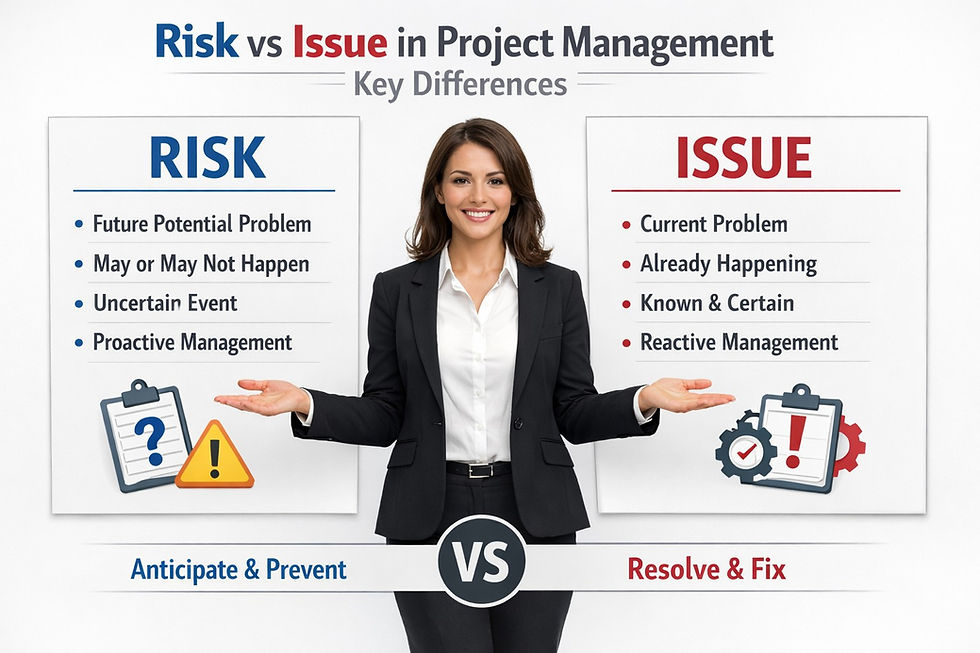
At a foundational level, the difference between risks and issues lies in uncertainty versus reality.
A risk is a potential event or condition that may occur in the future and could impact a project’s objectives. Risks have not yet happened, but they carry the possibility of affecting scope, cost, schedule, or quality if they materialize.
An issue, on the other hand, is a problem that has already occurred and is currently impacting the project. Issues require immediate attention, analysis, and resolution to prevent further disruption.
This distinction is central to project governance. Risk management focuses on anticipating and preparing for potential problems, while issue management focuses on responding to and resolving problems that already exist.
In enterprise project environments, understanding this distinction enables teams to adopt both proactive and reactive management strategies that keep projects aligned with business objectives.
What Is a Risk in Project Management?
In project management, a risk is defined as an uncertain event or condition that could affect the project if it occurs. Risks can have either negative consequences (threats) or positive outcomes (opportunities).
Common sources of project risks include:
Resource availability
Technology limitations
Vendor performance
Regulatory changes
Market volatility
Stakeholder alignment
Effective project risk management involves identifying potential risks early in the project lifecycle, analyzing their probability and impact, and developing mitigation strategies that reduce the likelihood or severity of negative outcomes.
Large enterprises typically implement structured risk management processes that include tools such as risk registers, probability-impact matrices, and quantitative risk analysis techniques. These tools allow project managers to prioritize risks and focus mitigation efforts where they will deliver the greatest value.
When managed effectively, risks can actually drive innovation and improvement by encouraging teams to think strategically about potential challenges before they occur.
What Is an Issue in Project Management?
Unlike risks, an issue is a problem that has already occurred and is actively affecting project progress.
Issues can arise from many sources, including:
Missed deadlines
Budget overruns
Resource conflicts
Technical failures
Stakeholder disagreements
Scope changes
Because issues are real-time challenges, they require immediate attention and decisive action from the project manager and project team.
Issue management typically involves a structured process that includes identifying the issue, documenting it in an issue log, analyzing its root cause, assigning ownership, and implementing corrective actions.
In enterprise environments, effective issue management processes are essential for maintaining operational stability and ensuring that problems do not escalate into larger project failures.
The speed and effectiveness with which a team resolves issues can significantly influence stakeholder confidence and overall project success.
How Risks and Issues Impact Project Outcomes
Although risks and issues both influence project performance, their impact on project outcomes differs significantly.
Risks influence the future trajectory of the project. If a risk materializes, it may disrupt schedules, increase costs, or create new operational challenges. However, because risks are identified before they occur, project managers have the opportunity to implement mitigation strategies that minimize potential damage.
Issues, by contrast, represent immediate disruptions that are already affecting the project. If not addressed quickly, issues can escalate and create cascading effects across project activities.
For example, a risk related to vendor delays may be identified during planning. If that risk materializes, it becomes an issue that must be addressed immediately to prevent schedule overruns.
Understanding this progression from risk to issue helps project managers design stronger governance processes that support both prevention and resolution.
How Project Managers Identify and Manage Risks
Effective risk management begins with early identification and structured analysis.
One common approach is to conduct risk identification workshops during project initiation. These workshops bring together key stakeholders to brainstorm potential threats and opportunities that could impact project objectives.
Once risks are identified, project managers typically assess them using a probability-impact matrix, which helps prioritize risks based on their likelihood of occurrence and potential severity.
Advanced enterprise projects may also use quantitative analysis methods, such as Monte Carlo simulations, to model risk scenarios and evaluate potential impacts.
Documenting risks in a risk register ensures that the project team continuously monitors potential threats and updates mitigation strategies throughout the project lifecycle.
This proactive approach allows project teams to maintain greater control over uncertain project environments.
How Project Managers Handle Issues Effectively
Issue management requires a structured and responsive approach that allows teams to resolve problems quickly.
Most organizations maintain an issue log, where all project issues are documented along with their status, priority, owner, and resolution plan.
Once an issue is identified, project managers typically perform a root cause analysis to understand why the problem occurred. This analysis ensures that teams address the underlying cause rather than simply treating the symptoms.
Effective issue management also requires strong communication with stakeholders. Transparent reporting ensures that leadership remains informed about challenges and can support escalation if necessary.
The faster issues are identified and resolved, the less likely they are to cause significant project disruption.
Best Practices for Managing Risks and Issues in Enterprise Projects
Successful project managers understand that risk management and issue management must operate together within a unified governance framework.
One best practice is to establish clear processes that differentiate how risks and issues are documented, analyzed, and resolved. This prevents confusion and ensures that teams apply the appropriate response strategy.
Regular project review meetings should include updates on both the risk register and issue log, allowing teams to monitor emerging threats while addressing existing problems.
Another important strategy is to foster a culture of transparency where team members feel comfortable raising potential risks early and escalating issues when they arise.
Finally, modern project management software tools can significantly improve visibility by providing dashboards that track risks, issues, and mitigation progress in real time.
Organizations that implement these practices are far better equipped to navigate complex projects and maintain consistent delivery performance.
Why is understanding risk vs issue in project management important?
Understanding the distinction between risk and issue in project management is essential for maintaining control, transparency, and effective governance across enterprise projects. While both risks and issues can affect project outcomes, they represent fundamentally different situations that require different management strategies. A risk refers to a potential future event that may affect project objectives if it occurs, whereas an issue is a problem that has already happened and requires immediate resolution.
Project managers who fail to distinguish between these concepts often struggle with ineffective planning and delayed responses to problems. For example, if a potential vendor delay is treated as an issue rather than a risk, the team may fail to create contingency plans in advance. Conversely, if an existing problem is mistakenly logged as a risk, the project team may delay necessary corrective actions. Proper classification ensures that risks are proactively managed and issues are quickly resolved.
In large organizations, clear differentiation between risks and issues also improves stakeholder communication. Executives, sponsors, and governance boards rely on accurate project reporting to make strategic decisions. When risks and issues are clearly defined, project dashboards and reports become more meaningful and actionable. Ultimately, understanding risk vs issue in project management strengthens project oversight and increases the likelihood of successful delivery.
What is the difference between a risk and an issue in project management?
The primary difference between a risk and an issue lies in timing and certainty. A risk is a potential event that may occur in the future and could impact the project’s objectives. It represents uncertainty. An issue, however, is a problem that has already occurred and is actively affecting the project.
For instance, if a project depends on a third-party supplier who may miss delivery deadlines, that situation represents a risk. However, if the supplier actually misses the delivery date and the project schedule is disrupted, the risk has now become an issue.
Because of this distinction, project managers approach each concept differently.
Risks are managed through proactive processes such as identification, analysis, mitigation planning, and monitoring. Issues require immediate action, investigation, and resolution in order to minimize damage to project objectives.
Understanding this progression from risk to issue is critical in enterprise project environments. Many issues originate from risks that were either unidentified or insufficiently mitigated earlier in the project lifecycle. By improving risk identification and mitigation practices, project managers can significantly reduce the number of issues that arise during project execution.
How do project managers identify risks effectively?
Effective risk identification is one of the most important responsibilities of a project manager. The process typically begins during project planning and continues throughout the project lifecycle. Project managers must work closely with stakeholders, subject matter experts, and project team members to identify potential threats and opportunities that could influence project outcomes.
Several techniques are commonly used to identify project risks. Brainstorming sessions allow teams to discuss potential uncertainties and explore different perspectives on potential project challenges. SWOT analysis can help identify risks related to organizational strengths, weaknesses, opportunities, and threats. Lessons learned from previous projects also provide valuable insight into common risk areas.
Once risks are identified, they are typically documented in a risk register. This register includes information such as the risk description, likelihood of occurrence, potential impact, and mitigation strategy. Maintaining a comprehensive risk register ensures that potential threats remain visible and can be monitored throughout the project lifecycle.
In enterprise environments, risk identification is often integrated into formal governance frameworks. Risk workshops, cross-functional reviews, and structured analysis techniques help ensure that projects identify potential risks early and prepare appropriate mitigation strategies.
How are issues managed once they occur in a project?
Issue management focuses on identifying, analyzing, and resolving problems that have already occurred during project execution. Because issues represent real disruptions to project progress, they require rapid response and structured resolution processes.
Most organizations maintain an issue log where problems are documented and tracked.
This log typically includes information such as the issue description, severity level, responsible owner, and target resolution date. The issue log provides transparency and ensures that all project stakeholders are aware of ongoing challenges.
Once an issue is recorded, the project manager typically performs a root cause analysis to determine why the problem occurred. Identifying the underlying cause is essential for preventing the same issue from recurring later in the project. Depending on the severity of the issue, escalation to senior leadership or governance boards may be necessary.
Effective issue management also requires clear communication. Stakeholders must be informed about the nature of the issue, the potential impact on project objectives, and the actions being taken to resolve it. Timely and transparent communication helps maintain stakeholder trust even when challenges arise.
Can a risk turn into an issue during a project?
Yes, risks frequently evolve into issues when the potential event actually occurs. This transition is a normal part of project management and highlights the importance of proactive risk mitigation strategies.
For example, imagine a project team identifies a risk that key technical resources may become unavailable due to competing organizational priorities. If the team implements mitigation strategies such as cross-training additional staff, the risk may be successfully managed. However, if the resource suddenly becomes unavailable despite mitigation efforts, the risk has now materialized and become an issue that requires immediate resolution.
The transition from risk to issue reinforces the importance of maintaining clear documentation. Risks should be carefully monitored throughout the project lifecycle so that teams can respond quickly if conditions change. Early warning indicators and regular risk reviews help project managers detect when risks are becoming more likely to occur.
In mature project management organizations, risk monitoring processes are closely integrated with issue management processes. This integration ensures that when risks materialize, teams can respond quickly and effectively.
What tools are commonly used to manage risks and issues?
Project managers use a variety of tools and frameworks to manage risks and issues effectively. One of the most widely used tools is the risk register, which provides a structured record of all identified risks along with mitigation strategies and monitoring information.
Another important tool is the issue log, which tracks problems that occur during project execution. The issue log allows project teams to prioritize issues based on severity and assign ownership for resolution activities.
Many organizations also use project management software platforms that integrate risk and issue tracking into broader project governance systems. These platforms provide dashboards that display risk levels, issue status, and mitigation progress in real time. This visibility enables project managers and executives to monitor project health and make informed decisions quickly.
Quantitative risk analysis tools, such as Monte Carlo simulations, are sometimes used in large or complex projects to assess the probability of schedule or cost impacts. These tools help project managers understand the potential consequences of different risk scenarios.
Ultimately, the goal of these tools is to create a structured and transparent environment where risks are proactively managed and issues are resolved efficiently.
How can organizations improve their risk and issue management processes?
Organizations can significantly improve project outcomes by strengthening their risk and issue management practices. One of the most effective strategies is to establish clear governance frameworks that define how risks and issues are identified, documented, analyzed, and resolved.
Training project teams to understand the difference between risks and issues is also critical. When team members understand how to identify potential risks early and escalate issues quickly, projects are more likely to remain on track.
Another important improvement strategy is fostering a culture of transparency. Teams should feel comfortable raising concerns about potential risks without fear of blame or criticism. Early identification of risks provides more time to develop mitigation strategies and reduces the likelihood of issues emerging later.
Organizations should also conduct regular project reviews that examine both risk registers and issue logs. These reviews allow leadership teams to monitor project health and provide guidance when necessary.
By continuously improving these processes, enterprises create more resilient project environments capable of navigating uncertainty, resolving challenges efficiently, and delivering strategic initiatives successfully.
Conclusion
Understanding the difference between risk vs issue in project management is essential for effective project governance and successful delivery. While risks represent potential future events that may impact project objectives, issues are problems that have already occurred and require immediate resolution.
Enterprise project managers who clearly distinguish between these two concepts can implement proactive risk management strategies while also responding swiftly to emerging challenges.
By maintaining structured risk registers, issue logs, and governance processes, organizations create a more resilient project environment that can adapt to uncertainty and change.
Ultimately, mastering the management of both risks and issues enables project managers to protect project performance, strengthen stakeholder confidence, and deliver strategic initiatives successfully in increasingly complex business environments.
Explore the blog Risk vs Issue: What’s the Difference? from the Project Management Academy
Discover More great insights at:
Hashtags
#ProjectManagement #RiskManagement #IssueManagement #EnterpriseProjects #PMO #ProjectLeadership #StrategicDelivery #ProjectGovernance


