
Questions to Ask When Buying a Business: Strategic Due Diligence

Introduction
For large organizations, buying a business is rarely a simple transaction. It is a strategic inflection point that can accelerate growth, secure market position, acquire critical capabilities, or eliminate competitive threats.
Corporate acquisitions, whether full buyouts, carve-outs, or majority stakes, expose the enterprise to material financial, operational, regulatory, and reputational risks. The quality of the questions asked before signing determines whether value is created, preserved, or destroyed.
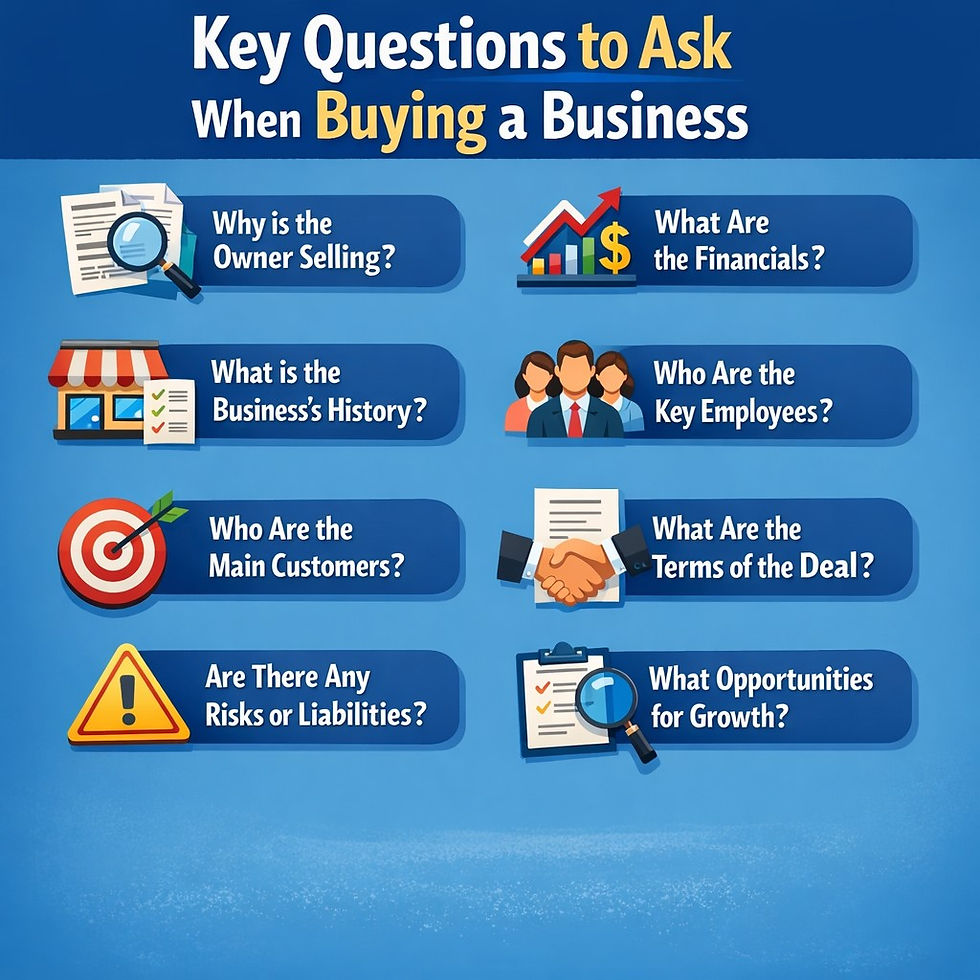
This blog provides a structured, enterprise-scale framework of questions to ask when buying a business. It is designed for corporate executives, board members, corporate development leaders, private equity operating partners, and senior finance, legal, and integration teams. The focus is on strategic clarity, governance discipline, and post-deal value realization rather than transactional mechanics alone.
Strategic Rationale and Alignment
Why Are We Buying This Business?
Before any financial or operational diligence begins, the acquiring organization must establish a clear strategic thesis.
Key enterprise-level questions include:
How does this acquisition support our corporate strategy, growth agenda, or portfolio priorities?
Is this a capability acquisition, a market expansion, a vertical integration play, or a defensive move?
What strategic gaps does this business fill that organic investment cannot address within the same timeframe?
How does this acquisition align with our long-term capital allocation strategy?
Large organizations frequently acquire assets that look attractive in isolation but lack strategic coherence at group level. Without a clear strategic rationale, integration teams struggle to prioritize investments, leadership focus drifts, and anticipated synergies fail to materialize.
How Does the Target Fit Within Our Existing Portfolio?
Portfolio alignment is critical at enterprise scale.
Questions to explore:
Does the target complement or compete with existing business units?
Will the acquisition simplify or increase organizational complexity?
Are there brand, channel, or customer overlaps that require rationalization?
How does the target affect portfolio risk concentration by geography, industry, or customer segment?
Organizations with multiple operating divisions must consider whether the target strengthens the overall portfolio or introduces friction between business units.
Financial Performance and Value Creation
What Is the True Quality of Earnings?
Reported financials rarely tell the full story.
Enterprise buyers should ask:
How sustainable are current revenues and margins?
What proportion of earnings is recurring versus one-off?
Are there customer concentration risks that could materially impact future performance?
How sensitive are earnings to economic cycles, commodity prices, or regulatory changes?
Quality of earnings analysis should extend beyond accounting adjustments to include commercial sustainability and operational resilience.
What Are the Key Value Drivers?
Understanding what actually creates value in the business is essential.
Key questions include:
What products, services, or customer segments generate the majority of profits?
Which capabilities are defensible and difficult to replicate?
Where does the business over- or under-invest relative to returns?
How does working capital management compare to industry benchmarks?
At enterprise level, value drivers must be scalable and transferable across the acquiring organization.
What Synergies Are Realistic and Achievable?
Synergy assumptions often determine deal pricing, yet they are frequently overstated.
Critical questions:
Which synergies are revenue-based versus cost-based?
What is the timeline for capturing synergies, and who is accountable?
What upfront investments are required to unlock these synergies?
How will synergies be measured, governed, and reported post-close?
Experienced acquirers treat synergies as managed programs with clear ownership, milestones, and governance rather than abstract financial assumptions.
Commercial and Market Considerations
How Strong Is the Market Position?
Market strength determines future resilience.
Enterprise-focused questions include:
What is the target’s market share by segment and geography?
How defensible is its competitive position?
What barriers to entry protect the business?
How exposed is the business to disruptive technologies or new business models?
Understanding market dynamics is particularly important when acquiring businesses in fast-evolving or regulated industries.
How Diversified Is the Customer Base?
Customer concentration introduces risk at scale.
Ask:
What percentage of revenue comes from the top ten customers?
How long are customer contracts, and how enforceable are they?
What is the historical customer churn rate?
Are key customer relationships dependent on specific individuals?
For large enterprises, over-reliance on a small number of customers can undermine earnings stability and valuation assumptions.
Operational Capability and Scalability
Can the Business Scale Within a Corporate Environment?
Not all successful mid-market businesses scale effectively within a large enterprise.
Key questions:
Are core processes documented, standardized, and repeatable?
Can systems, controls, and reporting support enterprise governance requirements?
How mature are procurement, supply chain, and vendor management practices?
What operational dependencies exist on founders or long-tenured staff?
Operational scalability is often underestimated and becomes a major integration challenge post-acquisition.
How Robust Is the Operating Model?
Enterprise buyers must assess operating resilience.
Consider:
How well does the business manage operational risk and business continuity?
Are there single points of failure in suppliers, systems, or facilities?
How mature are health, safety, and environmental practices?
What operational improvements could unlock margin expansion?
Strong operating models reduce integration risk and support predictable performance.
Technology and Data Readiness
Is the Technology Stack Fit for Purpose?
Technology is increasingly central to value creation.
Ask:
Are core systems modern, secure, and scalable?
How integrated are finance, operations, CRM, and analytics platforms?
What technical debt exists, and what is the cost to remediate it?
How compatible are systems with the acquiring organization’s architecture?
Technology misalignment is a common source of cost overruns and delayed integration benefits.
How Is Data Managed and Governed?
Enterprise buyers should assess data maturity.
Questions include:
How reliable is management reporting and forecasting data?
What data governance, privacy, and cybersecurity controls are in place?
Does the business comply with relevant data protection regulations across jurisdictions?
How easily can data be integrated into group-level reporting?
Weak data governance exposes the acquirer to regulatory and reputational risks.
Leadership, Culture, and Talent
Who Actually Runs the Business?
Understanding leadership depth is essential.
Key questions:
Who are the critical decision-makers and value creators?
How dependent is performance on founders or a small leadership group?
What succession plans exist for key roles?
How aligned is leadership with the acquiring organization’s values and governance standards?
Retention of key leaders often determines whether the acquisition succeeds operationally.
Is the Culture Compatible?
Cultural misalignment can quietly erode value.
Enterprise-scale considerations:
How are decisions made, centralized or decentralized?
What is the attitude toward risk, compliance, and controls?
How does the organization manage performance and accountability?
Are employee engagement and turnover within acceptable ranges?
Cultural diligence should be treated with the same rigor as financial diligence.
Legal, Regulatory, and Risk Exposure
What Regulatory Risks Exist?
Regulatory exposure varies significantly by industry and geography.
Ask:
What licenses, permits, or approvals are critical to operations?
Are there pending regulatory changes that could impact profitability?
Has the business faced regulatory enforcement actions or investigations?
How mature are compliance frameworks and internal controls?
For highly regulated sectors, regulatory risk can materially alter the investment case.
What Legal Liabilities Could Transfer?
Enterprise buyers inherit risk.
Key questions:
Are there outstanding litigation, disputes, or contingent liabilities?
How robust are contracts with customers, suppliers, and partners?
Are intellectual property rights properly owned and protected?
What warranties and indemnities are necessary to mitigate residual risk?
Legal diligence should focus on risk exposure rather than contract completeness alone.
Integration and Value Realization
How Will Integration Be Governed?
Integration is where value is won or lost.
Enterprise-level questions include:
What integration model will be used, full absorption, standalone, or hybrid?
Who owns integration at executive level?
How will progress be tracked and escalated?
What decisions must be made in the first 90 days post-close?
Clear governance structures enable disciplined execution across complex organizations.
What Does Success Look Like After 12, 24, and 36 Months?
Defining success upfront is critical.
Ask:
What financial, operational, and strategic outcomes define success?
How will performance be measured against the original investment thesis?
What exit options or portfolio decisions may be considered in the future?
How will lessons learned be captured for future acquisitions?
Large organizations that institutionalize post-deal reviews consistently outperform peers in M&A outcomes.
Industry-Specific Nuances
Different industries introduce unique considerations.
Examples include:
In regulated industries, approval timelines and compliance costs can materially affect returns.
In technology acquisitions, intellectual property ownership and talent retention are often primary value drivers.
In industrial and infrastructure assets, asset condition, maintenance backlogs, and safety performance are critical.
In professional services, revenue sustainability is closely linked to people, culture, and client relationships.
Enterprise buyers should tailor their question sets to sector-specific risks and opportunities.
Practical Executive Checklist
To support decision-makers, the following high-level checklist can be used during executive reviews:
Area | Executive Focus |
Strategy | Clear strategic rationale and portfolio fit |
Financials | Sustainable earnings and realistic synergies |
Operations | Scalable, resilient operating model |
Technology | Secure, compatible, and future-ready systems |
People | Leadership depth and cultural alignment |
Risk | Managed legal, regulatory, and compliance exposure |
Integration | Clear governance and value realization plan |
Frequently Asked Questions
What is the most important question to ask before buying a business?
For large organizations, the most important question is whether the acquisition clearly aligns with enterprise strategy. If the transaction does not directly support long-term growth objectives, portfolio optimization, capability acquisition, or competitive positioning, financial performance alone will not justify the risk. Strategic misalignment is the leading cause of post-acquisition value erosion at corporate scale.
How deep should due diligence go for enterprise acquisitions?
Enterprise due diligence should go beyond financial validation. It must assess operational scalability, leadership depth, technology maturity, regulatory exposure, and cultural compatibility. Large organizations should also evaluate how easily the business can operate under corporate governance, compliance, and reporting standards. Superficial diligence increases integration risk and undermines synergy realization.
How do large organizations assess whether a business can scale?
Scalability is assessed by examining process maturity, system capability, leadership structure, and dependency risks. Enterprise buyers look for standardized processes, documented controls, modern technology platforms, and management teams capable of operating within complex, multi-division environments. Businesses that rely heavily on informal decision-making or founder-driven execution often struggle to scale post-acquisition.
Why do synergies often fail to materialize?
Synergies fail when they are poorly defined, overly optimistic, or lack ownership. At enterprise level, successful synergy realization requires clear accountability, realistic timelines, upfront investment planning, and executive governance. Without disciplined tracking and integration leadership, synergies remain theoretical and rarely translate into financial results.
How important is culture in buying a business?
Culture is critical, particularly in people-driven or knowledge-based industries. Cultural misalignment can lead to leadership attrition, employee disengagement, and operational friction. Large organizations should assess decision-making styles, risk tolerance, accountability models, and attitudes toward compliance. Cultural compatibility supports faster integration and sustained performance.
What leadership risks should enterprise buyers watch for?
Key risks include over-dependence on founders, limited succession planning, and misalignment with corporate governance expectations. Enterprise buyers should identify critical roles, retention requirements, and leadership development gaps early. Acquisitions fail when leadership capability is assumed rather than validated.
How should technology influence acquisition decisions?
Technology should be evaluated as both a value driver and a risk factor. Enterprise buyers must assess system scalability, cybersecurity resilience, data governance maturity, and compatibility with corporate architecture. Significant technical debt or outdated systems can delay integration, increase costs, and limit strategic flexibility.
What role does integration planning play before deal close?
Integration planning should begin well before closing. Enterprise acquirers that define governance models, decision rights, and early priorities reduce disruption and accelerate value realization. Waiting until after closing to plan integration often results in lost momentum and delayed performance improvements.
How do boards evaluate whether an acquisition was successful?
Boards assess success by comparing outcomes against the original investment thesis. This includes financial performance, strategic impact, operational improvements, and risk management effectiveness. Mature organizations conduct structured post-acquisition reviews to capture lessons learned and improve future acquisition decisions.
What is the biggest mistake organizations make when buying a business?
The most common mistake is focusing on deal completion rather than long-term value creation. Enterprise acquisitions require discipline, patience, and governance. When speed and competition override strategic rigor, organizations increase the likelihood of integration challenges, underperformance, and value destruction.
Conclusion
Buying a business is one of the most consequential decisions a large organization can make. The right questions, asked early and rigorously, protect capital, guide integration, and increase the probability of long-term value creation. Enterprise-scale acquisitions demand more than financial analysis, they require strategic clarity, governance discipline, cultural awareness, and operational realism.
Organizations that institutionalize these questions within their corporate development and investment processes consistently outperform those that rely on deal momentum or headline metrics alone.
Key Resources and Further Reading
Hashtags
#BusinessAcquisition #CorporateStrategy #MergersAndAcquisitions #EnterpriseLeadership #ValueCreation


