Project Warranty Management: Best Practices for Project Closeout and Handover

Understanding Project Warranty Management
Effective project warranty management is practically important because unresolved defects, incomplete documentation, and unclear responsibilities can continue creating financial and operational risk long after a project has been formally completed.
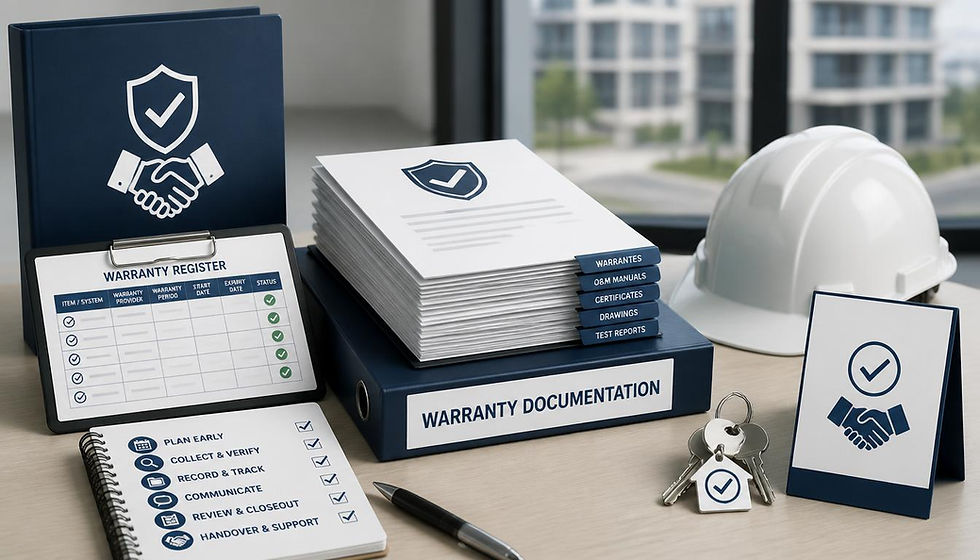
What Is Project Warranty Management?
Project warranty management is the structured process of managing contractual warranty obligations after project delivery and throughout the applicable warranty period.
It typically involves identifying warranty requirements, documenting covered assets or deliverables, tracking defects, coordinating inspections, managing claims, monitoring corrective work, and confirming that obligations have been fulfilled.
The process is particularly relevant to construction, engineering, infrastructure, manufacturing, technology implementation, facilities, and other projects where delivered assets require ongoing performance assurance.
Warranty requirements should be established during project planning rather than discovered during closeout.
Why Warranty Management Matters at Closeout
Project closeout does not necessarily mean that every responsibility ends on the completion date.
A project can achieve substantial completion while warranty obligations continue for months or years.
This creates a transition period in which ownership moves from the project team toward operations, facilities, maintenance, procurement, or another business function.
Without a structured handover, important information can be lost between these groups.
Warranty Management as a Project Lifecycle Activity
Warranty management should be treated as part of the project lifecycle rather than an administrative task performed after delivery.
Project teams should identify warranty requirements during procurement and contract development, monitor them during execution, and prepare the warranty register before handover.
This approach creates continuity between contract obligations, project deliverables, acceptance activities, and post-completion support.
Establishing Warranty Requirements Before Project Closeout
Establishing warranty requirements early is practically important because warranty obligations often originate in contracts, purchase orders, specifications, supplier agreements, and acceptance criteria.
Reviewing Contractual Requirements
The project manager should identify every relevant warranty obligation before closeout begins.
Important information can include warranty duration, commencement date, covered components, exclusions, supplier responsibilities, response times, inspection requirements, and claim procedures.
Contract language should be translated into operational requirements that the project and operations teams can actually manage.
Identifying Warranty Start Dates
Warranty periods do not always begin on the same date.
Depending on contractual arrangements, the warranty may commence at substantial completion, practical completion, acceptance, commissioning, delivery, or another defined milestone.
Incorrectly recording the start date can cause organizations to miss claim deadlines or misunderstand when warranty obligations expire.
Documenting Warranty Conditions
Some warranties require specific operating, maintenance, inspection, or installation conditions.
For example, equipment warranties may depend on prescribed maintenance schedules or qualified servicing.
Project teams should therefore document conditions that could affect warranty validity and ensure the receiving organization understands them.
Creating a Warranty Register
A warranty register provides a centralized record of warranty obligations.
It should identify the asset or deliverable, supplier, contract reference, warranty duration, start date, expiration date, coverage, exclusions, documentation, responsible owner, and claim process.
The register should be transferred to the operational owner as part of formal handover.
Managing Defects During the Warranty Period
Effective defect management is practically important because identifying, documenting, prioritizing, and resolving defects determines whether the organization actually receives the value promised by its warranty provisions.
Identifying Warranty Defects
Not every post-completion problem is automatically a warranty defect.
The project or operations team must determine whether the issue falls within the contractual warranty scope.
Potential causes can include defective materials, workmanship problems, equipment failure, installation errors, software defects, design problems, or improper operation.
Clear classification reduces disputes with contractors and suppliers.
Recording Defects
Every significant warranty issue should be recorded in a controlled system.
Useful information includes the date identified, affected asset, description of the problem, photographs or other evidence, operating impact, supplier notification, response date, corrective action, and final resolution.
A standardized process makes recurring problems easier to identify.
Prioritizing Defects
Defects should be prioritized according to operational impact and risk.
A cosmetic issue may require routine handling, while a failure affecting safety, production, critical infrastructure, security, or customer service may require immediate escalation.
Priority categories should be agreed before significant warranty claims arise.
Verifying Resolution
Closing a warranty issue should require evidence that the corrective action actually resolved the problem.
The responsible party should verify the repair, replacement, configuration change, or other corrective measure against the original defect.
Simply marking a claim as completed without validation can allow recurring failures to remain hidden.
Managing the Project Closeout and Handover
A structured warranty handover is practically important because operational teams need accurate information to manage obligations after the project team has been demobilized.
Preparing the Handover Package
The handover package should contain all information required to administer warranties.
This can include warranty certificates, contracts, supplier contacts, equipment records, maintenance requirements, commissioning documentation, inspection reports, defect records, acceptance documentation, and warranty expiration dates.
The package should be complete before responsibility transfers.
Assigning Operational Ownership
Every warranty obligation should have a clearly identified owner after project closeout.
Ownership might sit with facilities management, asset management, operations, procurement, IT, engineering, or another function.
The responsible team should understand both what is covered and what actions are required to preserve warranty rights.
Conducting Handover Meetings
Documentation alone may not provide sufficient knowledge transfer.
A formal handover meeting gives the project team an opportunity to explain outstanding defects, supplier relationships, warranty conditions, upcoming inspections, unresolved claims, and expiration dates.
Questions should be recorded and resolved before the project is fully closed.
Closing Outstanding Items
The project manager should distinguish between completed closeout activities and outstanding warranty obligations.
A project can be administratively closed while warranty responsibilities remain active.
The closure process should therefore identify which responsibilities transfer to operations and which remain with the project organization.
The Project Warranty Closeout Matrix
The Project Warranty Closeout and Handover Matrix provides a practical framework for confirming that warranty information and responsibilities are transferred before the project team exits.
Warranty Management Area | Required Information | Handover Evidence | Accountable Owner |
Warranty scope | Covered assets and deliverables | Warranty register | Project manager |
Warranty dates | Start and expiration dates | Contract records | Asset owner |
Supplier obligations | Responsibilities and response requirements | Contracts and contacts | Procurement |
Defects | Open and resolved issues | Defect register | Project manager |
Maintenance | Required servicing and inspections | Maintenance schedules | Operations |
Claims | Submitted and outstanding claims | Claim records | Warranty owner |
Documentation | Certificates and supporting records | Handover package | Document controller |
Escalation | Contacts and escalation routes | Escalation procedure | Operations |
This matrix should be reviewed before formal project closure.
The objective is to make sure the operational organization can continue warranty administration without depending on the original project team.
Managing Warranty Claims and Supplier Relationships
Effective warranty claim management is practically important because organizations can lose time and financial value when claims lack evidence, ownership, contractual references, or timely escalation.
Preparing a Warranty Claim
A warranty claim should clearly connect the observed defect to the applicable warranty obligation.
Supporting evidence may include photographs, inspection results, maintenance records, equipment serial numbers, test results, commissioning records, and descriptions of operational impact.
The claim should reference the appropriate contractual requirement whenever possible.
Managing Supplier Responses
Supplier response times should be tracked against contractual requirements.
A claim that remains unresolved beyond the required response period should be escalated through the appropriate commercial or contractual process.
The project team should maintain an auditable record of communications and decisions.
Avoiding Unnecessary Disputes
Many warranty disputes arise because the parties disagree about cause, responsibility, scope, or contractual interpretation.
Clear evidence can reduce ambiguity.
Organizations should maintain installation records, inspection results, maintenance documentation, operating conditions, and communications that demonstrate how the asset was managed.
Escalating Unresolved Claims
Escalation should follow a defined process.
Routine claims can remain with operational or maintenance teams, while high-value, repeated, safety-related, or contractually disputed claims may require procurement, legal, engineering, or executive involvement.
A defined escalation process prevents significant claims from remaining unresolved indefinitely.
Measuring Warranty Management Performance
Warranty performance measurement is practically important because organizations need evidence that their closeout and handover processes are reducing unresolved defects, controlling costs, and preserving contractual value.
Warranty Claim Metrics
Useful metrics include the number of warranty claims opened, claims closed, average resolution time, overdue claims, recurring defects, and claims by supplier.
These measures can identify suppliers or assets generating disproportionate levels of post-project work.
Defect Recurrence
Recurring defects deserve particular attention.
If the same failure occurs repeatedly after multiple repairs, the organization may need to challenge the corrective approach rather than continuing to close individual claims.
Root cause analysis can determine whether the issue originates in design, materials, installation, configuration, operation, or maintenance.
Warranty Cost Recovery
Organizations should monitor the financial value recovered through warranty claims.
This can include repair costs, replacement costs, labor, supplier credits, and other eligible expenses.
The objective is not merely to maximize claims but to ensure that valid contractual protections are actually used.
Expiration Management
Warranty expiration should be actively monitored.
Critical warranties should trigger advance notifications before expiration so that inspections or unresolved issues can be addressed while coverage remains active.
A warranty that expires before a known defect is formally documented can create avoidable financial exposure.
Common Project Warranty Management Failures
Understanding common warranty failures is practically important because weaknesses in closeout processes can transfer avoidable risk directly from the project organization to operations.
Incomplete Documentation
Missing warranty certificates, contracts, maintenance instructions, or supplier contacts can make otherwise valid claims difficult to administer.
Documentation should therefore be treated as a formal project deliverable.
Unclear Ownership
A warranty register without assigned owners creates little accountability.
The receiving organization should know exactly who monitors expiration dates, submits claims, coordinates repairs, and verifies resolution.
Late Handover
Warranty information delivered after the project team has already been demobilized can create gaps in accountability.
Handover should begin before completion rather than becoming a final administrative exercise.
Poor Defect Records
A vague description such as "equipment not working" provides limited value.
Defect records should describe what happened, when it occurred, where it occurred, operational impact, evidence available, and action taken.
Failure to Capture Lessons Learned
Warranty claims provide valuable information about project performance.
Recurring defects may indicate weaknesses in design, procurement, installation, testing, commissioning, or contractor selection.
These findings should feed into future project planning and procurement decisions.
Integrating Warranty Management Into Project Governance
Integrating warranty management into project governance is practically important because warranty obligations can represent significant residual risk even after the primary project deliverables have been accepted.
Including Warranty in the Project Management Plan
The project management plan should identify how warranty requirements will be captured, monitored, and transferred.
This creates a formal connection between project execution and post-completion responsibilities.
Procurement Integration
Procurement teams should ensure warranty requirements are clearly defined in contracts and purchase agreements.
Project managers should understand these obligations before suppliers are selected and major purchases are finalized.
Quality Management Integration
Warranty data should connect with quality management.
Defects identified during construction, testing, commissioning, and early operation can provide valuable information about potential warranty exposure.
Risk Management Integration
Warranty obligations should be considered in project risk assessments.
Potential risks include insufficient warranty coverage, supplier financial instability, ambiguous contractual terms, short warranty periods, recurring defects, and difficulty obtaining replacement components.
These risks can influence procurement and contract decisions before project completion.
Frequently Asked Questions About Project Warranty Management
When should project teams start planning for warranty management?
Warranty management should begin during project planning and procurement rather than at project closeout. Warranty periods, coverage, exclusions, documentation requirements, supplier responsibilities, and claim procedures should be identified early. By integrating these requirements into contracts, quality management, commissioning, and handover planning, project teams can avoid discovering important obligations only after operational responsibility has transferred.
What information should a project warranty register contain?
A comprehensive warranty register should identify each covered asset or deliverable, supplier, contract reference, warranty start and expiration dates, coverage, exclusions, responsible owner, required maintenance, documentation location, claim process, and outstanding issues. Critical warranties should also have advance expiration notifications, ensuring inspections or claims can be initiated before contractual coverage ends.
Who is responsible for managing warranties after project closeout?
Responsibility normally transfers from the project team to an operational function such as facilities, asset management, engineering, IT, procurement, or maintenance. The specific owner depends on the project's operating model. The handover should formally identify accountability, provide the necessary documentation, explain outstanding claims, and confirm that the receiving team understands warranty conditions and escalation procedures.
How should project managers handle defects that appear during the warranty period?
Project managers or designated warranty owners should document the defect, determine whether it falls within warranty scope, preserve supporting evidence, notify the responsible supplier, track the response, and verify the corrective action. Significant or disputed defects should be escalated according to contractual and organizational procedures. Recurring failures should also undergo root cause analysis rather than being treated as isolated incidents.
How can organizations improve warranty management on future projects?
Organizations can improve warranty management by analyzing historical claims, identifying recurring defects, strengthening contract requirements, standardizing handover procedures, and monitoring supplier performance. Warranty data should become part of lessons learned and procurement decisions. When multiple projects experience similar warranty failures, the organization should treat the pattern as a systemic process or supplier-management issue rather than a series of unrelated incidents.
Conclusion: Project Warranty Management: Best Practices for Project Closeout and Handover
Project warranty management is a critical component of effective project closeout because formal completion does not necessarily eliminate the project's contractual, operational, financial, and quality obligations.
The strongest approach begins before closeout. Project teams should identify warranty requirements during procurement, document obligations throughout execution, maintain accurate defect records, and establish ownership before responsibility transfers to operations.
A centralized warranty register provides the foundation for this process.
It should capture warranty periods, covered assets, suppliers, documentation, open claims, maintenance requirements, responsible owners, and expiration dates.
The handover process should then transfer this information through both documentation and structured knowledge transfer.
Warranty management also provides valuable feedback for future projects. Recurring defects can reveal weaknesses in design, specifications, procurement, installation, commissioning, supplier selection, or maintenance planning.
Over the next year, warranty management is likely to become increasingly integrated with digital asset management, project information systems, predictive maintenance platforms, and automated notification workflows.
Organizations will increasingly be able to connect project records with operational asset data, automatically monitor warranty expiration dates, identify recurring failures, and trigger claim workflows.
The most mature organizations will move beyond simply administering warranty claims and use warranty data as a source of project performance intelligence.
That shift can improve procurement decisions, contractor evaluation, quality management, project closeout, and lifecycle cost management.
Tags: Project Warranty Management, Project Closeout, Project Handover, Warranty Claims, Project Management