
Leadership Games: Building Stronger Leaders Through Interactive Learning

In organizations, leadership development extends far beyond classroom-based training, theoretical competency models, or generic behavioural frameworks. Enterprise leadership capability is built through experience, judgment under pressure, and exposure to complex, interconnected decision environments. Leadership games are increasingly adopted as structured experiential tools that allow organizations to develop decision-making quality, collaboration, accountability, and systems thinking within controlled yet realistic scenarios.
When designed and deployed correctly, these games are not recreational exercises or team-building distractions. They are deliberate, governance-aligned development mechanisms.
Effective leadership games simulate the complexity leaders face in real enterprise environments. They force participants to navigate competing priorities, limited resources, ambiguous information, and consequential trade-offs while operating within defined rules, constraints, and accountability structures.
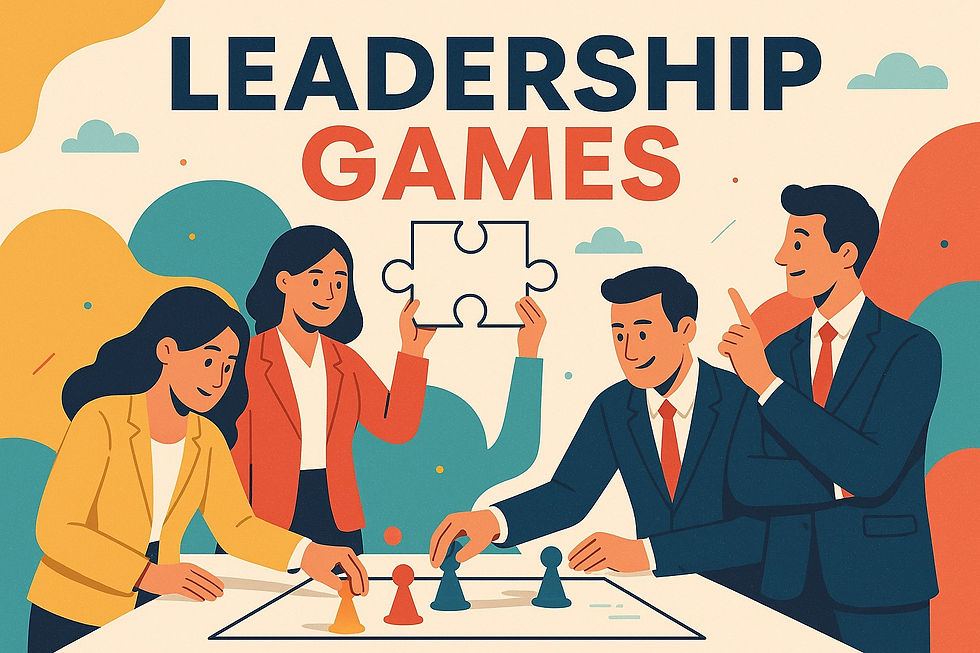
Decisions have visible outcomes, behaviours are observable, and patterns of leadership emerge in ways that traditional training rarely exposes. This makes leadership games particularly valuable for identifying leadership readiness, stress-testing decision frameworks, and reinforcing organisational values in practice rather than theory.
This blog explains leadership games from an enterprise perspective. It outlines their strategic purpose, core design principles, and governance considerations, and examines how large organizations use leadership games to develop leadership capability at scale. The focus is on how these tools support consistent leadership standards, informed decision-making, and enterprise-ready behaviour rather than entertainment or informal learning alone.
What Leadership Games Mean in Enterprise Contexts
Leadership games are structured simulations or facilitated exercises that place participants in scenarios requiring leadership behaviors under pressure. In enterprise environments, these games are:
Purpose-driven
Aligned to leadership competency frameworks
Designed around real organizational challenges
They differ significantly from icebreakers or generic team-building activities.
Why Large Organizations Use Leadership Games
Developing Decision-Making Under Complexity
Enterprise leaders operate within:
Competing priorities
Incomplete information
Time pressure
Leadership games simulate these conditions in a safe environment.
Revealing Behavioral Patterns
Games surface:
How leaders make decisions
How they handle conflict
How they balance risk and speed
This insight is difficult to obtain through theory alone.
Accelerating Learning Through Experience
Experiential learning:
Improves retention
Encourages reflection
Enables immediate feedback
This is especially valuable for senior or high-potential leaders.
Aligning Leadership Behavior to Strategy
Games can be designed to reinforce:
Enterprise values
Strategic priorities
Governance expectations
Behavior is shaped through experience, not instruction.
Common Types of Leadership Games Used by Enterprises
Strategic Simulation Games
These place leaders in:
Market or portfolio decision scenarios
Resource allocation challenges
Competitive environments
They develop strategic thinking and prioritization.
Crisis and Risk Management Simulations
Participants respond to:
Operational incidents
Reputational threats
Regulatory or compliance events
These games build resilience and escalation discipline.
Collaboration and Influence Exercises
Designed to:
Test cross-functional collaboration
Expose silo behavior
Strengthen stakeholder management
They reflect enterprise matrix realities.
Ethical and Governance Scenarios
These games challenge leaders to:
Balance performance and compliance
Navigate ethical dilemmas
Apply governance under pressure
They reinforce responsible leadership.
Design Principles for Enterprise Leadership Games
Realism Over Novelty
Scenarios should reflect:
Actual enterprise constraints
Familiar decision contexts
Artificial scenarios reduce credibility.
Clear Learning Objectives
Each game must link explicitly to:
Leadership competencies
Desired behaviors
Without this, value is diluted.
Structured Facilitation and Debrief
The real value lies in:
Guided reflection
Behavioral feedback
Linking actions to outcomes
Games without debrief are incomplete.
Psychological Safety
Participants must feel safe to:
Experiment
Make mistakes
Reflect honestly
This requires skilled facilitation.
Governance Considerations for Leadership Games
Alignment with Leadership Frameworks
Games should reinforce:
Existing leadership standards
Performance expectations
They should not contradict formal messaging.
Appropriate Audience Selection
Not all games suit all levels. Enterprises tailor:
Senior leadership simulations
Mid-level development exercises
Emerging leader scenarios
Measurement and Feedback
Organizations assess:
Behavioral shifts
Application in real roles
Feedback from participants
Learning must translate into performance.
Industry-Specific Applications
Financial Services
Leadership games focus on:
Risk appetite decisions
Regulatory pressure scenarios
Governance literacy is emphasized.
Technology and Digital Organizations
Games often simulate:
Rapid scaling
Innovation trade-offs
Platform dependency decisions
Speed versus stability is a common theme.
Construction and Infrastructure
Scenarios reflect:
Safety-critical decisions
Contractor and stakeholder management
Consequences are tangible.
Public Sector
Games emphasize:
Accountability
Transparency
Public value decision-making
Constraints are explicit.
Risks of Poorly Designed Leadership Games
Risk | Impact |
Over-simplification | Low relevance |
Entertainment focus | Limited learning |
Lack of debrief | No behavior change |
Misaligned messaging | Cultural confusion |
Design discipline is essential.
Practical Guidance for Enterprise Leaders
Use Games as Part of a System
Leadership games should complement:
Coaching
Formal training
Performance management
They are not standalone solutions.
Anchor Games in Real Enterprise Challenges
Use scenarios drawn from:
Actual incidents
Strategic dilemmas
Relevance drives engagement.
Reinforce Outcomes Post-Session
Encourage participants to:
Apply insights
Reflect on behavior changes
Learning must continue beyond the game.
Sample Enterprise Leadership Development Statement
“Leadership games are used as experiential development tools to strengthen decision-making, collaboration, and accountability in alignment with enterprise leadership standards.”
Outcomes of Effective Leadership Games
Enterprises that use leadership games effectively achieve:
Stronger decision-making capability
Improved cross-functional collaboration
Greater leadership self-awareness
Better alignment between strategy and behavior
These outcomes support sustainable performance.
Frequently Asked Questions (FAQ): Leadership Games in Enterprise Organizations
What are leadership games in an enterprise context?
Leadership games are structured, scenario-based simulations designed to develop leadership capability through experiential learning. In enterprise environments, they replicate real organizational complexity, including competing priorities, resource constraints, governance rules, and stakeholder pressures. The purpose is to observe and develop leadership behaviours in conditions that closely resemble real-world decision-making.
How do leadership games differ from traditional leadership training?
Traditional leadership training often focuses on theory, frameworks, and discussion. Leadership games emphasize action, consequence, and reflection. Participants must make decisions, manage trade-offs, and respond to outcomes in real time, allowing behaviours and decision patterns to surface naturally.
Why are leadership games used in large organizations?
Large organizations use leadership games to build leadership capability at scale in a consistent and controlled manner. They provide a safe environment to experience complexity, test judgment, and practice collaboration without risking real operational or financial impact.
Are leadership games just team-building exercises?
No. While they can improve collaboration, leadership games are not informal team-building activities. In enterprise settings, they are purposefully designed development interventions aligned to leadership frameworks, governance principles, and strategic objectives.
What leadership skills do games typically develop?
Leadership games commonly develop decision-making under uncertainty, prioritization, stakeholder management, communication, accountability, and systems thinking. They also highlight behaviours related to risk appetite, ethical judgment, and alignment with organizational values.
How do leadership games support governance and accountability?
Games are designed with explicit rules, roles, constraints, and decision rights that mirror enterprise governance. Participants experience the consequences of bypassing controls, poor escalation, or misaligned decisions, reinforcing the importance of governance discipline.
Who typically participates in leadership games?
Participants range from emerging leaders to senior executives, depending on the game’s design. Organizations often tailor games to specific leadership levels, functions, or transformation initiatives to ensure relevance and impact.
How are leadership games designed?
Effective leadership games are built around realistic scenarios, clear objectives, defined success measures, and structured debriefs. Design focuses on behavioural outcomes rather than winning, ensuring learning is aligned to enterprise leadership expectations.
What role does facilitation play?
Facilitation is critical. Skilled facilitators guide participants, manage dynamics, and ensure learning objectives are met. They also lead structured reflections to connect game experiences to real workplace behaviours and decisions.
Can leadership games be used for assessment as well as development?
Yes. Many organizations use leadership games as assessment tools to observe leadership readiness, decision quality, and behavioural tendencies. Insights gained can inform succession planning, role readiness, and targeted development.
How do leadership games scale across large organizations?
Scalability is achieved through standardized design, repeatable scenarios, and consistent facilitation frameworks. Digital and hybrid formats also enable broader reach across geographies and time zones.
Are leadership games suitable for regulated industries?
Yes. In fact, regulated industries often find them particularly valuable. Games can simulate regulatory constraints, compliance pressures, and audit scrutiny, allowing leaders to practice navigating these realities in a safe environment.
How do leadership games support change and transformation?
Leadership games expose leaders to change scenarios involving uncertainty, resistance, and competing objectives. This helps build resilience, adaptability, and alignment during real transformation initiatives.
How is success measured for leadership games?
Success is measured through behavioural observation, participant feedback, learning outcomes, and follow-up performance indicators. Enterprises often link insights from games to development plans or leadership metrics.
What are common risks in poorly designed leadership games?
Poorly designed games can feel artificial, overly simplistic, or disconnected from real work. Without clear objectives or debriefs, learning impact is reduced. Governance alignment is essential to avoid trivializing leadership challenges.
How often should leadership games be used?
Leadership games are typically integrated into broader development programs rather than used in isolation. Frequency depends on organizational maturity, leadership pipeline needs, and strategic priorities.
Can leadership games replace on-the-job experience?
No. They complement on-the-job experience by accelerating learning and exposing leaders to scenarios they may not yet have encountered. Real-world experience remains essential.
What role do HR and L&D functions play?
HR and L&D functions often sponsor and govern leadership games, ensuring alignment with leadership frameworks, talent strategies, and organizational values. They also integrate outcomes into broader development plans.
Are leadership games effective for senior leaders?
Yes. Senior leaders often benefit significantly, as games can challenge assumptions, surface systemic issues, and encourage reflection on decision-making patterns at scale.
What is the key takeaway for enterprises?
The key takeaway is that leadership games are powerful enterprise development tools when designed with purpose, realism, and governance alignment. They enable organizations to build leadership capability that is resilient, accountable, and prepared for complex decision environments.
Explore "18 Fun Leadership Games to Build Skills" A detailed guide from Teambuilding
Conclusion
Leadership games, when designed and governed properly, are powerful tools for developing enterprise leaders. They provide a safe environment to experience complexity, test judgment, and reflect on behavior. For large organizations, leadership games are not play. They are disciplined development mechanisms that translate strategy and values into lived leadership behavior.
Key Resources and Further Reading
Hashtags
#LeadershipDevelopment #EnterpriseLeadership #ExperientialLearning #ManagementTraining #OrganizationalCulture


