
Kanban Pull System: How Pull-Based Workflow Improves Flow and Delivery

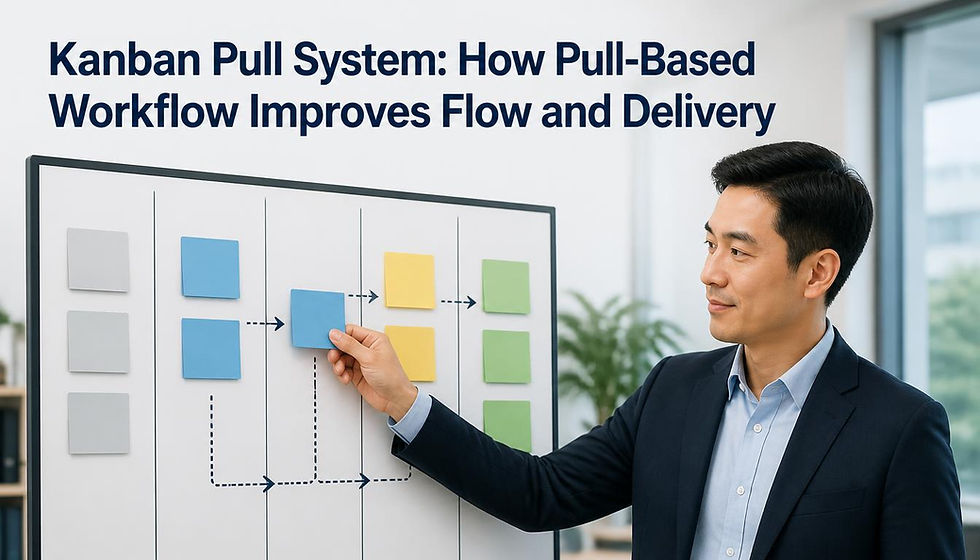
A Kanban pull system regulates work by allowing items to enter a workflow when downstream capacity becomes available. Rather than continually pushing additional tasks into the next stage, the system uses WIP limits, explicit policies, prioritization rules, and capacity signals to control how much work is active at any point in time.
This distinction matters because most delivery problems are not caused by a lack of work. They are caused by too much work entering a system that has limited processing capacity.
When work is pushed into a constrained workflow, queues grow. Teams switch between competing priorities, partially completed tasks accumulate, dependencies become harder to manage, and the time between starting and finishing work increases.
A pull system changes the control mechanism. The availability of downstream capacity becomes the trigger for additional work.
The objective is not to keep every person busy. It is to create a system in which valuable work moves through the process with less waiting, lower congestion, and greater predictability.
What a Kanban Pull System Actually Does
The defining characteristic of a pull system is that downstream capacity controls the release of additional work.
Consider a workflow with four stages: Ready, Development, Review, and Done. If Review has reached its WIP limit, completed development work cannot simply accumulate indefinitely in front of reviewers. The system creates pressure to resolve the review constraint before more work is pulled into the downstream stage.
This creates a feedback mechanism.
When a downstream stage has capacity, an eligible item can be pulled forward. When it does not, upstream work should not automatically continue expanding the queue.
That sounds straightforward, but it represents a significant change from conventional project management behavior. Many organizations reward starting work, launching initiatives, assigning tasks, and maximizing resource utilization. Pull systems place greater emphasis on finishing work and protecting the flow of completed outcomes.
Pull Is Not Simply Letting People Choose Tasks
Another common misunderstanding is that pull means employees select whichever task they prefer.
In a mature Kanban system, work selection operates within explicit constraints. The organization establishes which items are eligible, how priorities are determined, what capacity is available, and what conditions must be satisfied before work can move.
A pull policy might specify that a team pulls the highest-priority eligible item whenever a delivery slot becomes available. It might also reserve capacity for urgent work or specific classes of service.
Pull is therefore better understood as a flow-control mechanism than a task-selection preference.
Why Pull Reduces Congestion
The economic logic behind pull is straightforward: unfinished work consumes capacity without yet delivering a completed outcome.
Every additional active item introduces coordination, context switching, communication, review, testing, dependency management, and decision-making overhead.
This becomes particularly problematic when work has uneven processing times.
Suppose a team has five items in progress and one encounters a major dependency. If the team simply starts another item, the blocked work remains active while additional WIP accumulates. A pull system makes starting that additional item a deliberate decision rather than an automatic response.
The resulting constraint is useful information.
A full workflow stage may indicate insufficient capacity, poor quality upstream, excessive batch sizes, unclear requirements, external dependencies, approval delays, or an inefficient process.
The WIP limit does not solve the bottleneck by itself. It makes the bottleneck visible.
WIP Limits Are Control Mechanisms
A WIP limit establishes the maximum amount of work permitted within a defined part of the workflow.
It should not be treated as an arbitrary productivity target.
If the limit is consistently exceeded, the organization has learned something about its operating model. Either the policy is inappropriate, the workflow is poorly designed, or the underlying constraint has not been addressed.
Likewise, setting an extremely low WIP limit without considering demand and capacity can starve the system.
The useful question is not "What WIP number sounds right?" but "What WIP level supports acceptable flow while exposing meaningful constraints?"
The Architecture of a Pull-Based Workflow
A pull system requires more than a Kanban board. The workflow needs explicit rules that determine when work is eligible to move.
Control | Question it answers | Typical implementation | Why it matters |
Replenishment policy | What work is allowed into the system? | Pull eligible items from a prioritized queue | Prevents uncontrolled intake |
Entry criteria | Is the item ready to enter? | Defined information, dependencies, and acceptance conditions | Reduces premature starts |
WIP limit | How much work can be active? | Maximum items per workflow stage | Controls congestion |
Pull policy | Which item should move next? | Priority, class of service, or cost-of-delay rules | Creates consistent selection |
Exit criteria | Is the work actually complete? | Quality and acceptance conditions | Prevents premature handoffs |
Service expectation | How should flow be evaluated? | Lead-time or service-level target | Connects workflow to customer outcomes |
Exception policy | What happens when urgent work arrives? | Explicit expedite rules and reserved capacity | Prevents every item becoming urgent |
Feedback mechanism | How is the system improved? | Flow metrics and bottleneck analysis | Supports continuous improvement |
These controls turn visualization into an operating system for work.
Without them, a board may show where work is located but provide little control over how much work enters the process or which item should move next.
Replenishment and the Start of the Pull Cycle
A sophisticated Kanban implementation distinguishes between replenishment and execution.
Replenishment determines which work enters the ready queue or becomes eligible for delivery. Execution determines how that work moves through the workflow once capacity becomes available.
This distinction is important because teams can otherwise confuse a full backlog with available capacity.
A product team may have hundreds of requests waiting for consideration. That does not mean the delivery team should begin hundreds of them.
Replenishment acts as a demand-control mechanism. It creates a deliberate boundary between potential work and committed work.
This can be particularly valuable in project portfolios, where organizations frequently authorize more initiatives than delivery capacity can support.
A portfolio-level pull system can limit the number of initiatives entering active execution while leaving lower-priority opportunities visible in the upstream queue.
Pull, Bottlenecks, and Queue Behavior
A pull system exposes bottlenecks because constrained stages stop absorbing unlimited upstream work.
Imagine a workflow where analysis can process ten items per week but approval can process only four. A push system can allow ten items into analysis, producing an expanding approval queue.
A pull system constrains upstream release according to the downstream capacity signal.
The bottleneck still exists. What changes is its visibility and the amount of WIP accumulating around it.
This distinction matters because adding capacity is only one possible response.
Other interventions can include:
Reducing batch sizes
Improving upstream quality
Removing unnecessary approval steps
Automating repetitive processing
Cross-training team members
Eliminating dependencies
Changing work sequencing
Simplifying policies
Reducing demand entering the system
Pull provides the operating feedback needed to determine which intervention is justified.
Prioritization and Classes of Service
Pull does not remove prioritization. It makes prioritization more explicit because every available work slot represents a constrained opportunity.
A team needs a consistent mechanism for determining which item should be pulled next.
Potential criteria include:
Cost of delay
Customer impact
Regulatory deadlines
Business risk
Revenue implications
Dependencies
Strategic importance
Service-level commitments
Some organizations use classes of service to distinguish different types of demand.
Standard work might follow normal prioritization. Fixed-date work may receive special treatment because missing a deadline creates disproportionate consequences. Expedite work may be reserved for genuinely urgent circumstances.
The critical control is scarcity.
If every request is classified as urgent, the expedited path stops being an exception and becomes another form of push. The result is more context switching, less predictable flow, and reduced credibility of the prioritization system.
Pull and the Economics of Flow
The relationship between WIP, throughput, and lead time provides a useful way to understand why pull matters.
Little's Law expresses this relationship as:
WIP = Throughput × Lead Time
Under appropriate steady-state assumptions, if throughput remains relatively stable, increasing WIP increases the average time work spends in the system.
For example, a workflow completing approximately 20 items per month with an average WIP of 10 items has an implied average lead time of roughly half a month.
The equation is not a formula for choosing a WIP limit. Real workflows contain variability, interruptions, rework, and changing demand.
Its value is conceptual as well as mathematical: organizations cannot continually increase concurrent work and expect lead times to remain unaffected.
If faster delivery is the objective, WIP and throughput need to be considered together.
Measuring Whether Pull Is Improving Delivery
Pull systems should be measured through flow rather than individual busyness.
Lead time measures elapsed time from a defined starting point to completion.
Cycle time measures elapsed time during a specified active workflow period.
Throughput measures completed work over a defined period.
WIP measures unfinished work currently inside the system.
Flow efficiency compares active processing time with total elapsed time and can expose excessive waiting.
These measures become more useful when viewed together.
A team might increase throughput while WIP rises sharply. That could mean more work is being completed, but it could also indicate increasing congestion.
Similarly, reducing WIP while throughput falls may indicate that the organization has restricted work without addressing a capacity constraint.
Flow metrics should therefore support diagnosis rather than become simplistic performance targets.
Predictability Matters as Much as Speed
One of the strongest reasons to use pull is improved predictability.
A system with uncontrolled WIP can produce highly variable completion times because each item competes with a changing collection of other work.
Controlling WIP creates more stable conditions for understanding throughput and lead-time distributions.
This allows organizations to make more useful statements about delivery, such as the range within which a certain proportion of similar work is likely to complete.
That is more valuable than promising that every item will take exactly the same amount of time.
Kanban does not eliminate uncertainty. It creates better operating conditions for measuring and managing it.
Pull Systems Beyond Software Development
Kanban pull systems are often associated with software development, but the underlying mechanism applies to any workflow with constrained processing capacity.
A project management office might use pull to control the number of projects entering detailed planning.
A procurement function might limit active sourcing activities based on available specialist capacity.
A legal team might regulate the number of contracts entering review.
A customer-support operation might control the number of complex investigations actively assigned to specialist teams.
A marketing organization might limit the number of campaigns simultaneously entering production.
The implementation should reflect the economics of the workflow. A highly variable knowledge-work process may require different WIP and service policies from a repetitive operational process.
The principle remains consistent: new work enters a constrained stage because capacity exists, not merely because demand exists.
Scaling Pull Across Teams and Portfolios
Pull becomes more challenging when work crosses organizational boundaries.
A development team may operate with an effective WIP limit while security, legal, testing, procurement, or release management operates as a separate queue.
Optimizing each team independently can simply move congestion from one location to another.
The relevant unit of analysis should therefore be the value stream rather than the individual department.
This may require shared workflow visualization, explicit service expectations between teams, dependency management, cross-functional capacity planning, and visibility into queues that previously existed between organizational boundaries.
At portfolio level, the same logic applies to initiatives.
Organizations can create an upstream investment or prioritization queue and restrict how many initiatives enter active delivery. This prevents the portfolio from consuming scarce organizational capacity across too many simultaneous commitments.
Common Kanban Pull System Failure Modes
A board without pull policies. Visualizing tasks does not create a pull system. There must be explicit rules governing entry, movement, and capacity.
WIP limits that are routinely ignored. A limit that can be bypassed whenever pressure increases provides little real control.
Arbitrary WIP limits. Limits should be treated as operating hypotheses and refined using flow data.
Every item becoming urgent. Excessive expedite use destroys the scarcity that makes prioritization meaningful.
Optimizing utilization. Keeping every specialist busy can create queues and increase overall lead time.
Ignoring blocked work. A blocked item can consume a WIP slot while providing no forward progress. Teams need explicit policies for handling blocked work.
Local optimization. Improving one team's throughput can make the overall value stream slower if it creates additional downstream congestion.
Confusing activity with delivery. Starting tasks, attending meetings, and completing handoffs are not equivalent to delivering finished value.
Implementing a Kanban Pull System
A practical implementation can begin with the existing workflow rather than requiring an immediate organizational redesign.
Map the actual flow. Include waiting, review, approval, rework, and blocked states rather than documenting only active processing.
Establish baseline metrics. Measure WIP, throughput, lead time, cycle time, and major sources of waiting.
Identify constraints. Look for stages where work regularly accumulates.
Define explicit policies. Establish entry and exit criteria, WIP limits, prioritization rules, classes of service, and exception policies.
Separate replenishment from execution. Make the distinction between deciding what enters the system and deciding what moves next.
Introduce pull gradually. Start with a meaningful portion of the workflow and observe its behavior.
Use data to adjust. Treat WIP limits and policies as hypotheses rather than permanent numbers.
Improve the system, not individual utilization. Use bottleneck information to address capacity, quality, dependencies, automation, and demand.
The goal is a feedback-driven operating system in which work reveals the condition of the process rather than being hidden by ever-growing queues.
Conclusion: Kanban Pull System: How Pull-Based Workflow Improves Flow and Delivery
A Kanban pull system controls the release and movement of work according to downstream capacity, creating a deliberate alternative to continuously pushing additional demand into a constrained process.
Its effectiveness comes from several mechanisms working together: WIP limits expose congestion, explicit policies establish predictable movement, replenishment controls demand, prioritization governs scarce capacity, and flow metrics reveal whether the system is actually improving.
The most important conceptual shift is from starting work to finishing work.
An organization can have highly utilized teams, full backlogs, and constant activity while still delivering slowly. Pull challenges that assumption by making unfinished work, queues, and bottlenecks visible.
Over the next two years, pull-based workflow management should remain relevant as organizations coordinate increasingly complex digital products, project portfolios, service operations, and cross-functional work. AI-assisted planning may improve forecasting and help identify workflow constraints, but it cannot eliminate finite capacity or the economic consequences of excessive WIP.
The stronger implementations will therefore use Kanban as a flow-management discipline rather than treating it as a visual task board.
The objective is not maximum utilization. It is controlled flow: deliberately replenishing work, limiting concurrency, exposing constraints, completing valuable items, and using system-level evidence to improve delivery predictability.
What is a Kanban pull system?
A Kanban pull system allows work to enter a workflow when downstream capacity is available, using WIP limits, prioritization rules, and explicit policies to regulate how work moves through the system.
How does a pull system reduce work in progress?
Pull prevents additional work from automatically entering constrained stages. When capacity becomes available, an eligible item is pulled forward, limiting queues and reducing excessive concurrent work.
What is the difference between Kanban push and pull?
A push system releases work primarily according to upstream decisions or planned demand, while a pull system releases work according to downstream capacity and explicit workflow policies.
Which metrics are most useful for a Kanban pull system?
Lead time, cycle time, throughput, WIP, and flow efficiency provide complementary views of system behavior. They should be analyzed together rather than reduced to an individual productivity score.
Tags: Kanban pull system, Kanban, pull-based workflow, work in progress, flow management, Agile project management, workflow management


