
HVAC Project Management: A Complete Guide to Planning and Execution

Understanding HVAC Project Management
Effective HVAC project management is practically important because heating, ventilation, and air conditioning projects combine engineering, construction, procurement, commissioning, cost control, safety, and multiple stakeholder requirements within a single delivery environment.
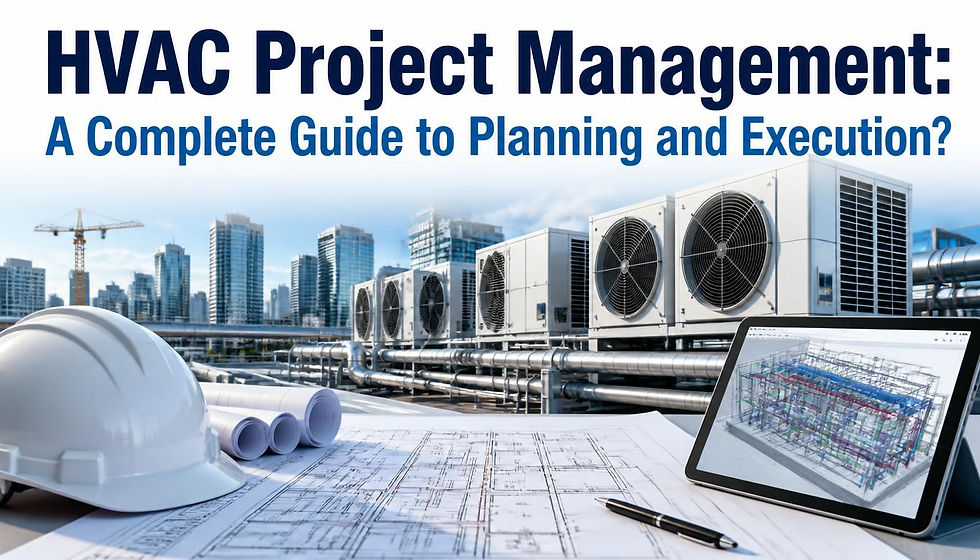
What Is HVAC Project Management?
HVAC project management is the coordinated planning, execution, monitoring, and completion of HVAC work within a defined scope, budget, schedule, and quality standard.
It applies to commercial buildings, industrial facilities, healthcare environments, educational institutions, residential developments, data centers, retail facilities, and infrastructure projects.
An HVAC project can involve equipment selection, load calculations, ductwork, piping, controls, insulation, electrical interfaces, equipment installation, testing, balancing, commissioning, and final documentation.
The project manager must ensure these activities occur in the correct sequence while coordinating engineers, contractors, suppliers, technicians, inspectors, owners, and other trades.
Why HVAC Projects Require Specialized Management
HVAC projects are highly interdependent. A change in equipment selection can affect electrical requirements, structural support, controls, ductwork, commissioning, energy consumption, and project cost.
A delay in equipment delivery can also prevent installation from progressing, which can then affect ceiling closure, electrical work, controls installation, and final commissioning.
Industry practice indicates that the strongest HVAC project outcomes depend on early coordination rather than attempting to resolve conflicts after installation begins.
The project manager therefore needs both conventional project-management capabilities and sufficient technical understanding to recognize HVAC-specific risks.
The HVAC Project Lifecycle
The HVAC project lifecycle generally progresses through several connected phases: project definition, design coordination, procurement, preconstruction planning, installation, testing, commissioning, closeout, and handover.
Each phase generates information that affects subsequent activities.
For example, incomplete design information can delay procurement, while late procurement can compress the installation schedule. Compressed installation schedules can then increase labor requirements and commissioning pressure.
Effective HVAC project management treats these phases as an integrated system rather than independent activities.
HVAC Project Planning and Scope Management
Detailed planning is essential because HVAC projects can experience substantial cost and schedule problems when scope, responsibilities, interfaces, and technical requirements are unclear before field work begins.
Define the Project Scope
The project scope should identify precisely what HVAC work is included and excluded.
Scope may include equipment, ductwork, piping, insulation, controls, supports, electrical connections, testing, balancing, commissioning, documentation, and maintenance training.
Ambiguous scope creates disputes, especially when responsibilities overlap with electrical, plumbing, architectural, structural, or building automation contractors.
A clear scope statement should establish deliverables, technical standards, project boundaries, assumptions, exclusions, and acceptance criteria.
Develop the Work Breakdown Structure
A work breakdown structure divides the HVAC project into manageable work packages.
Typical packages might include equipment procurement, duct installation, hydronic piping, refrigerant systems, controls, insulation, testing, balancing, commissioning, and closeout.
Breaking the project into defined components makes cost estimating, scheduling, resource planning, and progress measurement more reliable.
Each work package should have an identified owner, required inputs, dependencies, and measurable completion criteria.
Coordinate Design Information
Design coordination is one of the most important planning activities.
HVAC designs need to account for architectural layouts, structural systems, electrical requirements, plumbing, fire protection, lighting, ceilings, equipment access, maintenance clearances, and building automation.
Clashes that remain unresolved before installation can lead to field modifications, rework, schedule delays, and additional costs.
The project team should therefore review drawings, equipment schedules, specifications, shop drawings, and coordination models before releasing major work packages.
Establish Project Controls
Project controls provide the mechanisms used to monitor scope, cost, schedule, quality, and risk.
A strong control system establishes a baseline schedule, approved budget, procurement register, submittal log, request-for-information process, change-order procedure, risk register, and progress reporting cadence.
These controls create visibility before problems become difficult to correct.
HVAC Scheduling, Procurement, and Resource Management
Scheduling and procurement are critical because HVAC equipment and materials often have long lead times, while installation depends heavily on coordination with other construction activities.
Develop the HVAC Project Schedule
The HVAC schedule should reflect the actual sequence of engineering, procurement, delivery, installation, testing, and commissioning activities.
Major milestones may include design approval, equipment submittal approval, manufacturing release, equipment delivery, rough-in completion, equipment setting, controls installation, startup, testing and balancing, commissioning, and owner training.
Dependencies should be explicitly identified.
For example, ceiling installation may depend on ductwork completion, while commissioning may depend on power, controls, water flow, sensors, and equipment startup all being available.
Manage Long-Lead Equipment
HVAC equipment can include air-handling units, chillers, boilers, cooling towers, rooftop units, heat pumps, pumps, control systems, and specialized ventilation equipment.
Lead times can vary substantially depending on equipment type, manufacturer capacity, design requirements, customization, and market conditions.
Procurement planning should begin early enough to prevent equipment delivery from becoming a critical-path constraint.
The project manager should maintain a procurement tracker showing submittal status, approval dates, manufacturing status, shipping information, and expected delivery dates.
Allocate Labor and Resources
HVAC installation requires appropriate labor capacity at the correct project stage.
Resource planning should consider sheet-metal workers, pipefitters, HVAC technicians, controls specialists, testing and balancing personnel, commissioning agents, supervisors, and specialized subcontractors.
The required workforce can change significantly throughout a project.
Overstaffing increases cost, while understaffing can create schedule pressure and reduce installation quality.
Manage Material Availability
Material availability should be monitored alongside equipment procurement.
Common requirements can include duct materials, fittings, valves, dampers, piping, insulation, supports, filters, controls components, refrigerant-related materials, fasteners, and sealing products.
Material shortages can stop productive work even when labor is available.
A material tracking process should therefore distinguish between ordered, shipped, received, inspected, stored, and installed materials.
HVAC Cost Management and Change Control
Cost management is essential because HVAC projects can experience financial pressure from equipment changes, design revisions, labor productivity, material price changes, rework, procurement delays, and scope growth.
Build a Detailed HVAC Budget
The project budget should reflect the full cost of HVAC delivery rather than only equipment and installation labor.
Relevant categories can include engineering, equipment, materials, labor, subcontractors, transportation, lifting, temporary facilities, testing, commissioning, documentation, training, permits, and contingency.
A detailed budget provides a baseline against which actual project performance can be assessed.
Track Cost Performance
Project managers should monitor committed costs, actual costs, forecast costs, approved changes, pending changes, and remaining budget.
This allows financial problems to be identified before the project reaches the final stages.
A project that appears within budget because several supplier invoices have not yet arrived may actually have substantial committed liabilities.
Cost forecasting should therefore account for obligations that have been incurred but not yet invoiced.
Control Change Orders
HVAC projects frequently encounter change requests caused by design revisions, owner requirements, field conditions, equipment substitutions, coordination conflicts, and code-related requirements.
Every change should be documented and evaluated for cost and schedule consequences before implementation where contract conditions permit.
A disciplined change process should identify the reason for the change, affected scope, labor implications, material implications, schedule impact, and approval status.
Monitor Contingency
Contingency should not be treated as an unrestricted reserve for poor cost control.
It exists to address appropriate identified uncertainties and unforeseen conditions.
Project managers should track how contingency is used and distinguish legitimate project risk from preventable cost overruns caused by inadequate planning, coordination, or supervision.
HVAC Installation, Quality, and Risk Management
Installation management is critical because design quality alone does not guarantee a successful HVAC project; equipment, materials, workmanship, coordination, and testing must all meet the required performance standard.
Control Installation Quality
Quality management should begin before installation rather than relying exclusively on final inspections.
Installation teams should use approved drawings, specifications, manufacturer requirements, project standards, and documented installation procedures.
Quality checks can verify equipment positioning, supports, connections, insulation, duct sealing, piping, valves, access, labeling, controls installation, and safety requirements.
Early quality inspections are particularly valuable because defects are usually more expensive to correct after ceilings, walls, or finishes have been completed.
Manage HVAC Safety
HVAC construction involves several significant hazards, including lifting, electrical work, elevated work, hot work, pressure systems, refrigerants, confined spaces, rotating equipment, and heavy mechanical components.
Safety planning should therefore be integrated into the project schedule and work packages.
The project manager should coordinate safety requirements with supervisors and subcontractors while ensuring that required permits, procedures, training, inspections, and protective measures are in place.
Manage Project Risk
An HVAC risk register should identify threats that could affect cost, schedule, quality, safety, compliance, or system performance.
Typical risks include delayed equipment, design errors, coordination clashes, material shortages, subcontractor performance, labor availability, commissioning failures, unexpected site conditions, and scope changes.
Each major risk should have an assigned owner, probability assessment, potential impact, mitigation strategy, and response plan.
Address Commissioning Risk Early
Commissioning problems are often symptoms of issues that originated much earlier in the project.
Improper equipment installation, incomplete controls, inadequate sensor placement, incorrect piping, missing insulation, or unresolved documentation can all delay final commissioning.
The project manager should therefore treat commissioning requirements as a design and installation consideration rather than a final-stage activity.
HVAC Testing, Commissioning, and Project Closeout
Testing and commissioning are essential because an HVAC system is not successfully delivered merely because equipment has been installed and powered on.
Testing and Balancing
Testing and balancing verifies that HVAC systems are operating according to design requirements.
Activities can include airflow measurement, hydronic flow measurement, temperature verification, pressure testing, equipment performance checks, and system adjustment.
Testing and balancing should follow a coordinated plan based on approved design requirements and appropriate technical procedures.
Problems identified during this stage should be documented, assigned, corrected, and retested.
Controls and Building Automation
Modern HVAC systems increasingly depend on controls and building automation to manage temperatures, operating schedules, alarms, setpoints, equipment sequencing, and energy performance.
Controls commissioning should verify sensors, actuators, sequences, alarms, communication, trend data, and operator interfaces.
A mechanically complete system can still perform poorly if controls are incorrectly configured.
Commissioning the Complete System
Commissioning should evaluate how individual HVAC components operate together as an integrated system.
The process may identify interactions between air-handling equipment, chilled water, heating systems, ventilation, controls, electrical supply, and building automation.
Functional performance testing should confirm that systems respond correctly under expected operating conditions.
The emphasis should be on actual system performance rather than simply confirming equipment installation.
Project Closeout
Closeout typically includes final documentation, as-built drawings, warranties, operation and maintenance manuals, test reports, commissioning records, training, spare parts, deficiency resolution, and final approvals.
A complete closeout package supports future maintenance and reduces the risk that building operators lack the information needed to manage the installed systems.
The project manager should begin gathering closeout documentation well before final completion rather than attempting to assemble everything at the end.
HVAC Project Management Best Practices
The most effective HVAC project-management practices create visibility, accountability, and early intervention across the entire project lifecycle.
Use Regular Coordination Meetings
Coordination meetings should focus on decisions, dependencies, risks, and actions rather than simply reviewing status.
Participants should understand what has changed, which activities are blocked, which decisions are overdue, and which risks require management intervention.
Action items should have owners and target dates.
Maintain a Project Dashboard
A project dashboard can consolidate key information across schedule, procurement, cost, quality, safety, risks, changes, and commissioning.
Useful indicators can include equipment delivery status, schedule variance, approved change value, open RFIs, unresolved defects, safety observations, and commissioning readiness.
The goal is rapid visibility rather than excessive reporting.
Track Critical Path Activities
Critical-path activities require particular attention because delays in these activities can directly affect project completion.
HVAC equipment delivery, major equipment setting, electrical availability, controls installation, testing, balancing, and commissioning can all become schedule drivers depending on project design.
Managers should monitor these activities continuously and develop contingency actions when risk indicators emerge.
Use Data to Improve Decisions
Evidence-based project management is stronger than relying on subjective impressions.
Useful information includes actual labor productivity, procurement lead times, defect trends, schedule performance, cost commitments, change-order frequency, and commissioning deficiencies.
The data indicates where management attention should be concentrated.
For example, recurring quality issues from a particular installation team may indicate a training or supervision problem that requires intervention before the issue spreads across the project.
Build Strong Stakeholder Communication
HVAC projects depend on coordination among owners, architects, engineers, general contractors, mechanical contractors, subcontractors, suppliers, controls specialists, inspectors, and building operators.
Communication should be structured around decisions and responsibilities.
Stakeholders should understand what information is needed, when decisions are required, what risks exist, and who owns each action.
HVAC Project Management Performance Framework
A balanced performance framework is important because evaluating an HVAC project only by completion date or budget can conceal quality problems, unresolved defects, or poor system performance.
Key Performance Indicators
Appropriate KPIs depend on project objectives, but common categories include schedule, cost, quality, safety, procurement, productivity, commissioning, and customer satisfaction.
The most useful metrics are specific enough to support management decisions.
A project manager should avoid creating dozens of indicators that receive little attention. A smaller group of high-value metrics generally provides clearer visibility.
The HVAC Project Delivery Scorecard
The following HVAC Project Delivery Scorecard provides a practical framework for assessing project performance across major control areas.
Performance Area | Example KPI | Management Purpose |
Schedule | Milestone variance | Identify emerging completion risk |
Cost | Forecast cost versus approved budget | Control financial performance |
Procurement | Long-lead delivery status | Prevent equipment-related delays |
Quality | Open defects and rework rate | Identify installation problems |
Safety | Recordable incidents and corrective actions | Control site safety |
Productivity | Installed quantities versus planned quantities | Evaluate labor performance |
Commissioning | Open commissioning deficiencies | Assess system readiness |
Documentation | Closeout completion percentage | Prepare for handover |
Stakeholders | Open decisions and RFIs | Reduce coordination delays |
This approach provides a more complete assessment than relying exclusively on schedule and cost.
Use Lessons Learned
Lessons learned should be captured throughout the project rather than only during final closeout.
Important observations can include supplier performance, design coordination problems, installation productivity, recurring defects, change-order causes, commissioning challenges, and communication failures.
These lessons can improve future estimates, schedules, procurement strategies, subcontractor selection, and project controls.
FAQ: HVAC Project Management
What does an HVAC project manager do?
An HVAC project manager coordinates the technical, commercial, scheduling, procurement, quality, safety, and stakeholder requirements associated with an HVAC project. Responsibilities can extend from initial planning and design coordination through equipment procurement, installation, testing, commissioning, documentation, and handover. The role requires both project-management capabilities and enough HVAC knowledge to recognize technical dependencies and delivery risks.
What are the most important phases of an HVAC project?
The most important phases generally include scope definition, design coordination, procurement, preconstruction planning, installation, testing and balancing, controls integration, commissioning, and closeout. Each phase affects subsequent activities, so project managers should treat them as interconnected rather than independent stages. Early decisions about design, equipment, sequencing, and procurement can have significant effects on later installation and commissioning performance.
How can HVAC project managers prevent cost overruns?
Preventing cost overruns requires a detailed baseline budget, disciplined scope control, accurate procurement tracking, change-order management, labor monitoring, and regular cost forecasting. Managers should distinguish approved commitments from actual invoices and identify emerging risks early. Strong design coordination also reduces rework, while clear contract responsibilities can prevent disputes over work that was not adequately defined during project planning.
What causes HVAC projects to be delayed?
Common causes include late design information, equipment lead times, material shortages, coordination conflicts, labor constraints, unresolved RFIs, scope changes, site access problems, incomplete electrical or controls work, and commissioning deficiencies. Delay prevention requires more than monitoring the final completion date. Project managers should identify dependencies and critical-path activities early, then develop mitigation strategies before individual delays spread across multiple trades.
Why is commissioning important in HVAC project management?
Commissioning verifies that the completed HVAC system performs according to the intended design and operational requirements. Installation alone does not demonstrate effective system performance because equipment, controls, sensors, airflow, water flow, and sequences must operate together. Effective commissioning identifies deficiencies before turnover and provides building operators with greater confidence that the system can be operated and maintained as intended.
Which KPIs should be used for HVAC projects?
Useful HVAC project KPIs include schedule variance, forecast cost, procurement status, equipment delivery performance, defect levels, rework, installation productivity, safety performance, commissioning deficiencies, and closeout completion. KPI selection should reflect the project's specific objectives. The strongest dashboards focus on indicators that support management decisions, identify emerging problems, and demonstrate whether the project is moving toward successful operational handover.
Conclusion: HVAC Project Management: A Complete Guide to Planning and Execution
Effective HVAC project management connects engineering, procurement, construction, cost control, scheduling, quality, safety, commissioning, and stakeholder coordination into one integrated delivery process.
The strongest projects begin with a clearly defined scope, coordinated design information, realistic schedules, detailed budgets, early procurement planning, and clear responsibility for each work package.
Execution then depends on disciplined project controls. Managers need continuous visibility into equipment deliveries, labor requirements, cost commitments, changes, installation quality, safety performance, critical-path activities, and unresolved technical issues.
Commissioning deserves particular attention because the successful installation of HVAC equipment does not guarantee effective system performance. Testing, balancing, controls verification, functional testing, documentation, and operator training are necessary to demonstrate that the complete system performs as intended.
Future Outlook
Over the next two years, HVAC project management is likely to become increasingly data-driven. Project teams will make greater use of digital coordination platforms, automated reporting, building information modeling, connected equipment data, mobile field applications, and predictive analytics.
Artificial intelligence is also likely to support schedule-risk detection, procurement monitoring, document analysis, design coordination, and identification of recurring quality issues. These tools can improve visibility, but effective project management will still depend on experienced professionals making decisions about priorities, technical constraints, commercial risk, and stakeholder requirements.
The strongest HVAC project-management organizations will increasingly treat the discipline as an integrated project-controls function rather than simply an installation-management role. Better coordination between design, procurement, construction, controls, testing, and commissioning will remain a major determinant of successful project delivery.
Tags: HVAC Project Management, HVAC Project Planning, HVAC Construction Management, HVAC Project Scheduling, HVAC Commissioning


