
7 Best Hootsuite Alternatives For Regulated And Enterprise Teams In 2026


TL;DR: What's the best Hootsuite alternative for regulated teams in 2026?
For most regulated teams leaving Hootsuite, Planable is the strongest pick: approval can be made mandatory or multi-level, with a version trail that proves who approved what, in which version, and when. Hootsuite still wins on mature enterprise listening and an established security footprint, fair where broad monitoring outranks provable sign-off. The ranked list is below.
The auditor asked for the approval record of a post published eleven months earlier. The team produced it in four minutes: version, approver, checklist, timestamp. That is the test of a publishing tool in a regulated industry: can it prove, months later, who approved what and when?
Teams in banking, insurance, healthcare, and pharma are moving off Hootsuite for that reason. Its entry plan runs $99/user/month, with much of its approval depth in higher tiers. This guide ranks seven Hootsuite alternatives through one lens: provability.
What a regulated team actually needs from a Hootsuite alternative
For a regulated team, tool selection is a governance question first: six requirements decide the shortlist.
Mandatory approvals. Nothing should reach a publishing queue unapproved, so the tool must enforce sign-off, not merely offer a button.
Four-eyes and multi-level sign-off. A designer drafts, a market lead reviews, legal clears regulated claims, and the stages advance in order. On silence, it escalates; it never ships by default.
Role separation. Drafting and publishing must be different permissions held by different people, who are rarely in one room: Gartner forecast 39% of knowledge workers hybrid by the end of 2023, so the chain must hold across locations.
A version trail. Every change from draft to published post should be recorded and reversible: "approved" means approved against a specific version.
Market-specific review. A claim compliant in one country can be reportable in another, so reviewer chains differ per market.
Security at the enterprise tier. Regulated data governance is not free: Gartner forecasts worldwide information security spending to total $213 billion in 2025, and social teams sit inside that spend.
Scale adds pressure: LinkedIn alone now counts 1.3 billion members. The table ranks the seven, Hootsuite as the anchor.
Rank | Tool | Approval depth | Roles & permissions | Audit trail / version history | vs Hootsuite | Price |
- | Hootsuite | Higher tiers | Granular at Enterprise | Limited native trail | anchor | $99/user/mo |
1 | Planable | None to multi-level | 6 roles, customizable | Version history + revert | More provable | From $33/ws/mo |
2 | Sprout Social | By tier | Role-based; SSO higher | Reporting-grade records | Deeper analytics | $199/seat/mo |
3 | Sprinklr | Enterprise | Enterprise model | Enterprise audit tooling | More depth | ~$50k+/yr |
4 | Agorapulse | Required | Roles + assignments | Activity logs | Cleaner inbox | $79/user/mo |
5 | Sendible | Workflows | Roles; unlimited seats | Basic history | Unlimited seats | $29/mo |
6 | Loomly | Post-approval | Roles | Basic versioning | Simpler approvals | $49/mo |
7 | Zoho Social | By tier | Roles | Basic activity log | Lower cost | $15/mo |
1. Planable

Planable is a collaboration-first social media management tool built around provable approvals.
Best for: regulated and enterprise teams needing mandatory, multi-level sign-off with a version trail.
Standout: Approval workflows are set per workspace, from none to optional to required to multi-level, so a designer, legal, and a market lead each sign in sequence before anything schedules. Six roles, Owner, Administrator, Contributor, Writer, Approver, and Guest, separate drafting from publishing.
vs Hootsuite: Hootsuite carries broader integrations, more mature enterprise listening, and a longer security track record at Enterprise. Planable answers the governance question more directly, with approval workflows that separate draft from publish, a version history you can revert, and a post activity log recording who changed what. For proving sign-off across markets, that architecture is the point.
Pros:
Approvals from none to multi-level, set per workspace
Six preset roles, customizable per user
Version history with revert plus a post activity log
A workspace per brand or market for isolated reviewer chains
Cons:
Analytics and social inbox are paid add-ons
Multi-level approvals are Enterprise-only, and there is no white-label
The regulated-claims checklist still lives in your compliance stack, not the tool
Pricing: From $33/workspace/mo (billed annually; $39 month-to-month); Enterprise from $200/month, custom pricing.
The record shows: Approved is a fact, not a feeling, and Planable records it: version, approver, timestamp, assembled as a by-product of the workflow. Multi-level sits behind Enterprise and analytics costs extra. The audit trail builds itself. Findings: none.
2. Sprout Social

A premium social media suite built on best-in-class analytics and reporting.
Best for: enterprise teams that weight reporting and listening as heavily as approvals.
Standout: Sprout pairs polished reporting with approval workflows and role-based access, with SSO at higher tiers. For a regulated team the draw is defensible reporting: records that hold up when an auditor asks what ran.
vs Hootsuite: Hootsuite still wins on integration breadth and, at Enterprise, a longer-established support and governance footprint. Sprout counters with deeper native analytics and cleaner reporting exports, which matter when your compliance story depends on showing outcomes, not just posts published.
Pros:
Best-in-class reporting
Strong listening at higher tiers
SSO and role-based access on upper plans
Cons:
Expensive per seat
Governance features gated to top tiers
Pricing: Essentials from $79/seat/mo; Standard $199/seat/mo (billed annually).
The record shows: Sprout proves performance better than most and approval adequately. The gap is cost: per-seat pricing climbs fast across markets, and the governance you need sits in upper tiers. Strong reporting, priced accordingly.
3. Sprinklr

An enterprise CXM suite where social is one channel among many.
Best for: large enterprises consolidating social, care, and listening in one system.
Standout: Sprinklr offers enterprise-grade governance, AI, and omnichannel breadth well beyond publishing. For the largest regulated organizations its controls and audit capabilities are genuinely deep, though with a long implementation and a matching contract.
vs Hootsuite: Hootsuite is easier to adopt and integrates more readily for mid-sized teams, with no multi-month rollout. Sprinklr wins on governance and listening depth at enterprise scale, but for most teams leaving Hootsuite it is more system than the mandate requires.
Pros:
Enterprise governance and audit depth
Omnichannel breadth
Mature AI and listening
Cons:
No self-serve
3-6 month implementation and cost far beyond most teams
Pricing: No self-serve; enterprise contracts commonly $50k+/year.
The record shows: Sprinklr can prove almost anything, given the budget. For a focused governance mandate, you would be buying a CXM platform to solve an approval question: a large purchase for a small problem.
4. Agorapulse

A collaboration and engagement tool with a strong unified inbox.
Best for: mid-market teams balancing approvals with high-volume engagement.
Standout: Agorapulse pairs required approvals with assignments and solid reporting, so drafts route to a reviewer before publishing and engagement work is tracked to a person. Its unified inbox is a genuine strength for teams answering at volume across networks.
vs Hootsuite: Hootsuite offers broader integrations and deeper enterprise listening. Agorapulse answers with a cleaner unified inbox and more approachable collaboration, plus assignment tracking that shows who handled what. For approval and engagement in one place it is the tidier fit; for enterprise listening, Hootsuite stays ahead.
Pros:
Excellent unified inbox
Approvals with assignments
Solid ROI reporting
Cons:
Per-user pricing
Profile caps on standard tiers can force upgrades
Pricing: Standard $79/user/mo, billed annually.
The record shows: Agorapulse records who approved and who replied, covering two governance questions at once. Multi-market depth and formal four-eyes chains are lighter than a bank needs. Capable, engagement-first, mid-market by design.
5. Sendible

An agency-oriented tool with unlimited seats and white-label reporting.
Best for: teams and agencies managing many client or market accounts.
Standout: Sendible includes unlimited users on every tier and role-based permissions, so more reviewers add no cost. Approval workflows route content for client or legal sign-off, and white-label dashboards suit teams presenting to stakeholders.
vs Hootsuite: Hootsuite has the larger integration directory and stronger native listening. Sendible wins on seat economics: unlimited users at every tier, where Hootsuite charges the full rate per seat. For a wide review group that needs many named approvers, Sendible keeps the cost flat while Hootsuite scales up.
Pros:
Unlimited seats at every tier
White-label reporting
Role-based permissions
Cons:
Interface feels dated to some
Profile caps per tier
Pricing: Core from $29/mo, unlimited users (billed annually).
The record shows: Sendible solves the reviewer-count problem cleanly: many approvers, one flat cost. Version records and market controls are lighter than a strict regulated chain demands. Strong for wide teams, thinner on provability.
6. Loomly
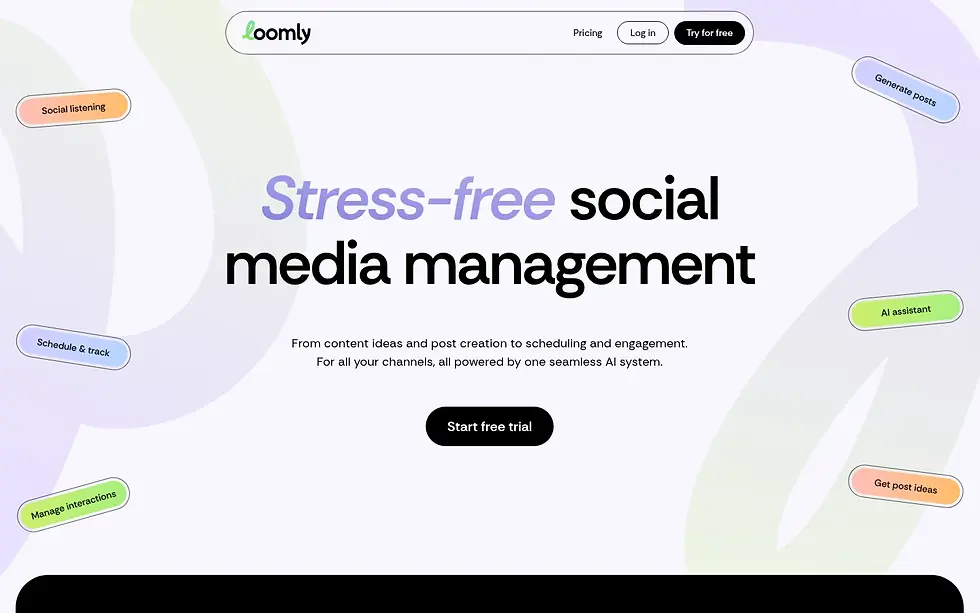
A workflow-first tool built around post approvals.
Best for: smaller marketing teams that want clean sign-off without heavy setup.
Standout: Loomly organizes content around an approval flow, so posts move through review states before publishing, with comments at each step. For teams needing a single reliable sign-off rather than a multi-stage chain, it is quick to adopt.
vs Hootsuite: Hootsuite carries broader integrations, deeper analytics, and more mature listening. Loomly counters with a simpler, more focused approval experience that smaller teams learn faster. It does less overall, but its review flow is cleaner for sign-off; enterprise listening and scale remain Hootsuite's.
Pros:
Clean approval and collaboration flow
Easy to adopt
Content-idea prompts
Cons:
Analytics and listening are basic
Large price gap between tiers
Pricing: Starter from $49/mo (billed annually).
The record shows: Loomly proves a single approval well and keeps the record readable. Multi-level chains and deep version retention are outside its range. A fair fit for lighter governance, short of a regulated mandate.
7. Zoho Social

A cost-effective tool, strongest inside the Zoho ecosystem.
Best for: teams already on Zoho that want publishing, monitoring, and basic approvals.
Standout: Zoho Social offers roles, approval steps, and monitoring at a low price, and connects tightly to Zoho CRM. For an organization standardized on Zoho, its shared identity and admin layer support governance already in place.
vs Hootsuite: Hootsuite has wider third-party integrations and more mature listening. Zoho counters on cost and native fit for existing Zoho customers, where user management and security ride on the suite you already run. Outside it, Hootsuite's breadth pulls ahead.
Pros:
Low cost
Solid publishing and monitoring
Roles and approval steps
Cons:
Listening and analytics lighter than premium tools
Best value locked to the Zoho stack
Pricing: Business Standard from $15/mo; Agency from $320/mo (billed annually).
The record shows: Zoho carries basic approvals and roles, and inside its own ecosystem the governance story holds. For a standalone regulated mandate with strict chains, it reaches its limit early. Value first, depth second.
The verdict
For most regulated and enterprise teams leaving Hootsuite, Planable is the strongest pick: it makes approval a recorded event, with mandatory or multi-level sign-off and a version trail that answers the auditor's question. Sprout Social and Sprinklr go deeper on analytics and enterprise breadth, at higher cost.
When Hootsuite still fits
Hootsuite is not wrong for everyone. Its listening and monitoring are mature and enterprise-grade, and its integration directory is among the largest in the category. It can be integrated even with AI Overviews Trackers. Its Enterprise tier brings an established security and support record with granular roles. If broad listening and wide integrations matter more than multi-level approvals, Hootsuite earns its place.
FAQ
What's the best Hootsuite alternative for regulated industries?
Planable, for most teams. It records approval as a fact: mandatory or multi-level sign-off, six customizable roles separating drafting from publishing, and a version history you can revert. Sprout Social fits teams weighting analytics equally; Sprinklr suits only the largest enterprises.
Can you prove who approved a social post, in which version, and when?
With the right tool, yes. Planable's post activity log and version history record each change and approval with a timestamp, so the sign-off is reconstructable months later. Provability, not scheduling volume, separates a governance-ready tool from a convenient one.
Does the tool support multi-level or four-eyes approval?
It varies. Planable offers none, optional, required, and multi-level approval, with multi-level reserved for Enterprise. Sprout, Sprinklr, and Agorapulse support approval chains at higher tiers. Loomly and Zoho Social handle a single sign-off but are lighter on multi-stage chains.
Is there an audit trail or version history for social posts?
The depth differs by tool. Planable keeps version history with revert, retained one week on Basic, 30 days on Pro, and unlimited on Enterprise, alongside a post activity log. Most alternatives log activity; retention length and exact-version revert are where they diverge.
hootsuite alternatives, best hootsuite alternatives, alternatives to hootsuite, hootsuite competitors, social media management tools, hootsuite alternative for agencies


