
End to End Project Management: Ensuring Success from Concept to Completion

Project initiatives whether they are a digital transformation, banking program, or software rollout require effective end to end project management. This approach ensures that every phase, from concept to delivery, operates under a unified governance and strategic vision.
End to end project management is far more than a project plan or Gantt chart. It represents a structured framework where leadership, execution, and accountability merge to deliver results aligned with business strategy. Corporations use it to control risk, optimize costs, and ensure every project component supports measurable objectives.
This blog explores how large organizations implement end to end project management, the tools and governance required, and how PMOs lead this process to deliver consistent value and performance.
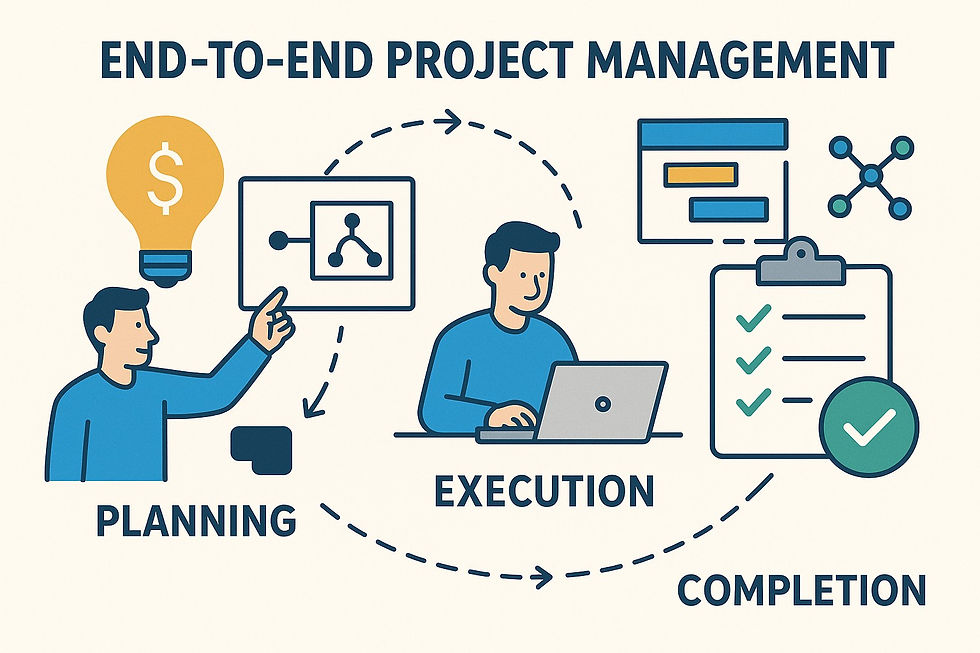
What Is End to End Project Management?
End to end project management is a holistic approach that covers the entire project lifecycle from initial concept and feasibility analysis to delivery, handover, and performance evaluation. It ensures seamless coordination between strategy, execution, and operations.
Rather than focusing only on one phase (like planning or execution), end to end project management integrates:
Strategic alignment (why the project exists)
Delivery control (how the project is executed)
Operational readiness (how outcomes are sustained after delivery)
This model is particularly effective in large corporations where projects must integrate across departments, technologies, and geographies.
Why Corporations Adopt End to End Project Management
Enterprise projects are complex by nature. They require clarity, control, and continuous alignment with strategic priorities.
1. Strategic Visibility
Corporate leaders need a full view of project health across all stages to ensure resources and funding are optimized.
2. Risk Management
End to end management provides structured checkpoints where risks are identified, evaluated, and mitigated.
3. Accountability
By defining ownership across all phases, organizations reduce ambiguity and improve accountability at every level.
4. Efficiency and Cost Control
Standardized frameworks eliminate redundancy, reduce rework, and ensure timely decision-making.
5. Governance Integration
End to end project management supports enterprise governance frameworks such as PMO standards, risk compliance, and ESG reporting.
This level of control turns projects into predictable, auditable investments rather than unpredictable initiatives.
The Lifecycle of End to End Project Management
A well-defined lifecycle ensures consistent governance from the moment a project is conceived until it transitions into operations.
1. Concept and Feasibility
This initial phase defines the business problem, potential benefits, and feasibility of execution. Deliverables include:
Business case development
Cost-benefit analysis
Risk assessment
Initial stakeholder engagement
2. Planning and Design
Once approved, detailed planning begins. Corporate teams develop timelines, budgets, and design specifications.Key activities include:
Defining scope and objectives
Establishing performance metrics
Resource allocation
Procurement strategy
Governance plan creation
3. Execution and Delivery
This phase converts plans into tangible results. The project manager coordinates multiple workstreams, contractors, and departments.Critical focus areas:
Schedule tracking
Budget adherence
Risk and issue management
Quality assurance
4. Monitoring and Control
Real-time monitoring through PMO dashboards ensures that performance aligns with expectations. Adjustments are made as needed to maintain efficiency.
5. Closure and Handover
After final deliverables are approved, the project transitions to the operations or maintenance team.The PMO ensures that:
All documentation is complete
Lessons learned are captured
Benefits realization metrics are validated
6. Post-Implementation Review
A final review measures the project’s long-term value and alignment with strategic goals.
This structured approach ensures that no phase operates in isolation, and that the project remains strategically relevant throughout its lifecycle.
Governance in End to End Project Management
Governance provides the backbone for effective end to end project management. Without it, even well-planned initiatives risk failure.
Corporate Governance Components Include:
Project Charter Approval: Establishes authority, objectives, and budget.
Decision Gate Reviews: Ensures each phase meets predefined performance criteria.
Financial Oversight: Budgets are monitored through centralized reporting systems.
Risk Governance: Major risks are escalated to enterprise risk committees.
Audit and Compliance Reviews: Maintain transparency and accountability.
By embedding governance in every phase, organizations maintain control over quality, cost, and schedule while minimizing exposure to reputational or operational risk.
The Role of the PMO in End to End Project Management
The Project Management Office (PMO) plays a pivotal role in orchestrating enterprise-level oversight across the entire project lifecycle.
PMO Responsibilities Include:
Establishing standardized frameworks and methodologies.
Defining performance metrics and dashboards.
Monitoring delivery progress across portfolios.
Providing executive reporting and risk analysis.
Ensuring that project outcomes align with corporate objectives.
The PMO acts as both the guardian of governance and the enabler of delivery excellence. It bridges strategy and execution, ensuring consistency across global operations.
Integration Across Departments and Systems
In corporate settings, end to end project management depends on seamless cross-functional collaboration.
Typical Integration Points Include:
Finance: Budgeting, forecasting, and cost control.
Procurement: Vendor management and contract compliance.
Human Resources: Workforce planning and performance management.
IT: Data management, security, and systems integration.
Legal and Compliance: Regulatory adherence and documentation.
By ensuring that all departments work within the same governance framework, corporations eliminate silos and create a unified delivery ecosystem.
Technology Supporting End to End Project Management
Digital transformation has redefined how corporations manage projects from start to finish.
Commonly Used Corporate Tools Include:
Daptiv PPM: For portfolio visibility and resource management.
Primavera P6: For scheduling and complex dependency control.
Microsoft Project Online: For centralized planning and execution.
Power BI or Tableau: For data visualization and executive dashboards.
SharePoint or Confluence: For document and knowledge management.
These technologies provide real-time transparency across portfolios, enabling faster decisions and more predictable outcomes.
Risk and Compliance in Corporate Delivery
Large-scale projects often carry significant financial, operational, and reputational risks.
Risk Management Process Includes:
Identification: Recognizing internal and external threats early.
Assessment: Measuring the impact and probability of each risk.
Mitigation: Designing action plans and contingency strategies.
Monitoring: Tracking residual risk and compliance progress.
Reporting: Providing visibility to executive leadership and regulators.
Compliance integrates closely with risk management to ensure that all activities adhere to corporate and industry standards such as ISO 9001 or SOX regulations.
Performance Measurement and KPI Frameworks
For end to end project management to succeed, corporations must measure performance using clear, standardized indicators.
Typical KPIs Include:
Schedule variance
Budget variance
Risk resolution rate
Stakeholder satisfaction index
Benefits realization metrics
These KPIs provide the PMO and executives with quantifiable insights into project performance and overall portfolio health.
Resource and Workforce Management
Managing human capital is central to successful end to end delivery.
Corporate Resource Management Practices Include:
Workforce capacity planning.
Cross-functional resource allocation.
Contractor and vendor integration.
Skill tracking and development programs.
Forecasting workload to prevent bottlenecks.
Optimizing workforce utilization reduces delays and improves morale across distributed teams.
Cost and Budget Control
Financial discipline ensures that corporate projects remain viable throughout their lifecycle.
Cost Control Techniques Include:
Baseline budgeting and variance analysis.
Earned Value Management (EVM) to track cost and progress.
Integrated financial dashboards for real-time reporting.
Continuous review of procurement contracts and change requests.
By integrating financial data into PMO systems, leadership maintains full visibility of portfolio performance and ROI.
Communication and Stakeholder Management
Large corporate projects often involve numerous stakeholders executives, clients, regulators, and vendors.
Communication Strategies Include:
Weekly steering committee updates.
Executive dashboards for quick insights.
Formal change management communications.
Transparent escalation channels for risk and issues.
Stakeholder surveys to gauge satisfaction.
Effective communication maintains trust, alignment, and accountability across the organization.
Quality Assurance Across the Project Lifecycle
Quality control is embedded at each stage of end to end project management.
Corporate Quality Processes Include:
Design and requirements reviews.
Independent quality audits.
Continuous improvement loops.
Formal acceptance testing.
Post-project quality evaluations.
This ensures consistent standards across projects and contributes to organizational maturity.
Benefits Realization and Post-Project Evaluation
One of the defining aspects of end to end project management is its focus on outcomes, not just outputs.
Benefits Realization Involves:
Tracking whether project objectives delivered measurable value.
Comparing expected ROI to actual results.
Identifying lessons learned for future improvement.
By quantifying benefits, corporations ensure that investments produce tangible results rather than activity for its own sake.
Challenges in End to End Project Management
Even well-structured corporate frameworks face challenges such as:
Misaligned stakeholder expectations.
Poor cross-departmental communication.
Overly complex governance requirements.
Limited executive engagement.
Inconsistent data across systems.
These challenges are mitigated through strong leadership, clear KPIs, and the strategic involvement of the PMO throughout all stages.
Future Trends in End to End Project Management
Corporate project delivery continues to evolve alongside technology and organizational culture.
Emerging Trends Include:
AI-Driven Forecasting: Predictive analytics for scheduling and risk management.
Integrated Hybrid Delivery Models: Combining Agile and Waterfall under unified governance.
ESG Integration: Measuring sustainability impact as part of project success.
Data-Driven Decision-Making: Enhanced through real-time dashboards.
Automation of Reporting: Using robotic process automation (RPA) to streamline PMO updates.
These trends are transforming end to end project management from a linear process into a dynamic, data-driven discipline.
Conclusion
End to end project management represents the gold standard of corporate delivery excellence. It aligns strategic vision with operational execution, ensuring that every stage of the project lifecycle is managed with transparency, accountability, and precision.
By adopting this model, corporations achieve stronger governance, greater efficiency, and measurable value from every initiative. Supported by PMOs, digital tools, and clear communication, end to end project management transforms complexity into clarity and intention into results.
As organizations pursue continuous improvement, this holistic approach will remain a cornerstone of sustainable business success.
Professional Project Manager Templates are available here
Key Learning Resources can be found here:
Hashtags
#EndToEndProjectManagement #CorporateGovernance #ProjectExecution #PMO #RiskManagement #BusinessStrategy


