
Change Enablement Process: A Framework for Successful Organizational Change

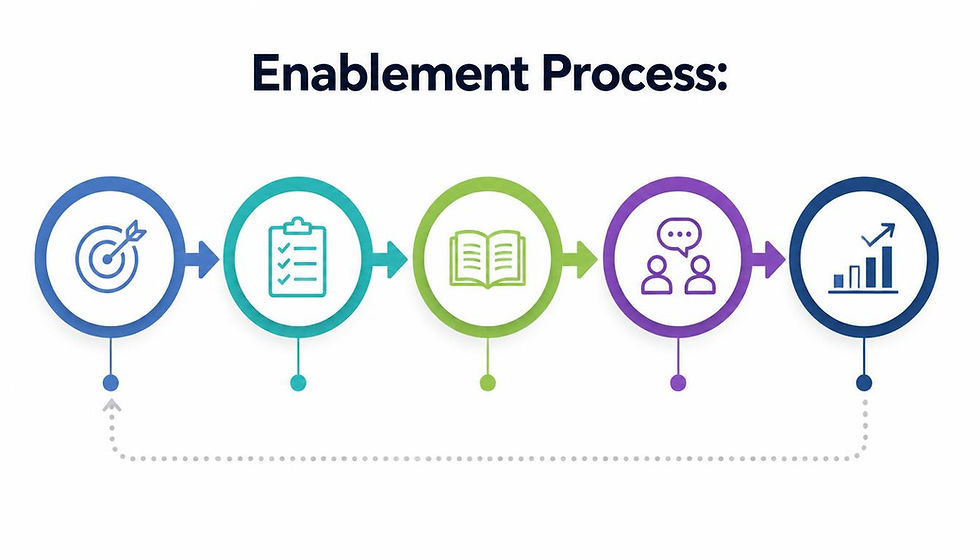
A change enablement process provides the operating mechanism for moving an organization from its current state to a defined future state and making that future state sustainable. It connects leadership, stakeholder engagement, communications, capability development, process change, technology adoption, behavioral reinforcement, and measurement around a specific transformation.
That makes change enablement considerably broader than communication and more operational than a high-level change strategy.
A new technology platform can be deployed successfully while employees continue using spreadsheets and legacy systems. A redesigned operating model can be formally implemented while managers continue making decisions according to the previous structure. A new process can be documented and trained without becoming the way work is actually performed.
These situations expose a fundamental distinction:
Implementation delivers the change. Adoption makes the change real.
A mature change enablement process is designed around that distinction. It identifies what people must understand, what they must be able to do, which behaviors must change, what leaders must reinforce, and which organizational conditions could prevent adoption.
The objective is not to eliminate resistance or persuade everyone to feel positive about change. It is to create the conditions in which the intended future state can operate effectively.
Change Enablement Begins With the Future State
The quality of change enablement depends on how precisely the underlying change has been defined. Organizations often start with a communications calendar, training plan, or stakeholder list before establishing exactly what will be different when the project is complete.
That reverses the logical sequence.
A strong change enablement process begins with three connected states:
Current state: How the organization operates today.
Future state: How it is expected to operate after the change.
Transition state: What must happen to move from one to the other.
The transition state is particularly important because the future state rarely appears immediately after implementation.
A new enterprise platform may require revised processes, new skills, changed roles, updated data, different approval mechanisms, and temporary support arrangements. Those requirements are part of the change, not administrative details surrounding it.
Define the change in behavioral terms
"Implement a new CRM" is a technology objective.
"Sales teams will manage customer opportunities, activities, and forecasts through the new CRM rather than local spreadsheets" describes an operational change.
The second formulation creates a much stronger foundation for enablement because it identifies the behavior that needs to change.
A useful change definition should establish:
what is changing
why it is changing
who is affected
what people will do differently
what capabilities are required
which processes and systems are changing
what leadership behaviors must change
what happens if adoption is incomplete
how adoption will be measured
The final point is important. If success cannot be observed or measured, the organization cannot reliably determine whether the change has been adopted.
Assess Change Impact Before Designing Interventions
Change impact assessment determines how the future state will affect different stakeholder groups, roles, processes, technologies, capabilities, and behaviors.
The impact is rarely uniform.
A new financial system may radically change the work performed by finance analysts while having relatively little effect on senior executives. A revised approval structure may significantly affect managers while barely changing the activities of frontline employees.
This means stakeholder lists are insufficient on their own.
Impact area | Questions to assess | Potential enablement response |
Roles | Which responsibilities, activities, or accountabilities change? | Role clarification, manager enablement, targeted communications |
Processes | Which workflows change and which legacy processes disappear? | Process education, simulations, procedures, job aids |
Technology | Which systems, interfaces, or tools change? | Training, guided adoption, support |
Skills | What new knowledge or capabilities are required? | Learning, coaching, practice |
Behaviors | What must people start, stop, or continue doing? | Leadership reinforcement, coaching, performance mechanisms |
Decision rights | Who gains, loses, or shares authority? | Governance clarification, leadership alignment |
Organization | Which teams, structures, or reporting relationships change? | Stakeholder engagement, transition planning |
Performance | Which measures, objectives, or expectations change? | Updated performance mechanisms and reporting |
Customers | What changes for customers or external partners? | Service readiness and targeted communications |
Risk | What happens if adoption is weak? | Mitigation plans, monitoring, intervention |
This analysis prevents a common mistake: assuming every adoption problem can be solved through training.
Training addresses capability.
It does not resolve an inefficient process, conflicting incentives, unclear accountability, poor technology, inadequate management support, or contradictory leadership behavior.
Those problems require different interventions.
Segment Stakeholders According to Their Experience of the Change
Effective change enablement does not treat the organization as one homogeneous audience.
Stakeholders should be segmented according to factors such as:
level of impact
influence over adoption
required behavioral change
capability gap
readiness
operational dependency
leadership responsibility
exposure to risk
Consider a hypothetical operating-model transformation.
Business users may need to learn new processes.
Managers may need to adopt new approval responsibilities.
Senior leaders may need to change governance and decision-making behavior.
Technology teams may need to modify systems but experience limited changes to their daily business processes.
Customers may experience changes in service channels without knowing anything about the internal transformation.
Each group requires a different enablement approach.
Managers are a critical adoption layer
Managers deserve particular attention because they sit between enterprise leadership and operational employees.
Employees often encounter a transformation through their manager before they experience it through formal corporate communication.
Managers interpret the implications, answer practical questions, allocate work, reinforce expectations, identify local problems, and determine whether old behaviors continue to be tolerated.
Manager enablement should therefore address more than presentation materials.
Managers need to understand:
why the change is occurring
what specifically changes for their teams
what concerns they are likely to encounter
what behaviors they must reinforce
what they should escalate
what decisions they can make locally
what evidence demonstrates adoption
A manager who understands the change can translate strategy into operational behavior.
Build an Integrated Change Enablement Strategy
Once the change impacts are understood, the organization can design the intervention portfolio.
A mature strategy may combine:
executive sponsorship
stakeholder engagement
communications
manager enablement
training
coaching
readiness assessments
pilot programs
change champions
job aids
process support
transition assistance
adoption analytics
reinforcement mechanisms
These components should not operate as isolated workstreams.
For example, training users on a new process before process ownership and exception handling have been resolved can create confusion rather than readiness.
Likewise, announcing a mandatory new system without providing realistic opportunities to practice creates a capability gap that communications cannot solve.
The strategy should therefore follow the actual adoption journey.
A Seven-Stage Change Enablement Process
Although organizations use different terminology, a practical change enablement lifecycle can be structured into seven stages.
1. Define
Establish the case for change, future state, scope, impacted populations, expected behaviors, and success measures.
The output is a precise definition of the change and its intended outcome.
2. Assess
Analyze stakeholder impacts, organizational readiness, capability gaps, dependencies, resistance factors, risks, and adoption barriers.
This assessment should directly influence intervention design.
3. Design
Develop the enablement strategy, stakeholder segmentation, communications approach, learning strategy, manager plan, readiness model, transition approach, and adoption measures.
4. Prepare
Prepare leaders, managers, employees, processes, technology, training, support arrangements, and change networks for transition.
Preparation should begin well before go-live.
5. Transition
Support the organization as the new state becomes operational.
Activities may include training, coaching, floor support, help desks, office hours, targeted communications, issue escalation, and rapid feedback.
6. Adopt
Measure whether people are actually using the new processes, systems, behaviors, and decision mechanisms.
This is where the organization moves beyond participation metrics and starts measuring outcomes.
7. Sustain
Reinforce the future state through leadership behavior, performance management, governance, process controls, ongoing learning, and continuous improvement.
This final stage is essential because adoption can weaken after the initial implementation period.
Readiness Is More Than Training Completion
Training completion is easy to measure, but it is an incomplete indicator of readiness.
Someone can complete a course without being capable of performing the new process independently. Conversely, someone can understand a new process but be unable to use it because the necessary system, permissions, or management support are unavailable.
A stronger readiness assessment examines several dimensions:
Awareness: Does the individual know that the change is happening?
Understanding: Do they understand why it is happening and what it means?
Capability: Can they perform the required activities?
Confidence: Are they sufficiently comfortable performing them?
Opportunity: Does the operating environment allow the new behavior?
Reinforcement: Do leadership, processes, systems, and performance expectations support it?
This distinction between individual readiness and organizational readiness is critical.
A technically trained workforce can still fail to adopt a change if the surrounding operating model contradicts the desired behavior.
Design Communications Around Decisions and Actions
Change communications are most effective when they answer the questions stakeholders need answered.
These typically include:
Why is the change happening?
What is changing?
What is not changing?
How will my work be affected?
When does the change occur?
What do I need to do?
What support will be available?
What happens to the existing process?
Where can I raise concerns?
Communication should also evolve.
Early communications establish the rationale and direction.
Pre-transition communications focus on practical implications, preparation, training, and expectations.
Go-live communications focus on immediate actions and support.
Post-implementation communications reinforce the future state and address emerging issues.
A single announcement cannot carry the entire adoption journey.
Training Should Build Capability, Not Just Awareness
Training should be designed around what each role actually needs to perform.
A role-based learning model considers:
what the role needs to know
what the role needs to do
what decisions it makes
which systems it uses
which exceptions it encounters
what evidence demonstrates competence
A senior manager, system administrator, occasional user, and frontline operator should not necessarily receive identical training.
Where possible, training should include realistic scenarios, simulations, practice environments, exercises, and job aids.
The objective is to shorten the distance between learning and actual work.
Leadership Reinforcement Determines Whether the Future State Becomes Normal
Leadership sponsorship is often reduced to executive messaging.
That is too narrow.
Leaders influence adoption through decisions, resource allocation, priorities, governance, incentives, and their own behavior.
If executives announce a new operating model while continuing to make decisions according to the old model, employees receive contradictory signals.
If a new process is described as mandatory while senior stakeholders routinely bypass it, the organization has effectively created two operating models.
Leadership enablement should therefore establish:
the behaviors leaders must demonstrate
decisions that need to change
old practices that must stop
how resistance will be handled
how adoption will be reviewed
what consequences follow from continued non-adoption
Leadership behavior is not adjacent to change enablement.
It is one of its primary mechanisms.
Use Change Champions as a Feedback Network
Large organizations cannot provide intensive direct support to every affected employee.
Change champion networks can extend the reach of the central change team.
Champions can:
explain local impacts
identify concerns
support learning
test processes
gather feedback
identify adoption barriers
share successful practices
escalate unresolved issues
However, champions should not become an informal substitute for proper organizational support.
Their responsibilities, authority, escalation routes, and expected time commitment should be defined.
Their greatest value may be the feedback loop they create between the transformation team and operational reality.
Measure Adoption Rather Than Activity
A mature change enablement process distinguishes between intervention metrics and adoption metrics.
Intervention metrics include:
training completion
communication reach
stakeholder meetings
champion participation
support sessions
These tell the organization whether enablement activities occurred.
Adoption metrics determine whether behavior has actually changed.
Depending on the transformation, these might include:
new-system usage
process adherence
legacy-system usage
error rates
rework
cycle time
support demand
employee capability
manager observations
customer outcomes
compliance with the future-state process
The appropriate measures depend on the change.
For a technology implementation, system usage may be central.
For an operating-model transformation, decision rights, process adherence, performance outcomes, and behavioral indicators may be more relevant.
Establish a baseline
Adoption measurement is substantially stronger when a baseline exists.
Before implementation, organizations should identify relevant current-state measures where practical.
These might include:
current process cycle time
error frequency
customer experience
system usage
employee capability
transaction volumes
rework
compliance
The future state can then be assessed against that baseline.
Without a baseline, organizations may know that adoption occurred without knowing whether the change actually improved performance.
Treat Resistance as Diagnostic Information
Resistance is often described as a people problem.
That can be an overly simplistic interpretation.
Resistance can arise from:
lack of understanding
inadequate capability
poor timing
conflicting priorities
loss of autonomy
perceived role impact
weak technology
inefficient processes
previous transformation failures
inconsistent leadership
The response should depend on the underlying cause.
A knowledge problem may require communication.
A capability problem may require training.
A process problem may require redesign.
An incentive problem may require changes to performance management.
A leadership problem may require intervention from sponsors.
This makes resistance useful information.
It can expose weaknesses in the design of the change itself.
Integrate Change Enablement Into Project Governance
Change enablement should not operate as a communications function sitting alongside the project.
It should be integrated into delivery governance.
A strong sequence might look like:
Solution design → impact assessment
Process design → stakeholder and role analysis
Build → training and communications development
Testing → readiness assessment
Deployment preparation → transition planning
Go-live → adoption support
Post-implementation → adoption measurement
This creates an important governance principle:
Technical readiness is not the same as organizational readiness.
A system can pass technical testing while users are unprepared.
A process can be operationally configured while managers do not understand their new responsibilities.
A project should therefore define readiness across both dimensions.
Common Failure Modes
Several recurring problems undermine otherwise well-designed change initiatives.
Starting change work too late
When enablement begins immediately before implementation, there may be insufficient time to understand impacts, prepare managers, develop capability, and address readiness gaps.
Treating communications as change management
Communication can explain the change but cannot fix poor process design, inadequate capability, unclear accountability, or incompatible systems.
Measuring attendance rather than adoption
High training completion does not demonstrate that the new behavior has become normal.
Using the same intervention for everyone
Different stakeholder groups experience different impacts and require different support.
Ignoring managers
The direct manager is often the most important local interpreter of change.
Leaving the old state available indefinitely
If legacy processes remain convenient and acceptable, employees may have little reason to adopt the future state.
Declaring success at go-live
Go-live demonstrates implementation.
Sustained adoption demonstrates organizational change.
Establish a Change Enablement Governance Model
Larger transformations benefit from clearly defined accountability.
A typical model may include:
Executive sponsor: Owns the strategic case and reinforces the desired outcome.
Change lead: Owns the change enablement strategy and adoption approach.
Program or project manager: Integrates enablement activities with delivery milestones.
Business leaders: Own adoption within affected functions.
People managers: Translate the change into day-to-day expectations.
Training and communications leads: Develop targeted enablement interventions.
Change champions: Provide local support and feedback.
Process owners: Ensure the future-state process is viable.
Technology teams: Ensure the solution supports the required behaviors.
This creates shared accountability.
A central change team can design and coordinate enablement, but it cannot single-handedly create adoption across the organization.
Build a Closed-Loop Adoption System
The most mature change enablement processes operate as a feedback loop rather than a one-way sequence.
The cycle is:
Define → Assess → Enable → Implement → Measure → Learn → Reinforce → Adjust
That final adjustment is important.
If adoption data shows that one stakeholder group is struggling, the response should not automatically be another generic communication.
The organization should determine why adoption is weak.
Perhaps the process is too complex. Perhaps the system is generating errors. Perhaps managers are not reinforcing the expected behavior. Perhaps the training does not reflect real work.
The intervention should address the underlying constraint.
This turns change enablement into an adaptive management capability rather than a fixed project workstream.
Conclusion: Change Enablement Process: A Framework for Successful Organizational Change
A high-performing change enablement process connects organizational intent with sustained behavioral and operational adoption.
Its purpose is not simply to communicate a transformation or train employees on a new system. It is to establish the conditions in which people can understand the change, develop the required capabilities, perform new behaviors, and continue operating in the future state after implementation.
The strongest processes begin with a precise definition of the current, future, and transition states. They assess impacts by stakeholder group, identify capability and behavioral requirements, prepare leaders and managers, establish readiness measures, support transition, and continue measuring adoption after go-live.
They also recognize a fundamental distinction:
A delivered solution is not necessarily an adopted change.
That distinction has significant implications for project governance. Technical completion should not automatically trigger a declaration of business success. The organization needs evidence that the new process, system, behavior, or operating model is actually being used and producing the intended outcome.
Over the next two years, change enablement is likely to become increasingly data-driven. Organizations have access to growing volumes of workflow information, system-usage data, employee feedback, learning analytics, operational metrics, and AI-assisted analysis. These signals can help identify adoption gaps earlier and allow enablement teams to target interventions more precisely.
AI may also assist with stakeholder feedback analysis, personalized learning, communications, knowledge retrieval, and identification of unusual adoption patterns.
Technology alone will not determine the outcome. Data quality, privacy, leadership behavior, process design, employee trust, incentives, and the organization's willingness to act on adoption evidence will remain decisive.
The mature change enablement function will therefore move beyond producing communications plans and training schedules.
It will increasingly operate as an adoption capability embedded within transformation delivery, connecting project execution with measurable changes in behavior, operating performance, and organizational outcomes.
The defining question will no longer be whether the organization implemented the change.
It will be whether the organization changed the way it actually operates.
What is a change enablement process?
A change enablement process is a structured approach for preparing people and organizations to adopt and sustain a change. It typically covers impact assessment, stakeholder engagement, communications, capability development, readiness, transition support, adoption measurement, and reinforcement.
What is the difference between change enablement and change management?
The terms are often used interchangeably, although organizations may define them differently. Change enablement generally emphasizes creating the conditions for successful adoption, while change management can encompass the broader discipline, methodology, governance, and structured management of organizational change.
When should change enablement begin?
Change enablement should begin during project or transformation planning, not immediately before implementation. Early involvement allows teams to assess impacts, influence solution design, prepare leaders and managers, develop capabilities, and establish meaningful adoption measures.
How should organizations measure change adoption?
Organizations should measure actual behavior and operational outcomes rather than relying solely on training completion or communication reach. Depending on the change, measures can include system usage, process adherence, legacy-system reduction, error rates, rework, cycle time, capability, customer outcomes, and sustained future-state behavior.
Meta Description:Change Enablement Process: A Framework for Successful Organizational Change, adoption, readiness, stakeholder engagement, and transformation.
Tags:Change Enablement Process, Change Management, Organizational Change, Change Adoption, Change Readiness, Change Leadership, Transformation Management


