
Blue Ocean Strategy Framework: A Complete Guide to Creating New Market Space

Understanding the Blue Ocean Strategy Framework
Understanding the Blue Ocean Strategy Framework is practically important because organizations can use it to shift strategic attention away from competing for existing demand and toward creating differentiated offerings that change the basis of competition.
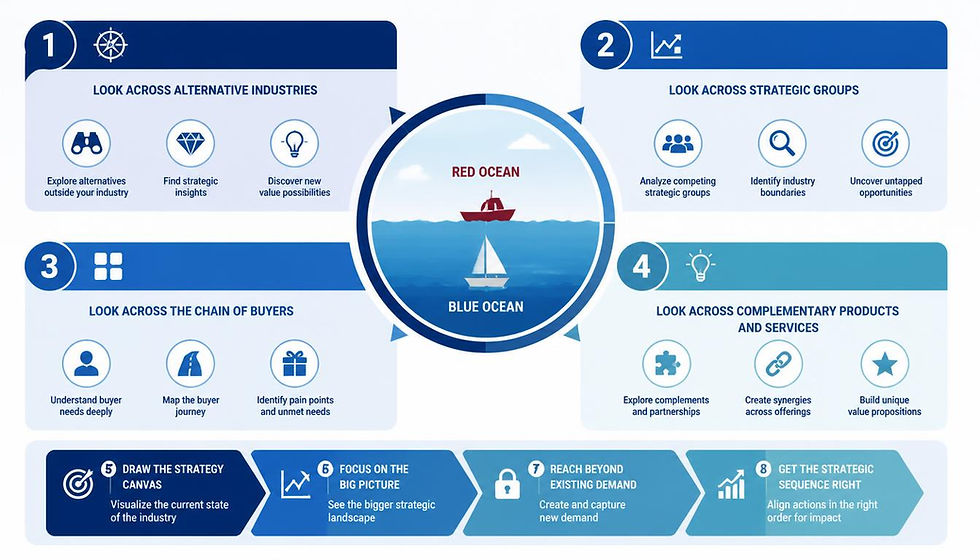
What Is Blue Ocean Strategy?
Blue Ocean Strategy is a strategic approach developed by W. Chan Kim and Renée Mauborgne that focuses on creating new market space where competition becomes less relevant.
The framework distinguishes between red oceans, where organizations compete within established market boundaries, and blue oceans, where organizations create new demand and redefine the factors customers value.
The central concept is value innovation.
Value innovation seeks to increase buyer value while simultaneously reducing or eliminating unnecessary costs. The objective is not simply to differentiate a product at a premium price or compete by being the lowest-cost provider.
Instead, organizations attempt to change the value equation itself.
Red Oceans and Blue Oceans
Established industries frequently contain accepted assumptions about what customers should receive and what suppliers should provide.
These assumptions can become embedded in pricing structures, product features, distribution models, service processes, and marketing practices.
In a red ocean, competitors generally respond to one another's moves within those established boundaries.
A blue ocean strategy asks whether those boundaries need to exist at all.
This distinction matters because intense competition can gradually compress margins as organizations imitate successful features and compete for the same customers.
The Role of Market-Creating Strategy
Blue Ocean Strategy is fundamentally concerned with market creation rather than simply gaining market share.
A company can increase market share through aggressive pricing, stronger distribution, acquisitions, or improved marketing while remaining inside an existing competitive structure.
A market-creating strategy takes a different approach by changing the factors that determine customer demand.
The strategic question becomes: What combination of value could attract customers who currently do not participate in this market?
Value Innovation as the Foundation of Blue Ocean Strategy
Value innovation is practically important because it provides the mechanism for creating a differentiated customer proposition without assuming that higher customer value must automatically require higher operating costs.
Differentiation and Low Cost
Traditional strategy often treats differentiation and low cost as competing choices.
Blue Ocean Strategy challenges this assumption by encouraging organizations to identify industry factors that can be eliminated or reduced while simultaneously identifying factors that should be raised or created.
This can produce a different cost structure and value proposition.
The objective is not to pursue differentiation at any price.
Instead, the organization searches for opportunities where changes to the offering can increase customer value while reducing unnecessary elements of the existing competitive model.
Identifying Buyer Value
Customer value should be assessed from the buyer's perspective rather than from the organization's internal assumptions.
Customers may pay for features that have become industry standards even though they provide limited incremental utility.
Other factors may be significantly underdeveloped despite having substantial importance to customers.
Value innovation requires identifying these discrepancies.
Breaking the Value-Cost Trade-Off
The value-cost relationship is central to the framework.
Organizations can examine which factors create genuine customer utility and which primarily increase operating costs or complexity.
Removing low-value elements can release resources for investments that customers actually notice.
This creates an opportunity to change both sides of the strategic equation.
Why Value Innovation Is Difficult
Value innovation requires organizations to challenge assumptions that may have supported the business for years.
Established organizations often have internal stakeholders who benefit from existing processes, product features, distribution models, or organizational structures.
Consequently, creating a blue ocean may require significant organizational willingness to question established industry practices.
The Strategy Canvas
The Strategy Canvas is practically important because it provides a visual method for comparing an organization's value proposition with competitors and identifying opportunities to change the strategic profile of an offering.
Mapping the Competitive Landscape
The Strategy Canvas maps the factors on which an industry competes and the relative level of investment or emphasis placed on those factors.
This creates a visual representation of the industry's current strategic profile.
For example, a market might compete heavily on product variety, physical locations, customer service, promotional offers, and premium features.
A new strategy could deliberately change that pattern.
Identifying Strategic Assumptions
The canvas can reveal areas where competitors follow similar strategies.
When multiple organizations offer comparable levels of investment across the same factors, differentiation can become difficult.
This creates an opportunity to question whether every factor remains necessary.
Creating a New Value Curve
A new value curve represents the strategic profile of the proposed offering.
The organization can determine which factors to eliminate, reduce, raise, and create.
The resulting curve should provide a meaningful alternative to the dominant industry model.
Using the Strategy Canvas for Decision-Making
The Strategy Canvas should not become a purely visual exercise.
The purpose is to support strategic decisions about resource allocation, customer value, cost structure, and competitive positioning.
Leaders should ask whether the proposed value curve creates genuine utility for buyers and whether the organization can economically deliver that proposition.
The Four Actions Framework and ERRC Grid
The Four Actions Framework is practically important because it converts broad strategic thinking into four specific questions that help organizations redesign their value proposition.
Eliminate
The first question asks which industry factors should be eliminated.
These are factors that customers may no longer value sufficiently to justify their cost.
Elimination can reduce operational complexity and free resources for other strategic investments.
However, organizations must validate the assumption with customers and market evidence before removing an established feature or service.
Reduce
The second question asks which factors should be reduced below the industry's standard.
Organizations often provide more of certain features than customers actually require.
Reducing excessive service levels, product complexity, customization, or process requirements can reduce cost without materially reducing perceived value.
Raise
The third question asks which factors should be raised substantially above the industry standard.
These are areas where increased investment could produce meaningful differentiation.
The objective is not to improve everything.
Resources should be concentrated on factors that can materially change customer utility or purchasing behavior.
Create
The fourth question asks which factors should be created that the industry has not previously offered.
This is often the most challenging element because it requires organizations to identify emerging customer needs or noncustomers who are not currently served by existing offerings.
Creating new factors can fundamentally change the value proposition.
The ERRC Grid
The Eliminate-Reduce-Raise-Create Grid provides a structured way to organize the four actions.
Four Actions | Strategic Question | Potential Impact |
Eliminate | What industry factors no longer create sufficient value? | Lower cost and complexity |
Reduce | What should be offered below the industry standard? | Greater efficiency |
Raise | What should receive significantly more attention? | Higher buyer value |
Create | What new value factors could attract new demand? | New market space |
The grid becomes more valuable when each decision is supported by customer research, financial analysis, operational feasibility, and competitive analysis.
Finding New Market Space
Finding new market space is practically important because blue ocean opportunities frequently emerge from customers, noncustomers, and alternatives that conventional competitive analysis overlooks.
Looking Beyond Existing Customers
Traditional market analysis often focuses on people already purchasing from the industry.
Blue Ocean Strategy expands the analysis to noncustomers.
These are people who either use alternatives, avoid the industry entirely, or participate only occasionally.
Understanding why these groups do not become customers can reveal significant opportunities.
Examining Alternatives
Customers do not necessarily compare products only with direct competitors.
They may choose completely different solutions to accomplish the same objective.
For example, customers may choose between purchasing a product, using a service, doing something internally, outsourcing the activity, or simply accepting the problem.
Analyzing alternatives can reveal opportunities outside conventional industry boundaries.
Challenging Industry Boundaries
Organizations can examine adjacent industries and complementary products.
The customer experience often extends beyond the specific product being purchased.
For example, transportation customers care about convenience, scheduling, reliability, booking, payment, and the total journey rather than simply the vehicle itself.
Strategic opportunities can emerge from redesigning that broader experience.
Identifying Emerging Demand
Market space can also emerge from demographic, technological, regulatory, and cultural changes.
Changes in remote work, artificial intelligence, sustainability requirements, digital commerce, and aging populations can alter customer priorities.
The key strategic question is whether these changes create new needs that existing industry models are poorly positioned to address.
Applying the Blue Ocean Strategy Framework
Applying the framework systematically is practically important because strategic concepts only create value when they can be translated into decisions about customers, products, operations, economics, and execution.
Define the Current Strategic Profile
The organization should first understand its existing value proposition.
This requires identifying the factors on which customers make purchasing decisions and comparing the organization's offering with competitors and alternatives.
The Strategy Canvas provides a useful starting point.
Identify Customer Pain Points
Customer research should identify problems that remain unresolved.
Organizations should examine complaints, switching behavior, unmet needs, abandoned purchases, support interactions, customer reviews, and reasons for choosing alternatives.
The strongest opportunities often exist where customer expectations and industry offerings diverge.
Build the ERRC Grid
The next step is to systematically evaluate elimination, reduction, raising, and creation opportunities.
The organization should resist the temptation to raise every factor.
The framework works by changing the overall strategic profile rather than adding more features to the existing model.
Validate the Strategic Proposition
Potential blue ocean strategies should be tested against customer demand and financial feasibility.
The organization needs evidence that customers value the proposed changes and that the business can deliver them economically.
A theoretically attractive strategy that cannot produce sustainable economics is not a viable blue ocean.
Strategic Execution and Organizational Alignment
Execution is practically important because creating a new market proposition can fail if organizational structures, incentives, capabilities, and operating processes remain designed around the old competitive model.
Aligning Resources
Resources should reflect the new strategic priorities.
If an organization claims that convenience is central to its new value proposition but continues allocating most investment toward low-value product complexity, execution will remain inconsistent with strategy.
Resource allocation should therefore follow the new value curve.
Managing Organizational Resistance
Employees may question the elimination or reduction of established industry practices.
Some features may have internal supporters even when customers place limited value on them.
Leadership should use evidence to explain why strategic changes are being made and how resources will be redirected toward higher-value opportunities.
Aligning Performance Metrics
Traditional KPIs can reinforce old strategic assumptions.
A company pursuing a new market proposition may need different measures for customer adoption, engagement, conversion, retention, operating efficiency, and value realization.
Metrics should reflect the new strategic logic.
Maintaining Strategic Discipline
Blue Ocean Strategy does not eliminate competitive pressure.
Successful market creation can attract competitors.
Organizations should therefore continue monitoring customer needs, competitor responses, profitability, and changing market conditions.
The objective is to maintain the strategic advantage created by the new value proposition.
Common Blue Ocean Strategy Mistakes
Avoiding common implementation mistakes is practically important because organizations can misapply the framework by confusing differentiation, product innovation, or market expansion with genuine market creation.
Assuming Every Innovation Creates a Blue Ocean
A new feature does not automatically create a blue ocean.
If competitors can easily copy the feature and customers view it as incremental improvement, the strategy may simply intensify existing competition.
Focusing Only on Technology
Technology can enable a blue ocean, but technology itself is not the strategy.
An advanced technical capability has limited strategic value if customers do not perceive meaningful additional utility.
The focus should remain on the value proposition.
Ignoring Cost Structure
A strategy that creates additional customer value while dramatically increasing costs may not produce sustainable economics.
Value innovation requires consideration of both buyer utility and organizational cost.
Confusing New Markets With New Customers
Entering a new geographic market or selling an existing product to a new demographic does not necessarily constitute blue ocean strategy.
The stronger question is whether the organization has changed the value proposition or market boundaries sufficiently to create new demand.
Failing to Validate Demand
Strategic teams can become attached to elegant frameworks and attractive hypotheses.
Customer validation is essential.
Organizations should test whether target customers understand, value, and are willing to adopt the proposed proposition before committing substantial resources.
Measuring Blue Ocean Strategy Performance
Measuring strategic performance is practically important because organizations need evidence that a new value proposition is creating demand and sustainable economics rather than simply generating internal enthusiasm.
Customer Adoption
Customer adoption provides an early indicator of market response.
Relevant measures can include acquisition rates, conversion rates, trial activity, repeat purchases, retention, and customer growth among previously underserved segments.
Customer Value
Organizations should assess whether customers perceive the new proposition as meaningfully different.
Customer interviews, satisfaction measures, usage data, willingness-to-pay research, and behavioral indicators can provide evidence.
Economic Performance
Financial measures should include revenue growth, gross margin, customer acquisition costs, retention economics, and operating costs.
A blue ocean strategy should eventually demonstrate economic sustainability rather than relying indefinitely on subsidized growth.
Market Response
Competitor behavior can provide another signal.
If competitors begin copying elements of the strategy, the organization may have demonstrated that the new value proposition is influencing the market.
However, imitation can also reduce differentiation over time.
Frequently Asked Questions About the Blue Ocean Strategy Framework
What is the main purpose of the Blue Ocean Strategy Framework?
The main purpose is to help organizations identify opportunities to create new market space rather than competing solely within established industry boundaries. The framework combines tools such as the Strategy Canvas and Four Actions Framework with the concept of value innovation. Its strategic objective is to increase buyer value while identifying opportunities to reduce or eliminate unnecessary costs and competitive assumptions.
How does the Blue Ocean Strategy Framework create competitive advantage?
The framework seeks competitive advantage by changing the factors that determine customer value rather than simply outperforming competitors on existing factors. Organizations can eliminate or reduce low-value elements while raising or creating factors that customers value more highly. This can produce a distinctive value curve that attracts existing customers and potentially converts noncustomers who were previously underserved.
What is the difference between Blue Ocean Strategy and traditional competitive strategy?
Traditional competitive strategy often focuses on outperforming rivals within established market boundaries through differentiation, cost leadership, focus, or other positioning approaches. Blue Ocean Strategy asks organizations to reconsider those boundaries themselves. Instead of competing for existing demand, it emphasizes creating new demand by changing the combination of value, cost, customer needs, and industry assumptions.
How do the Strategy Canvas and ERRC Grid work together?
The Strategy Canvas helps organizations visualize the existing competitive landscape and compare the strategic profiles of competitors. The ERRC Grid then provides four questions for redesigning that profile: what should be eliminated, reduced, raised, and created. Used together, they help translate competitive analysis into specific decisions about where resources should be removed, redirected, or newly invested.
Can Blue Ocean Strategy be used by established companies?
Established companies can use Blue Ocean Strategy, but implementation may be more difficult because existing processes, incentives, investments, and organizational assumptions can reinforce the current market model. Successful application requires leadership willing to challenge established practices and reallocate resources. Established organizations can have significant advantages because they already possess customers, capabilities, distribution, data, and financial resources.
Is Blue Ocean Strategy still relevant in technology-driven markets?
Blue Ocean Strategy remains relevant because technological change can alter customer needs, operating economics, and industry boundaries. However, technology does not automatically produce uncontested market space. Organizations still need to identify meaningful customer value and sustainable economics. AI, cloud computing, automation, and digital platforms can enable new propositions, but the strategic opportunity depends on how those technologies change the customer value equation.
Conclusion: Blue Ocean Strategy Framework: A Complete Guide to Creating New Market Space
The Blue Ocean Strategy Framework provides organizations with a structured approach to identifying new market opportunities by challenging established assumptions about customer value, industry boundaries, cost, and competition.
Its central principle is value innovation, which combines the pursuit of stronger buyer value with the systematic elimination or reduction of unnecessary factors.
The Strategy Canvas provides visibility into the existing competitive landscape, while the Four Actions Framework and ERRC Grid help organizations determine what should be eliminated, reduced, raised, and created.
The framework also expands strategic analysis beyond existing customers.
Noncustomers, alternative solutions, adjacent industries, complementary products, and emerging customer needs can all reveal opportunities that conventional competitor analysis may overlook.
Over the next two years, the application of Blue Ocean Strategy is likely to become increasingly connected to artificial intelligence, digital platforms, automation, and rapidly changing customer expectations.
AI may reduce the time required to analyze customer behavior, competitor offerings, pricing, product features, and emerging demand patterns. However, access to more data will not automatically create stronger strategy.
The organizations most likely to benefit will be those that combine analytical capabilities with disciplined customer research and a willingness to challenge established assumptions.
Blue Ocean Strategy will therefore remain less about finding a market with no competitors and more about changing the basis on which customers evaluate alternatives.
When organizations can create meaningful buyer value while establishing a defensible cost structure, they can move beyond incremental competitive positioning and develop new sources of sustainable growth.
Tags: Blue Ocean Strategy, Blue Ocean Strategy Framework, Value Innovation, Strategy Canvas, ERRC Grid, Strategic Growth


