
Beyond VPNs: standardizing technical QA tools for global web projects

Request /cdn-cgi/trace on any Cloudflare-proxied domain through a consumer VPN set to Frankfurt and two lines matter: loc=DE, the country assigned, and colo=, the data center that answered. What the trace hides is how everyone else classifies that exit IP. MaxMind's GeoIP2 Anonymous IP database has a dedicated is_anonymous_vpn flag, and fraud and bot-management tools consume the same kind of data.
That gap explains a familiar ticket. "DE checkout shows USD" gets filed, a developer reconnects to a different VPN server, sees EUR and closes it as cannot-reproduce. Nobody logged the IP, the ASN or the CDN edge, because none of the team's QA tools asked for them.
A better VPN won't fix it. What fixes it is treating network location as test infrastructure: versioned, verified before each run and logged next to every result, the same way teams already pin browser and Node versions. In practice, that's what standardizing technical QA tools for global web projects comes down to.
Why consumer VPNs fall short as QA tools
One tunnel, one country, one machine
A VPN client reroutes the whole operating system, or at best a whole network namespace. Moving from Germany to Brazil means tearing down the tunnel and reconnecting, and every process on the host moves with it. That's acceptable for a quick manual look, not for QA tools that run in CI.
A regression suite covering 12 markets either runs them one after another with reconnects in between, or it needs a container per country. Teams that take the container route usually end up with gluetun-style VPN containers exposing a local HTTP proxy per country. That is a proxy layer, just with more moving parts and no control over the exit IP.
Exit IPs that sites already classify
Consumer VPN exits mostly sit in hosting networks rather than consumer ISPs, and one exit is shared by many subscribers at once. MaxMind's Anonymous IP data separates anonymous VPNs, hosting providers, public proxies and residential proxies into distinct flags.
So a VPN session can hit challenge pages, reduced payment options or fallback content that local customers never see. The result describes the VPN, not the market.
Nothing to pin, replay or audit
You can't reserve a VPN exit. Tomorrow's "Spain" server may be a different /24 in a different city with its own geo record. Standardized QA tools need the opposite: a fixed endpoint per market, the ability to rerun a failed test against the same IP, and logs showing exactly what the site saw.

What a standardized QA proxy layer looks like
Standardizing QA tools doesn't mean one IP type for every test. It means each test declares the network profile it needs, and one registry supplies it. Five decisions cover most teams:
Assign an IP class to each test type: datacenter IPv4 for functional geo checks (currency, language, redirects), static ISP or residential IPs where your own CDN, WAF or fraud rules treat consumer networks differently, and mobile only for carrier-specific flows such as direct carrier billing.
Default to HTTP(S) CONNECT. The proxy resolves DNS, and mainstream browsers and HTTP clients support username and password auth for it; SOCKS5 goes only into clients that handle both authentication and remote DNS.
Keep one IP per session for multi-step flows like login and checkout, and rotate between runs, never inside one.
Target by country unless the business logic reads something finer, for example US state sales tax or French-language requirements for customers in Quebec.
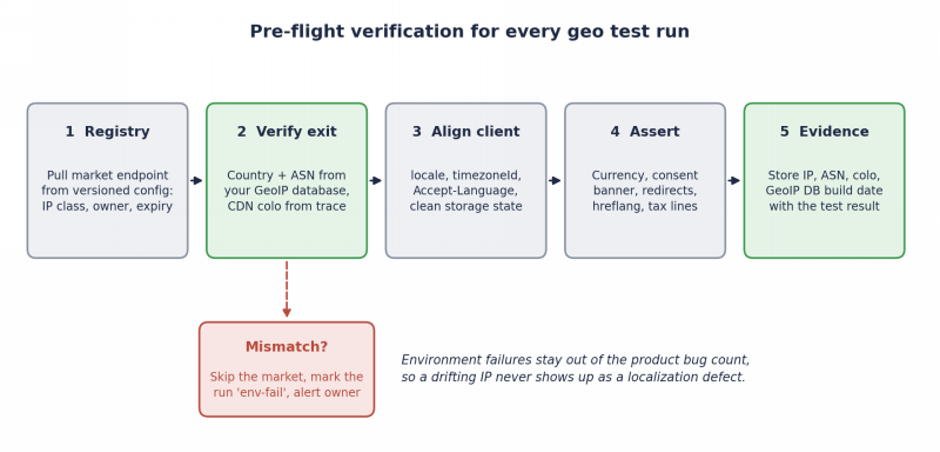
Store the exit IP, ASN, country (according to the GeoIP build your production stack uses), CDN edge code and a timestamp with every result.
Automated runs: one proxy per browser context
Among automation QA tools, Playwright makes this easiest: it accepts a proxy option per browser context, so one worker can hold US, UK and German sessions side by side. The proxy alone isn't enough. A runner in AWS us-east-1 reports UTC and en-US, and plenty of storefronts read the browser's time zone or Accept-Language before they look at the IP.
const m = registry.markets.DE; // from qa-proxies.json
const context = await browser.newContext({
proxy: { server: m.server, username: m.user, password: process.env.QA_PROXY_PASS },
locale: 'de-DE', // navigator.language + Accept-Language
timezoneId: 'Europe/Berlin',
geolocation: { latitude: 52.52, longitude: 13.405 },
permissions: ['geolocation'],
});
Selenium is clumsier: Chrome ignores credentials in --proxy-server, so grids rely on IP authorization or a local forwarder that injects credentials.
IP authorization has its own trap. GitHub-hosted runners egress from large, changing Azure ranges, so an allowlist that worked on Monday can return 407 Proxy Authentication Required on Wednesday. Keep IP auth for office networks and self-hosted runners with a fixed egress, and pull credentials from a secret store everywhere else.
Manual and exploratory testing
Manual QA tools need the same registry, minus the code. Pick a browser extension that imports endpoints rather than hand-typed IP:port pairs; a typo in a shared spreadsheet is how the wrong market gets tested.
The Proxy Control browser extension from Proxys.io is one example. It pulls IPs straight from the account with an API key (a general key or one per order), keeps them as a flat list rather than profiles, and adds a per-site whitelist and hotkeys for switching the proxy on and off. It runs in Chrome, Opera and Firefox.
The catch is inherited from Chromium: SOCKS5 with a username and password isn't supported, so the extension handles HTTP(S) endpoints only. For SOCKS5 the vendor's guide points to Proxifier, which routes per application rather than per tab. One more reason to make HTTP(S) the default.
Geo-QA failure modes and how to confirm them
Many "localization bugs" found through proxies are environment faults, and they look the same whichever QA tools run the check. Each of these six has a cheap way to prove it before anyone opens a ticket.
Table 1. Environment faults that look like localization defects.
Symptom | Usual root cause | How to confirm | Fix |
Right country, wrong CDN edge | DNS resolved on the runner (curl socks5://, local resolver) | Compare colo= in /cdn-cgi/trace; dig from runner and proxy | HTTP CONNECT or socks5h://; no pre-resolved hosts |
German IP, but USD prices or English copy | Runner locale, time zone or old cookies reach the site | Log Accept-Language and the page's resolved time zone | Set locale and timezoneId; start from empty storage |
Your site geolocates the IP to another country | GeoIP databases disagree after a range changes owner | Check your production GeoIP build plus one other vendor | Quarantine the IP, request a replacement, log the DB build date |
Challenge pages, missing payment methods | Your bot or fraud stack classes the IP as VPN, hosting or proxy | Find the IP's score in your own WAF or bot logs | Allowlist registered QA IPs in your own rules |
407 Proxy Authentication Required, CI only | IP authorization tied to a network the runner left | curl -v through the proxy from the runner | Username and password from a secret store |
Two countries in one analytics session | WebRTC UDP or an IPv6 route skips the proxy | Inspect ICE candidates; compare IPv4 and IPv6 egress | Proxied-only WebRTC; disable IPv6 on runners |
DNS decides which edge you actually test
This one catches experienced engineers. In curl, socks5:// resolves the hostname on your machine and sends only the IP to the proxy, while socks5h:// hands the hostname to the proxy. On a CDN that maps users to edges through DNS, as Akamai does, the first form tests your home region's edge even though the exit IP is German.
Anycast CDNs like Cloudflare pick the edge by routing, so colo follows the proxy's network path. Either way, assert on loc and colo and log both.
WebRTC and IPv6 routes around the proxy
A browser proxy setting covers HTTP traffic. WebRTC can still gather ICE candidates over direct UDP and expose the runner's public address to any page that asks. In managed Chrome, the WebRtcIPHandling policy set to disable_non_proxied_udp closes that path; in Firefox the preference is media.peerconnection.ice.proxy_only.
IPv6 causes a quieter version: helper scripts that call APIs outside the proxied browser take the runner's native IPv6 route and report a different country. IPv6 proxies are cheap (Proxys.io lists them from $0.13 a month) but only reach targets that publish AAAA records, so run dig AAAA first.
When GeoIP databases disagree
A vendor labels an IP from its own records; your site uses whatever GeoIP build is deployed. After a range changes hands, databases update at different speeds, so one address can resolve to two countries for a while.
RFC 8805 geofeeds let network operators publish self-declared locations, but vendor adoption is uneven. Verify against your production database, not a public lookup page.
Comparing proxy providers for QA workloads
QA traffic is small and predictable compared with scraping, which changes how you should buy the proxy layer under your QA tools. A regression pass that loads 15 pages in 12 markets on two browser engines makes 360 cold page loads. The 2025 Web Almanac from HTTP Archive puts the median mobile home page at 2,164 KB, so one fresh-context run moves roughly 0.78 GB and nightly runs add up to about 23 GB a month.
At $4/GB pay-as-you-go that's about $94 a month, and every added market or retry raises it. Twenty-four dedicated IPs, two per market, cost the same whether the suite retries or not. Inner pages are lighter than home pages, so treat the bandwidth figure as an upper estimate.
Table 2. Entry prices from vendor pages and published price checks, September 2026. USD before tax; promotions change often.
Provider | Dedicated IP, entry price | Residential, entry price | Advertised coverage | What matters for QA |
IPv4 from $1.47/month in 24 countries ($2.30 each for 1–4 IPs) | From $1.50/GB | 195 countries, region and city selection | HTTP(S) and SOCKS per IP; 7 Mbit/s on static IPs; 24-hour refund | |
Bright Data | Datacenter from $0.90/IP; ISP from $1.30/IP | $8/GB list ($4 with a 50% coupon when checked) | 195 countries; ZIP and ASN targeting | KYC review before residential access |
Oxylabs | 3 dedicated datacenter IPs for $6.75 | $8/GB; plans from $30 for 5 GB | Dedicated datacenter IPs in 188 countries | Per-IP concurrency falls from 100 to 10 sessions after 100 GB per billing cycle |
Decodo (ex-Smartproxy) | 3 dedicated datacenter IPs for $5.55 | $4/GB pay-as-you-go | 115M+ IPs, 195+ locations | 3-day free trial |
IPRoyal | Datacenter from $1.39/IP (90-day plan); ISP from $2.40/IP | $7/GB at 1 GB, $1.75/GB at volume | 195+ countries | Purchased residential traffic doesn't expire |
Treat the table as a shortlist, not a ranking. Bright Data and Oxylabs earn their price when you need ZIP- or ASN-level targeting and an enterprise contract. Decodo's trial suits validating a market before committing, and IPRoyal's non-expiring traffic fits teams whose geo checks cluster around releases.
For a fixed Tier 1 matrix on per-IP billing, Proxys.io sits at the low end: its 5–49 IP tier starts at $1.60 per foreign IPv4, so the 24-IP setup above runs about $38 a month with no bandwidth metering. The trade-off is throughput. Static IPs come with a 7 Mbit/s channel (10 Mbit/s on request), fine for functional checks but too narrow for Lighthouse or load-time baselines, which should run from cloud regions without a proxy.
When the provider, not the test, is the problem
Some failure patterns point at the IP supply feeding your QA tools rather than at your code:
● The same market fails pre-flight checks repeatedly because the vendor's country label and your GeoIP build disagree.
● Your own WAF or bot-management logs keep scoring QA addresses as public proxies, even after replacements.
● Replacement IPs come from the same /24, so a bad range stays bad.
● Dedicated IPs aren't sold in the Tier 1 markets you ship to, only rotating traffic.
That last case is where Proxys.io fits well. Individual IPv4 addresses are available in 24 countries, including the US, UK, Germany, France, the Netherlands, Spain, Italy, Sweden, Canada and Australia, each with HTTP(S) and SOCKS ports and a 24-hour refund window for checking fit. A "Windows pOSf" IPv4 variant (Russia and Spain) is designed to present a Windows passive OS fingerprint at the TCP/IP level, which matters if your own bot management compares that signature with the browser's User-Agent.
Two gaps matter. Japan and Southeast Asia aren't in the dedicated IPv4 list, and static residential ("Premium") IPv4 currently covers only Russia and Poland. Those markets go through the rotating residential pool (195 countries, city targeting, rotation timers from 2 to 60 minutes), with the timer set longer than your longest checkout test.
Rolling the standard out across teams
Treat the proxy registry like any other dependency of your QA tools. One qa-proxies.json in the test repository maps each market to an endpoint, IP class, owner and renewal date. Pull requests change it, CI reads it, and passwords stay in the secret store.
Run a pre-flight check before every suite, whichever QA tools execute it. It costs one request per market and turns silent geo drift into an explicit env-fail status instead of a flaky red test that someone reruns until it goes green.
Renewals need an owner too. When a monthly IP lapses and is reissued, you get a new address with a new geo record, and a months-old green baseline starts failing for reasons unrelated to the release. Auto-renewal from a prepaid balance, which Proxys.io supports, removes that failure mode.
Also register the QA ranges with whoever owns your WAF and bot rules. Allowlisting known test IPs in your own infrastructure beats hoping they pass, and it keeps deliberate parity tests on ISP or residential IPs meaningful.
Start with the market that generates the most support tickets. Run it through registered static IPs with pre-flight checks for two release cycles, then compare its cannot-reproduce rate with the VPN-era tickets. That number is the case for moving every other market onto standardized QA tools.


