
7 Best Project Controls Software for Capital Construction & Mega Projects Compared


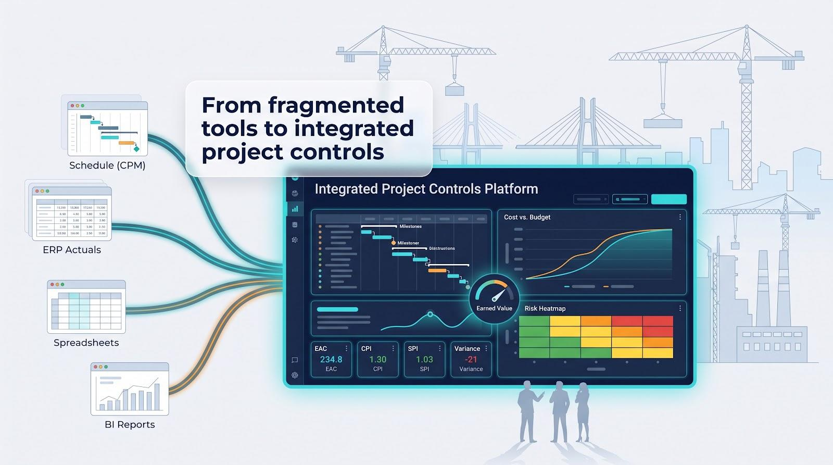
Running a capital program still means juggling Primavera schedules, ERP actuals, and Excel forecasts then praying Power BI lines them up before the board meeting. McKinsey reports that 98 percent of megaprojects blow past budgets by more than 30 percent, and 77 percent finish at least 40 percent late (McKinsey construction-productivity analysis).
JBKnowledge adds that over 40 percent of firms use four or more apps a day, yet more than 50 percent still copy data by hand because they don’t have one integrated platform. This guide compares seven owner-scale solutions so you can pick the one that finally retires your spreadsheets.
Quick answer: best-fit platforms at a glance
The table below shows, at a glance, which platform eases the most common owner headaches. Scores reflect the seven weighted pillars described in the next section.
Rank | Platform | Best for | Product category | Two standout strengths | Key caution |
1 | InEight | Integrated cost-and-schedule control | Project-controls suite | Estimate-to-field data in one model; deep change tracking | Enterprise-scale rollout effort |
2 | Octave Sequence Enterprise <br>(formerly EcoSys) | Portfolio-level cost governance | Enterprise performance platform | Highly configurable; direct ERP ties | Field layer still maturing |
3 | Kahua | Owner PMIS and asset handover | Owner-centric PMIS | Configurable workflows; FedRAMP-style security | Needs an external CPM engine for large schedules |
4 | Procore | Field adoption and contractor collaboration | Field construction platform | Mobile ease; unlimited external users | Advanced CPM and risk live elsewhere |
5 | Oracle Primavera P6 / Cloud | Claims-grade scheduling rigor | Scheduling engine | Handles very large CPM models; multiple baselines | Requires companion tools for cost, documents, field data |
6 | SAP EPPM | ERP-native financial control | ERP module suite | Direct ledger tie-in; procurement visibility | Construction docs and field workflows need add-ons |
7 | Oracle Aconex | Cross-company document audit trail | Common data environment | Immutable correspondence; long-term record | Limited native cost/schedule control |
We rate owner fit, not feature count or price. The scorecards that follow explain why each platform lands where it does and when you might choose one over another.
How we picked and scored the seven
We reviewed scheduling engines, construction suites, owner PMIS tools, ERP extensions, and common-data environments against one owner question: Can this product materially help an owner running multi-billion-dollar programs?
A platform stayed on the list only if it 1) shows active development, 2) covers at least two core controls domains, 3) exposes APIs for external data, and 4) scales across multiple projects. Tools aimed at subcontractors or one-off builds dropped out quickly.
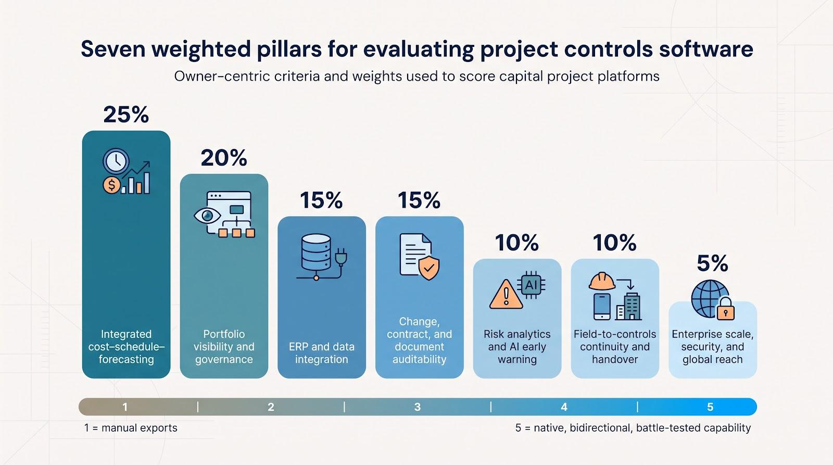
We then graded each contender on seven owner-centric pillars:
Integrated cost–schedule–forecasting: 25 percent
Portfolio visibility and governance: 20 percent
ERP and data integration: 15 percent
Change, contract, and document auditability: 15 percent
Risk analytics and AI early warning: 10 percent (according to RICS, 79 percent of firms have no AI implementation or are only piloting, while 56 percent plan to increase spending)
Field-to-controls continuity and handover: 10 percent
Enterprise scale, security, and global reach: 5 percent
Scoring runs on a five-point scale:
1 = manual exports; 5 = native, bidirectional, battle-tested capability. Weighted averages produced the ranking you just saw and the deep dives that follow.
InEight: the one-stop shop for connected cost, schedule and field data
The Ineight Project Controls suite links estimate, schedule, cost, change, documents and field progress to one shared data model, so every update ripples through the platform automatically while eliminating the fragmented systems that plague many capital programs. When a superintendent logs 12 percent progress in the mobile app, the earned-value curve and portfolio dashboard refresh in real time, with no CSV shuffle needed.
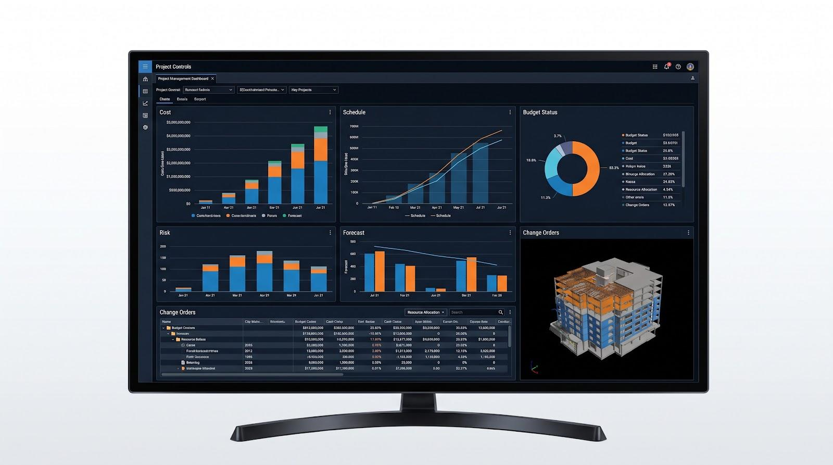
Owners also gain contractor-grade depth. Earned-value reporting, baseline control and Monte Carlo schedule risk live in the same database, letting executives drill from a red KPI to the exact change order without opening another tool.
The trade-off is setup. InEight behaves like an ERP-scale system; you’ll standardize cost codes, cleanse legacy data and agree on governance before the first project goes live. The reward is a single source of truth strong enough to retire spreadsheets and weekly XML imports.
Choose InEight when you’re ready to replace piecemeal controls rather than patch them.
Octave Sequence Enterprise: enterprise portfolio control built for capital owners
Octave Sequence Enterprise (formerly EcoSys) feels less like a shelf-ready app and more like a configurable cost ledger for mature owner PMOs. Map your WBS, cost codes and funding workflows, then let the platform connect to SAP, Oracle and other ERP systems through its no-code Sequence Data Integration layer, wiping out manual spreadsheet reconciliations.
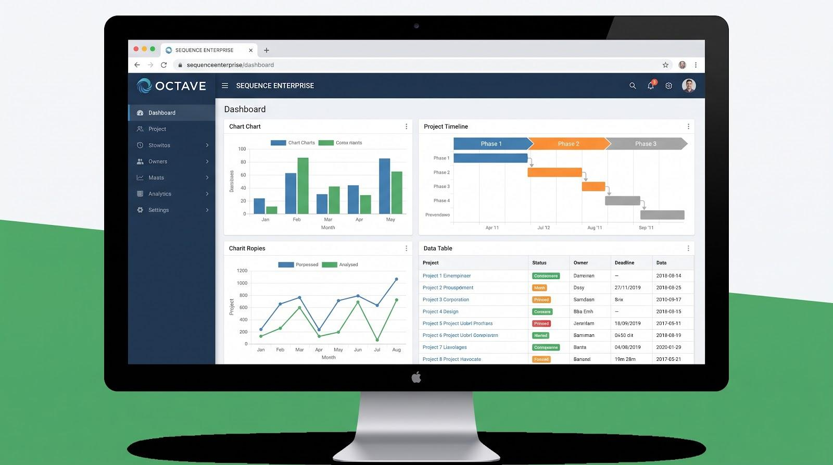
Octave Sequence Enterprise official product page screenshot
Its strength is scenario agility. Approve a scope change, re-phase the cash curve and push the revised forecast to finance within the same governed workflow, so multi-contract programs see the knock-on effect of a late change order within hours, not after month-end.
The trade-off is effort up front. Data-model workshops, integration sprints and administrators fluent in both accounting and P6 are part of the journey. Owners who invest in that foundation gain a portfolio cockpit that stays current even when inflation or design tweaks appear mid-build.
Kahua: governance and asset hand-over, minus the red tape
Kahua approaches project controls from an owner’s seat. Each project lives in configurable workflows that govern funding, approvals, documents and cost logs, then pass the same data into asset records ready for operations.
Need a three-step sign-off before a change touches the budget? Toggle the rule. Want external consultants inside the same approvals without extra licenses? Invite them and let the audit trail record every click.
Security is a differentiator. Kahua runs in a FedRAMP-authorized environment and recently renewed its certification, one of the few construction PMIS platforms that meet that bar. The same architecture powers its private-infrastructure AI suite, released in 2025.
The trade-off for flexibility is CPM depth. Detailed logic still lives in Primavera or another schedule engine, then syncs back into Kahua for portfolio reporting.
Choose Kahua when portfolio governance, external-party approvals and clean turnover packages matter more than native CPM analytics.
Procore: field-first collaboration that now speaks owner language
Procore is already a fixture on North American job sites; RFIs, photos, daily logs, and subcontractor invoices land in the platform with minimal training, so owners see near-real-time field data instead of week-old email updates.
In 2026 Procore began layering owner-specific modules onto that field core. The new suite includes Portfolio Monitoring, Capital Planning, Owners Hub, Funding Source Management, and Asset Management; it rolls every project into a funding-source view and captures asset data long before substantial completion. The first four modules are in beta, with general availability slated for summer 2026.
Limits remain. Complex CPM logic still lives in Primavera and syncs as snapshots; quantitative risk sits in partner apps; and deep cost-schedule integration typically relies on Procore’s data lake or middleware ETL.
Choose Procore when contractor participation, mobile ease, and fresh field insight matter more than native CPM analytics.
Oracle Primavera P6 and Primavera Cloud: the gold standard for complex schedules
When consultants, lenders, and megaproject owners ask for a “Primavera file,” they mean P6. Its critical-path engine, multi-baseline support, and resource-loaded curves remain the benchmark for heavyweight CPM planning; schedules exceeding 10,000 activities are common in oil-and-gas turnarounds and rail megaprojects.
Primavera Cloud puts the same engine on the web and adds portfolio dashboards, what-if scenarios, and Monte Carlo risk analysis inside the Risk app. Owners can compare contractor updates side by side, flag out-of-sequence work, and quantify schedule confidence in one browser tab instead of several desktop add-ons.
The downside is specialization. Mastering lag logic, constrained float, and global calendars takes trained schedulers. Field teams rarely touch the native interface, so owners export snapshots to tools such as Procore, Kahua, or Power BI for wider visibility. Cost control, documents, and change workflows usually live in sister products like Unifier or Aconex.
Keep P6 or Primavera Cloud in the stack when rigorous CPM, forensic transparency, and contractual defensibility matter more than the convenience of an all-in-one suite.
SAP Enterprise Portfolio and Project Management: financial fidelity above all else
SAP already handles purchasing, payroll, and the general ledger for many capital-intensive owners. Enabling SAP Enterprise Portfolio and Project Management (EPPM) keeps budgets, commitments, change orders, and actuals inside the same S/4HANA database that cuts checks and closes books, wiping out the overnight batch jobs common in stand-alone controls tools.
Because every project shares one chart of accounts, finance sees a forecast slip the moment the team approves a variation. Procurement and logistics data ride along, showing planners which purchase orders still await release and which materials are stuck in transit; the insight comes straight from the modules that manage inventory and vendor payments.
What you don’t get is boots-on-the-ground collaboration. Daily reports, drawings, and RFIs usually stay in field tools such as Procore or Kahua, and detailed CPM scheduling lives in Primavera. That split is acceptable when financial integrity outranks field ergonomics and IT prefers SAP as the single system of record.
Choose SAP EPPM when your organization already “speaks SAP” and wants capital spend governed by the same rules that run the rest of the enterprise.
Oracle Aconex: the permanent record your lawyers will thank you for
Oracle Aconex is built for evidence, not eye-candy dashboards. Every drawing, RFI, 3D model, and email lands in a neutral cloud vault that time-stamps and locks metadata the moment it’s uploaded, giving public agencies and litigators a defensible record years after handover.
Its power shows on cross-company programs. Contractors, designers, and owners share one workspace, yet each party controls its own mailbox and permissions; auditors see a single thread while internal notes stay private.
What you won’t find is deep cost or schedule analytics. Owners usually pair Aconex with Primavera for CPM, Octave Sequence or InEight for forecasting, or SAP for actuals. That extra step is worthwhile when the priority is an indelible, searchable archive that survives mergers, staff turnover, and laptop failures.
Choose Aconex when a defensible document trail, rather than advanced forecasting, is the project’s make-or-break requirement.
Which platform actually covers the most ground?
Put all seven side by side and two stand out for integrated breadth. InEight ties cost, schedule, change, risk, documents, and field progress to one data model, while Octave Sequence Enterprise matches that reach on the financial side with portfolio strategy and configurable cost governance. Both aim to eliminate spreadsheet re-entry and surface a live estimate-at-completion before month-end.
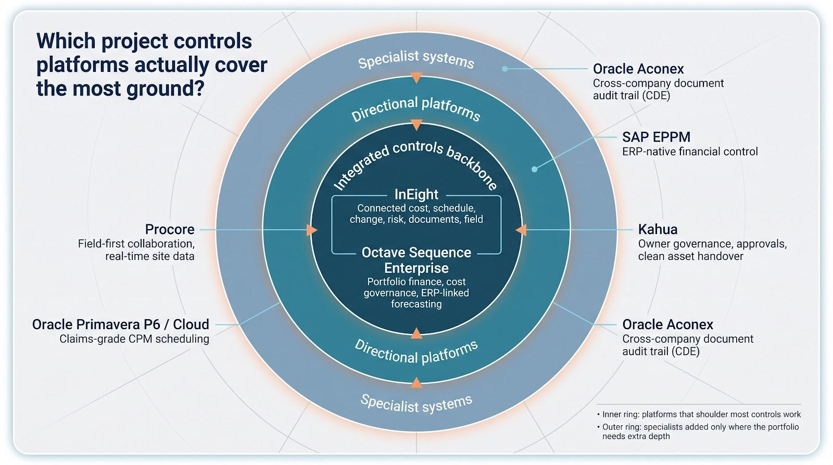
Procore and Kahua follow, each strong in one direction: Procore captures real-time field input, and Kahua enforces owner governance and clean turnover. The right choice depends on whether job-site visibility or board-room auditability is the pressing gap.
Primavera, SAP EPPM, and Aconex remain specialists. Primavera protects the critical path, SAP guards the general ledger, and Aconex preserves the document vault. They excel at their core missions but rely on neighboring tools to complete the controls picture.
In practice, pick InEight or Sequence when one platform needs to shoulder most controls work, and add a specialist only where the portfolio truly needs extra muscle.
Keeping Primavera? Here’s your best add-on play
Many owners stay committed to P6 and its CPM engine. The pragmatic move is to wrap Primavera with a controls or governance layer rather than force schedulers into a new tool.
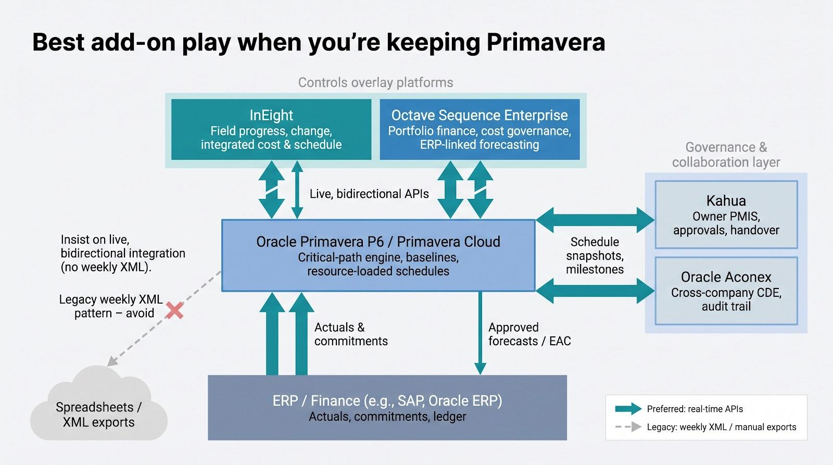
Octave Sequence Enterprise and InEight offer the deepest controls overlay. Both consume P6 updates via API, align activities with cost codes, and recalculate forecasts without manual spreadsheets; Sequence leans toward portfolio finance, while InEight focuses on field progress and change management.
Kahua and Oracle Aconex solve a different gap. They leave P6 untouched but add structured approvals, immutable document trails, and cross-company collaboration; perfect when scheduling is solid yet auditability or contractor coordination still fails reviews.
Whichever path you choose, insist on a live bidirectional link. XML uploads once a week undercut the very integration you’re paying for.
Start with the target operating model
Before you book a demo, map how work and data flow today, and how they should flow tomorrow.
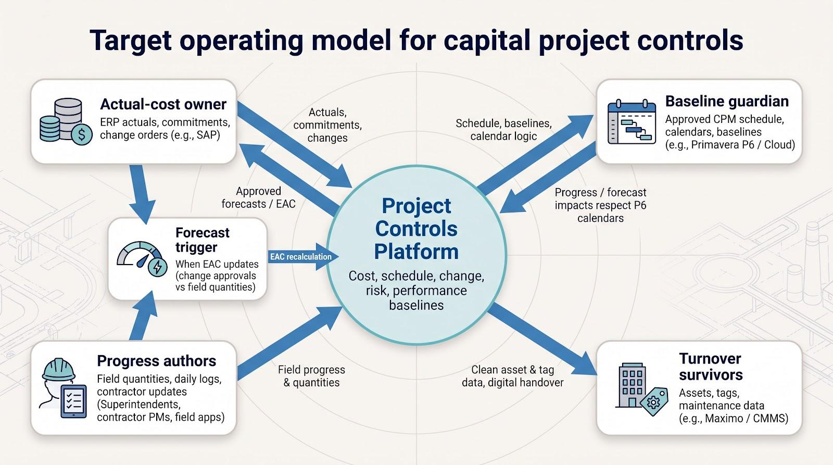
Actual-cost owner. Which system owns actuals? If it’s SAP, every candidate platform must post back to SAP without a CSV detour.
Baseline guardian. Is the approved schedule locked in Primavera? Integrations must respect P6 calendar logic, not overwrite it.
Progress authors. Who updates progress superintendents in the field or contractor PMs once a week? Some platforms charge for external users, while others include them.
Forecast trigger. Does EAC update when a change order is approved or when field quantities roll in? Platforms that hide this logic send teams back to Excel.
Turnover survivors. Asset data often dies in archive folders. If operations lives in Maximo, pick a platform that exports directly, not via PDF.
Capture these rules on a single page. It will act as your north star during vendor calls and stop flashy features from derailing a workable operating model.
Narrow the shortlist to two serious contenders
With the operating model set, eliminate any platform that can’t honor those baseline rules.
Next, match pain to strength:
Forecast latency. If executives wait weeks for an updated EAC, compare InEight and Octave Sequence Enterprise.
Field visibility. If site data shows up days late, swap one of those for Procore.
Audit trail. If public scrutiny is the risk, replace with Oracle Aconex or Kahua for their record-keeping depth.
Stop at two finalists. More than two drags out meetings and diffuses feedback; two lets you schedule equal demos, supply identical data sets, and keep politics in check.
From there, move straight to a live-data pilot, the only test that exposes real integration and workflow gaps.
Run a live-data pilot, not a canned demo
Scripted demos rarely reveal stress points. A pilot does.
Launch two projects: one in planning, one mid-construction.
Import the approved P6 schedule, the past three months of ERP actuals, and one pending change order.
Let the field crew update quantities from the job site.
Measure:
Minutes from field update to a refreshed EAC on the portfolio dashboard
Clicks to trace a variance back to the source drawing revision
Whether any step depends on an overnight batch or hidden spreadsheet
Plan four to six weeks, long enough for at least one progress cycle and an unplanned event. Software that meets your metrics under live conditions is ready for contract discussions.
Define pass / fail metrics before day one
A pilot without hard yardsticks turns subjective. Agree on the scoreboard first so every stakeholder sees the same finish line.
Core metrics:
Forecast cycle time: hours from field update to approved EAC
Reconciliation labor: staff hours spent copying data between systems
Forecast accuracy: variance between pilot EAC and month-end actuals
Change-approval duration: elapsed time from request to baseline shift
Spreadsheet retirement: number of legacy files eliminated
Audit retrieval time: seconds to open the source document behind a KPI
Require the platform to beat today’s baseline on at least four of these six measures; roadmap promises don’t override live numbers.
Build the ROI case in plain dollars and hours
Executives buy outcomes, not licenses. Convert each pilot gain into metrics the finance team already tracks.
Labor. If the pilot trims eight hours from every monthly forecast cycle and controls staff cost $125 per hour, that saves about $12,000 per project per year. Across 30 active projects, that’s $360,000.
Schedule acceleration. Preventing a one-week slip on a $5 million weekly burn avoids roughly $100,000 in overhead and financing costs, cash preserved, not just risk mitigated.
System rationalization. Retire three legacy modules and five custom integrations, then add the license fees, infrastructure, and support hours those systems consumed.
Audit efficiency. A consolidated data room can shave weeks off claims resolution or regulatory reporting; assign a conservative dollar value to avoided legal fees or liquidated damages.
Add the four savings lines, subtract subscription and implementation cost, and present the payback period in months, not years. Few decision-makers argue with math that specific.
Negotiate the contract like a controls professional, not a commodity buyer
Software pricing hides in footnotes, so surface them early. Ask for a marked-up order form before the final demos, then review every line with procurement, IT security, and legal on the call.
Scope. Confirm which modules cover cost, schedule, change, and documents. Are APIs, sandboxes, and data-warehouse connectors included or billed per use? If contractors need licensed seats, negotiate unlimited participant access or a defined usage band to avoid surprise invoices.
Data ownership. Who keeps the database if you leave? Require a documented export routine native tables, not PDFs and post-termination access for regulators and claims teams.
Price protection. Accept annual CPI-linked increases, but strike “market rate” language. Freeze user tiers for the contract term so additional collaborators don’t inflate costs mid-project.
AI governance. With most firms still piloting AI, keep new algorithms behind opt-in toggles and record that choice in the order form.
Frequently asked questions
What is project-controls software?
It’s the system of record for cost, schedule, change, risk, and performance baselines on capital projects. In plain English, it predicts where money and time will land and proves how you got there.
How is project controls different from construction project management?
Project controls look forward: forecasting cost and time, enforcing baselines, and flagging variance early. Construction project-management tools coordinate day-to-day tasks, RFIs, and field activities.
Which platform is best overall for owners?
For most integrated-stack goals, InEight wins on breadth and real-time data flow. Octave Sequence Enterprise is a close second when portfolio-finance governance tops the wish list.
Can Primavera P6 replace an integrated controls suite?
No. P6 excels at CPM scheduling but delegates cost, change, and document control to other products. Owners usually pair it with Oracle Unifier, Aconex, or a separate controls platform.
Will Procore replace my scheduler?
On megaprojects, no. Procore surfaces schedule data for field teams, but critical-path logic and delay analysis still run in P6 or another CPM engine.
Which tools ship earned-value management out of the box?
InEight and Octave Sequence Enterprise include native EVM dashboards. Primavera supports cost and resource loading but normally needs Unifier or a BI layer for full EVM reporting.
Do these platforms run Monte Carlo risk?
Primavera Cloud includes schedule risk; InEight offers integrated cost-and-schedule risk; Octave Sequence Enterprise links risk to cost forecasts. Others rely on third-party add-ins.
How long does a typical implementation take?
Timelines vary widely based on data readiness and organizational scale. Always verify durations with reference customers.
What does enterprise pricing look like?
Vendors quote by module, project volume, or total construction value. Multi-project owner licenses usually land between the low six figures and the low seven figures per year.
Who owns the data after project closeout?
Contract terms vary. Insist on an unconditional, no-cost export of native tables and attachments so future audits and claims aren’t tied to license renewals.
Conclusion
Following the operating-model roadmap, pilot metrics, and ROI calculus above will steer your team toward a project-controls platform that delivers measurable value and long-term confidence.


