
6 Best Proxies for Business Research and Data Collection in 2026

Business research increasingly depends on public web data to track competitors, compare prices, study product assortments, analyze customer reviews, and evaluate markets. This demand is also reflected in the growth of competitive intelligence technology. Grand View Research estimates the global competitive intelligence tools market at $823.4 million in 2026, with projected growth to $3.0 billion by 2033 at a 20.3% CAGR. For teams working across several regions, the challenge is not only collecting enough information but collecting it under conditions that make observations comparable.
Proxy infrastructure helps researchers access location-specific public data and repeat collection across the same sources over time. The quality of that process matters because incomplete pages, incorrect locations, inconsistent sessions, or repeated collection failures can distort the dataset and, ultimately, the business conclusions drawn from it.
Which Business Research Tasks Need Proxies?
Proxies are useful when business research depends on collecting public web data repeatedly, across different locations, or at a scale that cannot be handled efficiently through individual manual checks. The required proxy setup depends on the sources, geographic scope, and frequency of the research.
Competitor intelligence: Monitor competitor websites, listings, offers, positioning, and other publicly available information over time.
Price benchmarking: Compare prices across competitors, marketplaces, locations, and collection periods.
Product and availability research: Track products, categories, variants, services, inventory, and other availability signals that change over time.
Market expansion research: Collect and compare public data across countries, cities, or regions when evaluating prospective markets.
Consumer review collection: Gather public reviews and ratings from multiple sources for sentiment and customer-experience analysis.
Search visibility research: Compare how brands, products, and competitors appear in search results across different locations.
What Makes Web Data Reliable for Business Research?
Reliable business research requires more than a large number of collected pages. Researchers need to know that observations represent the intended sources and markets and that the collection methodology remains sufficiently consistent for comparisons across locations or time periods.
Consistent Sources and Fields
Use the same sources and extract the same fields when comparing competitors, markets, or collection periods. A dataset becomes less reliable when its source mix or data structure changes without being documented.
Accurate Market Location
Requests need to originate from the geographic market the dataset is intended to represent. Country, city, or regional accuracy is important when prices, availability, search results, and promotions vary by location.
Complete and Valid Records
Check that required fields and page elements are present before accepting a record into the dataset. Block pages, incomplete renders, connection failures, and missing values should be identified separately from valid observations.
Repeatable Collection Rules
Use collection rules that can be reproduced when the research is updated. This includes the selected sources, locations, timing, session behavior, and retry process.
Comparable Observations Over Time
Record collection timestamps and keep the research conditions consistent across comparison groups. Stable sessions can also help when several requests form one connected research sequence, reducing avoidable variation in the final dataset.
Where Do the Best Dedicated Proxies Improve Research Consistency?
The best dedicated proxies can improve consistency when business research needs stable, controlled access to the same public sources over time. They are useful when changes in the dataset need to reflect market conditions rather than a changing collection environment.
Repeated source access: A dedicated IP provides a more consistent network identity when a workflow revisits competitor sites, product pages, directories, or review platforms.
Stable IP identity: Keeping the same IP can reduce unnecessary changes during connected research sessions and repeat checks.
Longitudinal monitoring: Stable collection conditions help teams compare pricing, availability, catalog, and visibility changes across reporting periods.
Account-based research: Dedicated access can support approved multi-step research tasks and tools that require a persistent connection instead of frequent IP changes.
Controlled regional observations: Keeping the same IP environment and selected location helps maintain consistency in local-market, city-level, and country-level comparisons.
Lower IP sharing: Dedicated proxies are assigned to one customer, reducing overlap with unrelated traffic and giving teams greater control over recurring research sessions.
How Does Location Affect Business Research Data?
Web data can change according to the visitor’s location, which makes proxy geography an important research variable. A dataset collected from one country or city may not accurately represent what customers, competitors, or businesses see in another market.
Prices and Promotions
Prices, currencies, taxes, discounts, and campaign offers can vary between national and regional markets. Consistent geographic targeting helps researchers compare equivalent offers instead of mixing data from different commercial conditions.
Availability and Catalogs
Products, services, listings, inventory, and marketplace assortments can differ between cities or regions. This is particularly important for retail, travel, delivery, and local-service research.
Local Competitors and Search Results
Businesses that compete in one city or country may not appear in another. Search results, local packs, publishers, and organic competitors can also change according to the selected location.
Market-Specific Content
Websites may adjust language, landing pages, product details, content, and user messages based on the visitor’s market. Using the same country or city configuration across collection cycles makes cross-market comparisons more reliable.
What Are the 6 Best Proxies for Business Research in 2026?
Business research requirements differ according to geographic scope, source difficulty, collection frequency, and dataset size. The providers below offer different combinations of location targeting, residential or mobile access, session controls, and scaling options for recurring public-web research.
Provider | Research Data Fit | Location Precision | Session Reliability | Recurring Collection | Best Research Use |
1. Live Proxies | Residential and mobile research | Country, city, ASN | Sticky up to 24 hours | Unlimited threads | Recurring multi-market research |
2. SOAX | Location-sensitive residential and mobile data | Country, region, city, ISP | Rotating and sticky sessions | Unlimited concurrent connections | Regional market and competitor research |
3. IPRoyal | Flexible residential and ISP research | Country, state, city | Sticky from 1 second to 7 days | Unlimited residential requests | Moderate recurring research |
4. DataImpulse | Cost-conscious multi-market collection | Country. State, city, ZIP, ASN available | Rotating and sticky up to 120 minutes | Non-expiring traffic | Price and market research |
5. Oxylabs | Enterprise-scale research datasets | Country, state, city, ZIP | Rotating and sticky sessions | Enterprise-scale capacity | Large research programs |
6. Decodo | Automated public-web research | Country, state, city, ZIP, ASN | Rotating and sticky sessions | Unlimited concurrent sessions | Automated recurring collection |
1. Live Proxies
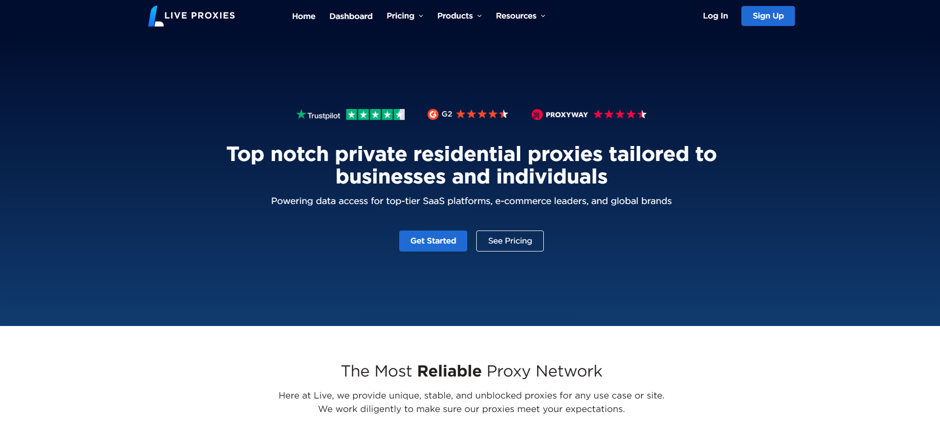
Live Proxies is suited to recurring business research where teams need to collect public data across several locations while keeping collection conditions controlled. Its rotating residential and mobile proxies provide millions of IPs across 55 countries, with particularly strong coverage in the United States, Canada, and the United Kingdom.
Country, city, and ASN targeting helps researchers separate observations by market, while private IP allocation reduces overlap with unrelated proxy users. This combination is useful for recurring competitor monitoring, price research, product comparisons, and other workflows where the same sources need to be revisited regularly. For teams evaluating a residential proxy with unlimited bandwidth, Live Proxies also supports high-volume research through unlimited threads and scalable enterprise plans.
Research Coverage
Residential and mobile access: Supports research across consumer-web and mobile-network environments.
Country, city, and ASN targeting: Allows researchers to control the geographic and network context of collected observations.
Millions of IPs: Provides a broad address base for distributed and recurring collection.
Strong US, Canada, and UK coverage: Fits research programs focused on these major markets.
Private IP allocation: Gives B2C customers exclusive allocations and reduces overlap for B2B customers working with the same or similar targets.
Collection Reliability
Sticky sessions up to 24 hours: Keep the same IP during longer research sequences.
Unlimited threads: Run multiple collection jobs in parallel without restrictive thread limits.
HTTP and SOCKS5: Supports common research, scraping, and automation environments.
Reduced IP overlap: Helps limit exposure to activity generated by unrelated users on the same or similar targets.
Large parallel research jobs: Combines unlimited threads with rotation and geographic targeting for multi-source collection.
Pricing
Residential proxies start at $70 for 4GB with 30-day validity. Enterprise pricing starts at $2,000/month for 1TB, equivalent to $2/GB. Free trials are available for B2B customers.
2. SOAX
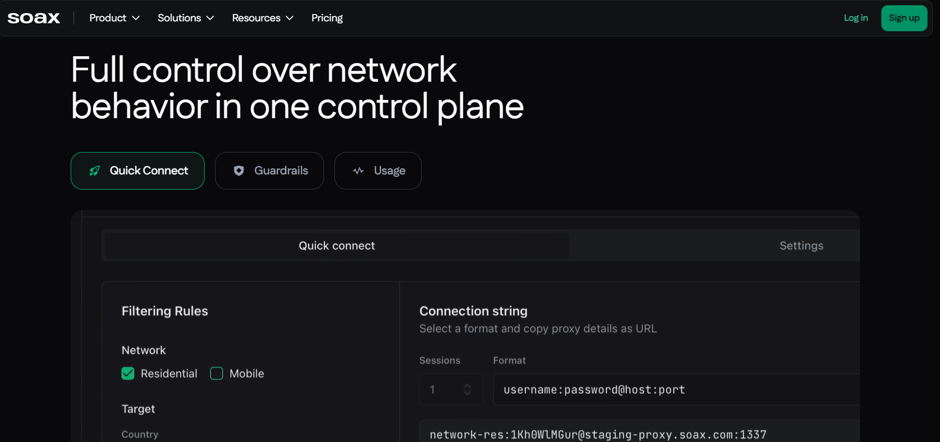
SOAX is particularly relevant to business research that depends on precise geographic observations. Its residential and mobile networks cover more than 195 geographies, while targeting controls allow teams to collect market information by country, region, city, and ISP. Higher plans also add ASN and ZIP targeting.
This makes the network useful for comparing prices, competitor activity, products, and consumer-facing content between locations. SOAX specifically positions its infrastructure for market research, including regional trend tracking, competitor benchmarking, and large-scale public-web collection.
Research Coverage
Residential and mobile networks: Collect public data through both household and mobile-network connections.
Granular location filters: Target country, region, city, and ISP, with additional ASN and ZIP controls on higher plans.
Multi-country access: Residential and mobile networks cover more than 195 geographic markets.
Local-market observations: Geographic controls help distinguish regional prices, competitor content, and other location-dependent information.
Collection Reliability
Rotation controls: Rotate IPs between independent research requests.
Session persistence: Sticky sessions provide continuity when several observations belong to the same research flow.
Recurring regional checks: Revisit markets using consistent geographic filters.
Multi-market collection: Unlimited concurrent connections support research across multiple locations in parallel.
Pricing
The Builder plan starts at $200/month plus VAT. Enterprise plans start at $3,000/month plus VAT, with network usage rates varying according to location tier.
3. IPRoyal
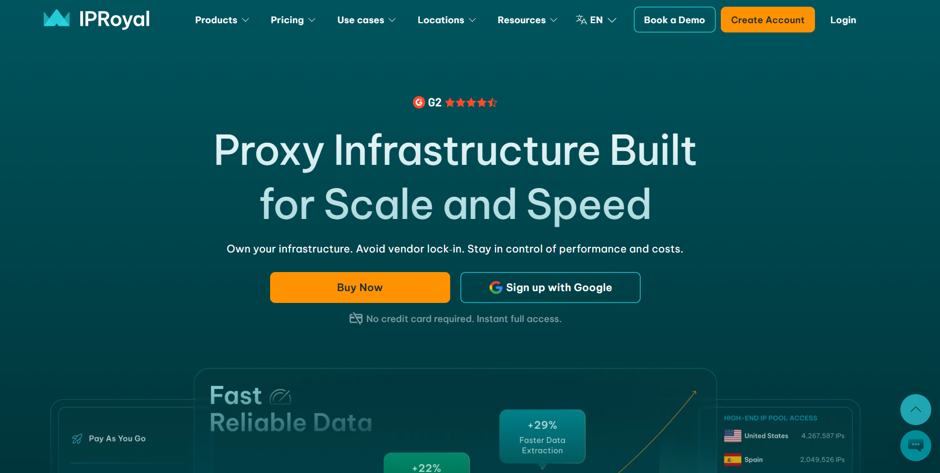
IPRoyal provides residential and ISP proxies that can support both rotating and persistent business research workflows. Its residential network covers more than 195 countries and provides country, state, and city targeting, making it suitable for international research and more focused regional comparisons.
Flexible residential session controls are useful when research methods vary between broad collection and longer source analysis. Teams can request a new IP for each independent observation or configure sticky sessions from one second to seven days when a research sequence benefits from greater continuity.
Research Coverage
Residential and ISP access: Use rotating residential connections for distributed collection or ISP proxies for workflows that benefit from stable addresses.
Country and regional targeting: Residential proxies support country, state, and city-level selection.
International coverage: The residential network spans more than 195 countries.
Flexible traffic options: Residential traffic does not expire, which can fit research projects with uneven collection schedules.
Collection Reliability
Rotation: Assign a new residential IP to independent research requests.
Sticky sessions: Set session TTL from one second to seven days.
Persistent research flows: Longer sessions support multi-page competitor or product research.
Recurring collection: Unlimited concurrent residential requests support repeated automated research as workloads expand.
Pricing
Residential proxies start at $1.75/GB at high-volume subscription tiers, while smaller subscriptions start at $7/GB. ISP proxies start at $2.40/proxy.
4. DataImpulse
DataImpulse is a cost-conscious option for geographically distributed business data collection. Its residential network provides more than 90 million IPs across 195 countries, while traffic uses a pay-per-GB model and does not expire. Country targeting is included, with state, city, ZIP, and ASN targeting available as additional options.
The service is particularly relevant to price comparison, market analysis, and other recurring research where collection volume may vary between projects. DataImpulse explicitly supports price intelligence and market research use cases, while its non-expiring traffic can reduce pressure to consume an allocation within a fixed monthly period.
Research Coverage
Residential network: More than 90 million residential IPs provide a broad pool for public-web collection.
Regional targeting: Country targeting is included, while state, city, ZIP, and ASN targeting can provide greater geographic precision.
Multi-market collection: Coverage across 195 countries supports international research programs.
Broad geographic availability: Researchers can use the same infrastructure to compare observations across many national markets.
Collection Reliability
Rotating access: Rotation supports independent observations and larger research queues.
Sticky sessions: Sessions can retain the same IP for up to 120 minutes when research requires continuity.
API and scraping integrations: HTTP(S), SOCKS5, API access, and integrations with common automation tools support custom research pipelines.
Recurring research workloads: Non-expiring traffic can be used as research demand changes rather than within a fixed monthly expiration window.
Pricing
Residential proxies start at $1/GB with no mandatory subscription. The 1TB residential package costs $800, equivalent to $0.80/GB, while custom plans for 5TB or more start from $4,000 with custom per-GB pricing.
5. Oxylabs
Oxylabs fits enterprise research programs that need to collect large datasets across many locations and sources. Its infrastructure includes residential, ISP, datacenter, mobile, and dedicated ISP proxies, allowing data teams to select different network types according to source requirements and research methodology.
Detailed geographic controls and high-volume infrastructure make the service relevant to international competitor intelligence, pricing research, product monitoring, and recurring datasets. Teams that do not want to manage every collection step internally can also use Oxylabs scraping-focused products alongside its proxy infrastructure.
Research Coverage
Broad geographic reach: Residential infrastructure supports research across a large international footprint.
Fine location targeting: Country, state, city, and ZIP controls help separate observations by geographic market.
Multiple proxy products: Residential, ISP, datacenter, mobile, and dedicated ISP options support different research environments.
Enterprise collection infrastructure: Large-scale capacity fits research programs collecting substantial volumes of public web data.
Collection Reliability
Long session options: Session controls allow related observations to remain on a consistent IP when required.
Large-scale request handling: Enterprise infrastructure supports high-volume and parallel data collection.
Automation support: Proxy and scraping products can integrate into automated research pipelines.
Production research pipelines: Infrastructure can support recurring data feeds rather than only one-time collection projects.
Pricing
Residential proxies start at $6/GB ($30 for 5GB/month). Enterprise residential pricing starts at $2,500/month for 1TB ($2.50/GB). Mobile proxies start at $7.50/GB ($30 for 4GB/month).
6. Decodo

Decodo supports automated business research through residential, ISP, datacenter, and mobile proxy products. Its residential network provides more than 115 million IPs across 195+ locations, with country, state, city, ZIP, and ASN targeting for research that needs to distinguish between geographic markets.
Rotating and sticky sessions allow teams to adapt proxy behavior to the research method, while unlimited concurrent residential sessions support larger automated collection jobs. These controls are useful for repeated price checks, product research, competitor monitoring, and other datasets that need to be refreshed on a schedule.
Research Coverage
Residential access: A large residential network supports public-web collection from consumer-facing sources.
Broad geo coverage: More than 195 locations allow international research programs to use one proxy infrastructure.
Regional targeting: Country, state, city, ZIP, and ASN controls support more precise market comparisons.
Multiple collection options: Residential, ISP, datacenter, and mobile products allow teams to match infrastructure to different sources.
Collection Reliability
Rotation controls: Rotating sessions distribute independent research requests across different addresses.
Sticky sessions: Persistent sessions support research sequences that need to retain the same IP.
Scalable automation: Unlimited concurrent residential sessions support parallel collection.
Repeated data collection: Rotation, geo-targeting, and automation integrations fit recurring monitoring workflows.
Pricing
Residential proxies start at $3.75/GB, with pay-as-you-go access at $4/GB. The 250GB residential plan costs $625/month ($2.50/GB), while the 1TB enterprise plan costs $2,000/month ($2/GB).
How Do You Keep Recurring Research Comparable?
Recurring research becomes useful only when changes in the dataset reflect changes in the market rather than changes in collection methodology. Teams should therefore keep important collection conditions consistent between research cycles and document deliberate methodological changes.
Same target sources: Revisit the same websites, pages, marketplaces, or search environments where possible.
Consistent locations: Use equivalent countries, cities, or other geographic settings between collection periods.
Fixed collection intervals: Collect observations on a consistent daily, weekly, or monthly schedule when timing affects the comparison.
Consistent session and retry rules: Apply the same rotation, sticky-session, and failed-request policies across comparable research runs.
Comparable fields: Extract the same prices, products, ratings, availability signals, or other variables during each cycle.
Timestamping and change tracking: Record when observations were collected and retain previous records to distinguish genuine market changes from missing or newly added data.
Which Proxy Setup Fits Each Research Method?
Different research methods place different demands on proxy infrastructure. A one-time market scan primarily needs broad coverage, while longitudinal or competitor research places greater emphasis on methodological consistency and session control.
Snapshot Research
Snapshot research captures market conditions at a particular point in time. The priority is broad source coverage and efficient collection rather than preserving the same IP for long periods.
One-time market studies: Collect a defined dataset for a specific research question or decision.
Broad source coverage: Include enough relevant sources to represent the market being studied.
Rotating IPs: Distribute independent observations when session continuity is unnecessary.
Longitudinal Research
Longitudinal research compares observations across multiple collection periods. Consistency matters because changes in methodology can be mistaken for changes in prices, products, competitors, or market conditions.
Repeated observations: Revisit the same sources over weeks, months, or other defined periods.
Stable methodology: Keep extraction logic, validation rules, and collection procedures consistent.
Consistent locations: Use equivalent proxy locations so geographic differences do not distort changes over time.
Multi-Market Research
Multi-market research compares business conditions between countries, cities, or other geographic areas. Proxy targeting becomes part of the research design because each observation needs to represent the intended market.
Country and city targeting: Match exit locations to the geographic units included in the research.
Parallel collection: Gather observations from several markets within comparable time windows.
Regional comparison: Apply the same sources, fields, and validation rules across locations.
Deep Competitor Research
Deep competitor research often involves more than retrieving one page. Researchers may need to move between category pages, product pages, search results, reviews, pricing pages, or other connected sources.
Multi-page workflows: Collect several related pages as part of one competitor observation.
Sticky sessions: Maintain IP continuity when a sequence benefits from a consistent connection.
Repeated source access: Return to the same competitor sources as products, prices, positioning, or availability change.
How Do You Measure Data Collection Quality?
Raw request volume says little about whether a business research dataset is actually usable. A collection process may retrieve thousands of pages while still producing incomplete, duplicated, or geographically incorrect records. Quality metrics should therefore measure whether the resulting data is complete, accurate, comparable, and efficient enough to support reliable analysis.
Record Completeness and Accuracy
Measure the share of observations containing all required fields and confirm that records were collected from the intended geographic market. Missing prices, product details, ratings, or incorrect locations can make otherwise successful requests unsuitable for comparison and analysis.
Collection Success and Failures
Track successful observations that pass both request-level and content-level validation alongside pages lost to connection failures, blocks, incomplete responses, or validation errors. This shows how much of the collected data is actually usable rather than simply retrieved.
Data Consistency and Duplicates
Check whether equivalent sources produce records with comparable structures, fields, and formats across collection cycles. Duplicate pages or records should also be identified because they can distort counts, distributions, trends, and market comparisons.
Collection Speed and Cost
Measure how long each research batch or scheduled refresh takes and how many resources are required to produce usable data. Calculating cost per valid record rather than per raw request provides a clearer view of collection efficiency as research volume increases.
What Can Proxies Not Fix in Business Research?
Proxies improve access, geographic control, and collection scalability, but they do not make a weak research methodology reliable. Data quality still depends on source selection, extraction logic, validation, and how analysts interpret the resulting observations.
Source and sample quality: Proxies cannot make irrelevant sources representative or correct a dataset that excludes important markets, competitors, products, or consumer groups.
Incorrect entity matching: Researchers still need to distinguish equivalent products, companies, listings, and other entities correctly.
Outdated data: Previously collected records may no longer represent current market conditions, even when the original collection was accurate.
Parsing errors: A proxy cannot correct extraction logic that assigns the wrong values, misses required fields, or misreads page content.
Weak validation rules: Invalid, incomplete, or unexpected pages can enter the dataset when the pipeline does not verify content quality.
Research interpretation: Public web data still requires business, geographic, temporal, and methodological context before researchers can draw reliable conclusions.
Conclusion
The best proxy infrastructure for business research depends on the research methodology. Snapshot studies, longitudinal tracking, multi-market comparisons, and deep competitor research require different balances of rotation, location targeting, session persistence, and collection scale.
Prioritize representative and repeatable data rather than raw request volume. Keep sources, locations, collection intervals, and validation rules consistent when comparing markets or changes over time, and measure usable records rather than successful requests alone. Proxy infrastructure can improve access and collection consistency, but research findings should still be validated before they inform business decisions.


