
10 Value Stream Mapping Techniques That Transform Project Delivery

In project management, the ability to deliver value both effectively and efficiently has become one of the most critical determinants of organizational success. Projects are no longer isolated initiatives; they exist within complex workflows, involve multiple stakeholders, and are influenced by ever-changing market demands and operational constraints.
In such an environment, identifying inefficiencies, optimizing processes, and ensuring that every activity contributes directly to value delivery is not just desirable it is essential. One of the most powerful and versatile tools that organizations can leverage to achieve these objectives is Value Stream Mapping (VSM).
Value Stream Mapping provides a visual representation of the flow of information, materials, and activities across an entire process. By creating this detailed visualization, teams gain the ability to pinpoint bottlenecks, identify non-value-added steps, and highlight areas where resources are underutilized.
Beyond simple process diagrams, VSM serves as a strategic framework that allows organizations to examine the interconnections between tasks, workflows, and stakeholder contributions. It enables leaders to not only detect problems but also understand their root causes and systemic impact on project delivery, timelines, and overall efficiency.
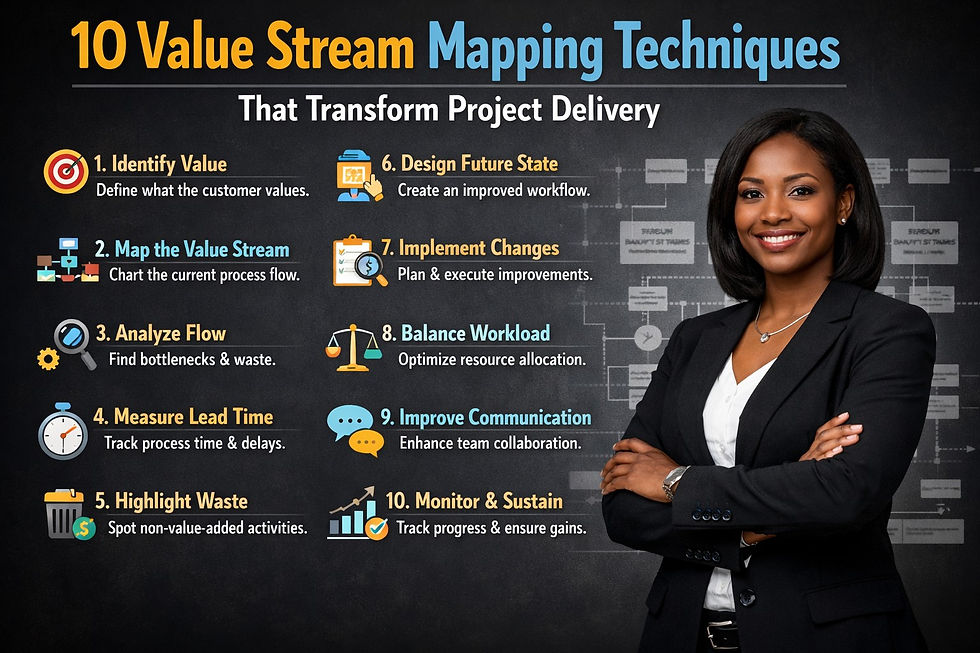
In this article, we will dive deep into 10 Value Stream Mapping Techniques That Transform Project Delivery that That Transform Project Delivery. These techniques go beyond basic mapping exercises to address practical challenges such as workflow optimization, stakeholder engagement, communication flow, and continuous improvement.
By adopting these approaches, project managers and organizational leaders can streamline operations, reduce waste, accelerate delivery, and ultimately maximize the value delivered to both customers and internal stakeholders. Whether your organization is operating in manufacturing, healthcare, software development, or service delivery, mastering VSM techniques can provide a significant competitive advantage and elevate project outcomes to a new level of efficiency and effectiveness.
Understanding Value Stream Mapping for Project Success
Value Stream Mapping is a visual representation of the flow of materials and information through a process. By mapping out every step of a workflow, teams can identify areas of waste and inefficiency. This visualization allows project managers not just to see where delays occur but to understand the relationship between different steps in a project.
For organizations striving for excellence, VSM serves as the blueprint for continuous improvement. It’s not merely a diagram; it’s the foundation for strategic decision-making.
At its core, VSM encourages a holistic view of project delivery. Instead of focusing solely on individual tasks, it emphasizes the entire value stream, enabling organizations to align their strategies with the overall goal of delivering value to customers. When all team members understand their roles in the larger context, collaboration and communication improve significantly.
This understanding not only leads to smoother workflows but also fosters an environment where innovation can thrive.
Moreover, VSM is adaptable, making it suitable for various industries and project types. Whether in manufacturing, healthcare, or software development, the principles of VSM remain the same: visualize the process, engage the team, and continuously refine the workflow. By understanding these foundational elements, organizations can better implement VSM techniques that drive project success.
Key Benefits of Value Stream Mapping Techniques
One of the most significant benefits of Value Stream Mapping is its ability to reveal inefficiencies in processes. By engaging teams in mapping out workflows, organizations can pinpoint exactly where delays occur and which steps add little to no value. This focus on waste reduction not only improves productivity but also enhances the overall quality of the project outcome. When teams can visualize their processes, they are more likely to identify redundancies and streamline operations.
Additionally, VSM encourages cross-functional collaboration. Stakeholders from different departments come together to analyze the value stream, fostering a culture of teamwork and shared responsibility. This collaboration not only leads to a more comprehensive understanding of processes but also creates a sense of ownership among team members. As a result, employees are more engaged and invested in the success of the project, which can lead to higher morale and better performance.
Finally, implementing VSM techniques can lead to enhanced customer satisfaction. By focusing on the value delivered at each step, organizations can ensure that they meet or exceed customer expectations. When teams understand the importance of each phase in the value stream, they can prioritize activities that directly impact customer experience. This alignment between project delivery and customer satisfaction ultimately results in more successful projects and a better reputation in the marketplace.
The Role of Stakeholder Engagement in VSM
Stakeholder engagement is a crucial factor in the successful implementation of Value Stream Mapping. Engaging stakeholders throughout the mapping process ensures that diverse perspectives are considered, which can lead to richer insights and more robust solutions. When stakeholders actively participate, they are more likely to buy into the changes that emerge from the mapping process, resulting in smoother implementation.
Moreover, stakeholder engagement fosters a culture of transparency and communication.
When team members feel their voices are heard, they are more likely to share valuable insights about processes that may often go unnoticed. This open dialogue can uncover hidden challenges and opportunities for improvement. Each stakeholder can provide unique insights based on their experiences, which enriches the mapping process and leads to more effective outcomes.
Lastly, involving stakeholders creates a sense of accountability. When everyone understands their role within the value stream and the impact of their contributions, they become more committed to the project's success.
This high level of engagement not only improves the mapping process but also encourages ongoing collaboration as the project progresses. Stakeholders who feel invested in the outcome are more likely to proactively seek ways to optimize processes and enhance project delivery.
Visualizing Workflows: Tips for Effective Mapping
Visualization is at the heart of Value Stream Mapping, and creating an effective map requires a mix of techniques and strategies. Start by choosing the right tools, whether digital software or traditional paper and markers. Tools like Lucidchart or Microsoft Visio allow for easy adjustments and sharing capabilities, enabling teams to collaborate and refine their maps effectively. If using traditional methods, ensure that all team members can contribute to the mapping process in real-time, allowing for immediate feedback and adjustments.
When mapping workflows, it is essential to focus on clarity and simplicity. Avoid cluttering the map with excessive details; instead, highlight key steps and decision points that impact the flow of value. Use color coding, symbols, and clear labels to differentiate between various elements of the process.
This not only makes the map easier to understand but also enhances the overall impact of the visual representation.
Incorporate feedback loops into your mapping process. Regularly revisit and revise your maps to reflect changes in processes, technology, or team dynamics. This practice not only keeps the maps relevant but also reinforces a culture of continuous improvement. The goal is to create a living document that evolves alongside the project, ensuring that teams always have an accurate understanding of their workflows.
Identifying Bottlenecks to Enhance Project Delivery
Bottlenecks can severely hinder project delivery, making their identification a priority in the Value Stream Mapping process. Regularly revisiting the mapped workflows helps uncover these choke points, allowing teams to focus their efforts on improvement. A bottleneck could arise from a variety of factors, including resource constraints, inadequate communication, or inefficient processes. Identifying these areas is the first step toward enhancing project delivery effectively.
Once bottlenecks are pinpointed, teams should engage in root cause analysis to determine the underlying issues contributing to these constraints. Tools such as the 5 Whys technique can help drill down to the fundamental problems, leading to more effective solutions. By addressing the root causes rather than mere symptoms, organizations can implement long-lasting changes that improve project workflows and efficiency.
Furthermore, organizations should prioritize continuous monitoring of their workflows to ensure that new bottlenecks do not emerge as changes are implemented. This ongoing analysis can lead to the establishment of key performance indicators (KPIs), providing teams with measurable benchmarks for assessing improvement. Regular check-ins and feedback loops can help maintain momentum and drive a culture of sustained enhancement in project delivery.
Techniques for Continuous Improvement in VSM
Continuous improvement is a fundamental principle of Value Stream Mapping, and several techniques can support this goal. First, organizations should adopt the Plan-Do-Check-Act (PDCA) cycle to systematically implement changes. This iterative approach encourages teams to plan improvements, execute them, measure their effectiveness, and refine the processes based on observed results.
By consistently applying this cycle, organizations can cultivate a culture of steady progress and enhancement.
Another effective technique is the Kaizen approach, which emphasizes small, incremental changes over time. In the context of VSM, this means that teams should continuously seek minor adjustments that can lead to significant improvements. Encouraging employees to contribute their ideas for enhancing processes fosters a sense of ownership and investment in the project's success.
Finally, leveraging technology can significantly enhance continuous improvement efforts. Digital tools and platforms can automate data collection, allowing for real-time analysis of workflows. By utilizing data-driven insights, organizations can make informed decisions and adapt their strategies based on evolving needs. This agile approach ensures that project delivery remains aligned with organizational goals and customer expectations.
Analyzing Data: Making Informed Decisions with VSM
Data analysis is a critical component of Value Stream Mapping, providing teams with the insights necessary to make informed decisions. Collecting relevant data at each step of the value stream allows organizations to understand performance metrics and identify trends. This quantitative analysis can supplement qualitative feedback from stakeholders, creating a comprehensive view of how value flows through the project.
Utilizing data visualization tools can enhance this analysis. Dashboards and graphical representations of data can reveal patterns that may not be immediately apparent. For instance, by analyzing cycle times, lead times, and resource utilization, organizations can make strategic adjustments that optimize workflows. These data-driven insights can inform future mapping efforts, ensuring that teams are continually refining their processes based on measurable outcomes.
Finally, organizations should establish a culture of data-driven decision-making. Encouraging teams to base their choices on empirical evidence fosters accountability and enhances performance. By integrating data analysis into the Value Stream Mapping process, organizations can not only improve project delivery but also increase overall efficiency across the enterprise.
Real-World Success Stories Using VSM Techniques
Many organizations have successfully implemented Value Stream Mapping techniques to transform their project delivery. One notable example is Toyota, which pioneered the use of VSM in its manufacturing processes. By mapping out their production workflows, Toyota was able to identify inefficiencies and reduce waste, leading to significant cost savings and improved quality. This focus on efficiency has become a hallmark of their operational philosophy, allowing them to maintain a competitive edge in the automotive industry.
Another example comes from the healthcare sector, where hospitals have utilized VSM to enhance patient care. By mapping patient journeys through various departments, healthcare organizations have identified bottlenecks that lead to delays in treatment. Implementing changes based on these insights has led to improved patient flow, reduced wait times, and higher patient satisfaction. The success of these initiatives highlights the versatility of VSM across different industries.
Finally, software companies are increasingly adopting VSM techniques to optimize their development processes. By mapping out their software delivery pipelines, these organizations have identified areas for automation and improved collaboration among development teams. The result is faster release cycles and better alignment between development and business goals.
These real-world success stories serve as powerful examples of how VSM can transform project delivery and drive tangible results for organizations.
Frequently Asked Questions (FAQ) - 10 Value Stream Mapping Techniques That Transform Project Delivery
1. What is Value Stream Mapping (VSM) in project management?
Value Stream Mapping (VSM) is a Lean management technique used to visually map the flow of materials, information, and activities required to deliver a product or service. In project management, VSM helps teams identify bottlenecks, eliminate waste, and optimize workflows to improve overall project delivery performance.
It provides a structured visualization of:
Process steps
Information flow
Cycle times
Lead times
Handoffs
Non-value-added activities
The goal is to enhance efficiency while maximizing customer value.
2. How does Value Stream Mapping improve project delivery?
VSM improves project delivery by creating end-to-end visibility across the workflow. It enables project managers to:
Identify process inefficiencies
Reduce delays and rework
Improve cross-functional collaboration
Streamline approval cycles
Align activities with strategic objectives
By focusing on the complete value stream rather than isolated tasks, organizations can significantly increase speed, predictability, and quality outcomes.
3. What are the key benefits of Value Stream Mapping?
The primary benefits of Value Stream Mapping include:
Increased operational efficiency
Reduced cycle time and lead time
Improved resource utilization
Enhanced stakeholder alignment
Better risk identification
Stronger data-driven decision-making
Continuous process improvement
Organizations implementing VSM often experience measurable improvements in cost control, delivery speed, and customer satisfaction.
4. Is Value Stream Mapping only for manufacturing?
No. While VSM originated in Lean manufacturing, it is widely used across industries, including:
Software development
Healthcare operations
Financial services
Construction and engineering
Government and public sector
IT service management
Any environment with defined workflows and value delivery processes can benefit from VSM techniques.
5. What types of waste does VSM help identify?
VSM highlights Lean waste categories such as:
Waiting time
Overprocessing
Excess inventory
Unnecessary handoffs
Defects and rework
Redundant approvals
Underutilized talent
By exposing these inefficiencies visually, teams can prioritize improvement initiatives based on measurable impact.
6. How does VSM support Lean and Agile project management?
Value Stream Mapping complements both Lean and Agile frameworks by:
Enhancing workflow transparency
Supporting continuous improvement (Kaizen)
Reducing work-in-progress bottlenecks
Improving flow efficiency
Strengthening cross-functional collaboration
In Agile environments, VSM can be used to optimize sprint cycles and release pipelines.
7. What are the main components of a Value Stream Map?
A typical Value Stream Map includes:
Process steps
Information flows
Cycle time and lead time metrics
Inventory or backlog levels
Decision points
Customer demand indicators
These elements create a comprehensive view of the current state and inform future-state optimization planning.
8. How often should organizations conduct Value Stream Mapping?
VSM should not be a one-time exercise. It is most effective when conducted:
At the start of major transformation initiatives
During process improvement programs
After recurring delivery delays
As part of continuous improvement cycles
Organizations committed to operational excellence revisit and refine their value streams regularly.
9. What challenges can arise when implementing VSM?
Common challenges include:
Resistance to process transparency
Incomplete data collection
Siloed departmental collaboration
Lack of executive sponsorship
Failure to act on identified inefficiencies
Successful VSM implementation requires leadership support, stakeholder engagement, and disciplined follow-through.
10. How does Value Stream Mapping contribute to strategic alignment?
By visualizing how value flows from initiation to delivery, VSM ensures that every process step supports organizational objectives. It links operational execution to strategic outcomes, enabling leaders to:
Prioritize high-impact improvements
Allocate resources effectively
Reduce operational risk
Improve customer value delivery
This alignment strengthens both project performance and long-term business competitiveness.
Conclusion
Value Stream Mapping (VSM) is far more than a process visualization tool it is a strategic capability that enables organizations to transform how projects are delivered. In an environment where speed, efficiency, and customer value define competitive advantage, understanding the complete flow of work is essential.
Projects often struggle not because of a lack of effort or expertise, but because inefficiencies remain hidden within fragmented workflows, redundant approvals, and poorly aligned handoffs. VSM brings those inefficiencies to the surface, creating clarity where complexity once existed.
By mapping the end-to-end value stream, project leaders gain actionable insight into cycle times, bottlenecks, delays, and non-value-added activities. This holistic perspective shifts the focus from optimizing isolated tasks to improving the entire system.
As a result, organizations can reduce lead times, improve throughput, and enhance overall project performance. More importantly, VSM fosters cross-functional collaboration. When teams see how their contributions affect downstream outcomes, accountability increases and silos begin to dissolve.
The real strength of Value Stream Mapping lies in its alignment with continuous improvement principles. It provides a data-driven foundation for Lean transformation, Agile optimization, and operational excellence initiatives. Rather than reacting to delays after they occur, organizations can proactively redesign workflows to eliminate waste and strengthen flow efficiency. This structured improvement cycle enhances predictability, cost control, and stakeholder satisfaction.
In today’s dynamic business landscape, project delivery must be both disciplined and adaptable. VSM supports this balance by offering visibility without rigidity. It enables leaders to make informed decisions grounded in measurable performance data while remaining agile enough to respond to evolving customer demands and market pressures.
Ultimately, organizations that integrate Value Stream Mapping into their project management methodology position themselves for sustainable success. They move beyond task management and embrace systemic optimization.
By continuously refining how value is delivered, enterprises strengthen operational resilience, increase delivery speed, and maximize strategic impact turning project execution into a true driver of business performance.
Hashtags: #ValueStreamMapping #ProjectManagement #ContinuousImprovement #WorkflowOptimization #StakeholderEngagement
Discover More great insights at


